Get Full Government Meeting Transcripts, Videos, & Alerts Forever!
Get email alerts on the Clean Fuel Standard topic
No spam. Unsubscribe anytime.
Clean fuel standard draws broad support from fuel and charging firms, and criticism over aviation and land‑use impacts
Summary
Industry, charging companies and renewable fuel proponents urged the Telecom, Utilities and Energy Committee to adopt a Low Carbon/Clean Fuel Standard to reduce transportation emissions and drive private investment in chargers and low‑carbon fuels.
A range of industry, renewable‑fuel and charging companies urged the Telecom, Utilities and Energy Committee to adopt a Low Carbon Fuel Standard (LCFS) or technology‑neutral Clean Fuel Standard (CFS), while a coalition opposed the bills’ treatment of aviation fuels and warned of land‑use tradeoffs.
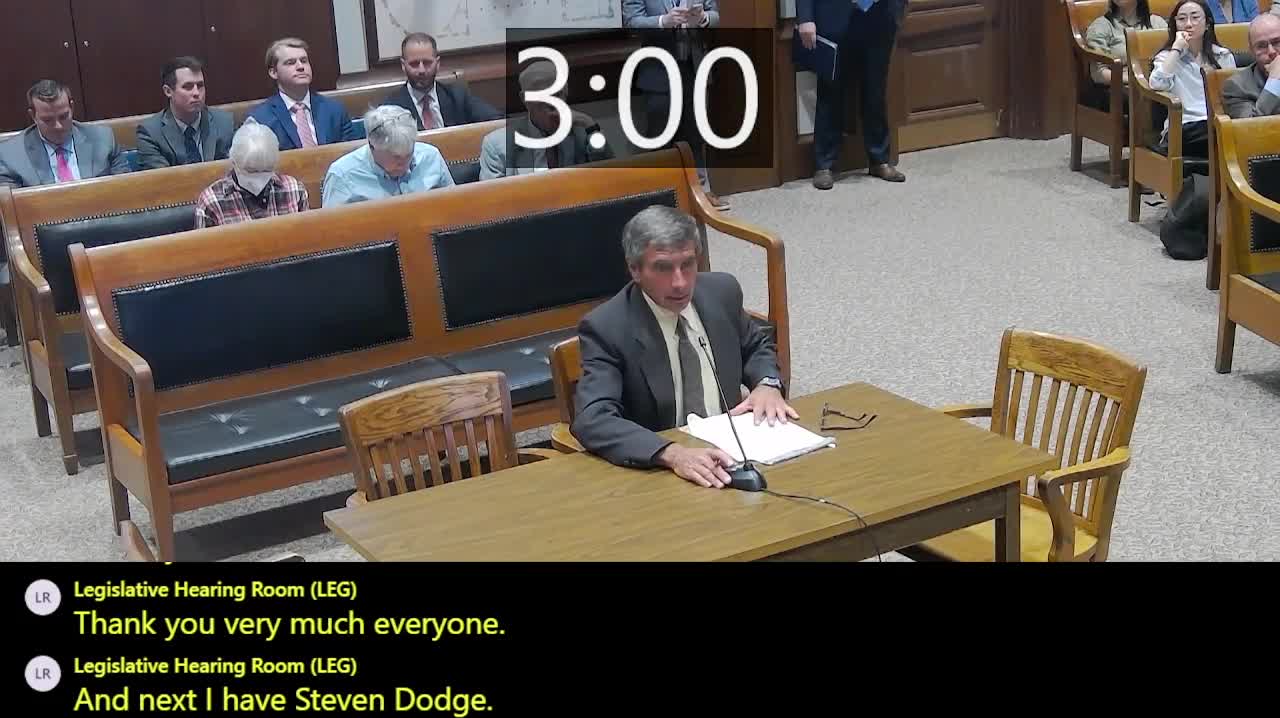
Pro‑CFS witnesses included Steven Dodge of Clean Fuels Alliance America, Anthony Willingham of Electrify America, Ender Reid of Neste, Yannick Torres for the Coalition for Renewable Natural Gas, and Jonathan Harding of the American Biogas Council. Speakers said LCFS programs in other states have reduced carbon intensity in the diesel and gasoline pools, generated credit revenue to build charging infrastructure and attracted private investment without increasing retail fuel prices. Mr. Dodge said California’s program made low‑carbon diesel widely available and that credits have funded electrification and charging infrastructure. Mr. Willingham said LCFS revenues have enabled charger upgrades and that credits can be monetized by transit and bus fleets to help finance electrification.
Proponents argued a technology‑neutral market mechanism that rewards lower carbon intensity—including electricity, renewable diesel, renewable natural gas (RNG) and sustainable aviation fuel (SAF)—would help decarbonize hard‑to‑electrify sectors such as heavy‑duty trucking and aviation while mobilizing private capital for chargers and fuels.
Opponents focused on the bill’s treatment of aviation fuels. Representatives from the Coalition to Stop Private Jet Expansion said sustainable aviation fuel is not ready at scale, is substantially more expensive than conventional jet fuel, and could require diversion of agricultural land if widely adopted. The panel urged exempting aviation fuel or otherwise excluding SAF from credits until robust, independent evidence shows sustainable aviation production at scale without adverse land‑use impacts.
Committee members probed costs and tradeoffs. Senator Barrett noted criticisms from economists that LCFS programs can be an expensive way to reduce a ton of carbon and asked proponents about food vs. fuel and price impacts; proponents said programs include guardrails, periodic reviews and state interventions to prevent unintended consequences. The hearing included both technical defense of LCFS/CFS market design and cautionary public‑interest critiques on sustainable aviation fuels and biofuel feedstocks.
Discussion only: testimony supported adopting a CFS/LCFS but the committee took no legislative action at the hearing.
Ending: Proponents urged Massachusetts to join other states with market‑based fuel standards to attract investment and speed emissions reductions; opponents sought explicit limits on aviation and stricter guardrails to avoid land‑use and equity harms.