Get Full Government Meeting Transcripts, Videos, & Alerts Forever!
Get email alerts on the Business Assessment Schedule topic
No spam. Unsubscribe anytime.
Broadwater County panel approves recommendation to send updated business-assessment fee schedule to county commissioners
Summary
A Broadwater County board voted to recommend an updated business-assessment fee schedule to county commissioners after staff answered questions about decals, notice and enforcement; commissioners will consider the proposal at a later public hearing and the assessment is expected to appear on next November's property tax bill, staff said.
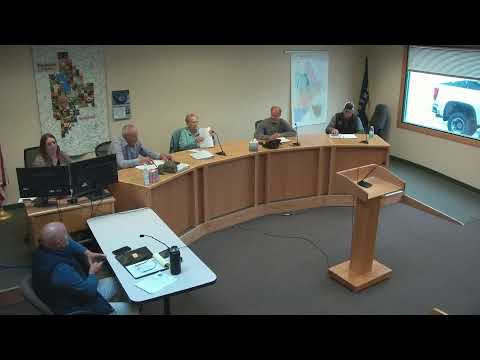
Members of a Broadwater County assessment panel voted to forward an updated business-assessment fee schedule to the county commissioners after a discussion about how to notify businesses, how decals and transfer-station staffing will be enforced, and how seasonal campers on vacant lots should be treated.
The vote was moved, seconded and carried by roll call; the panel’s action allows county staff to present the schedule to the county commissioners for formal consideration, staff said. "This will be presented to your commissioners tomorrow," a staff member said after the motion passed.
The panel discussed several implementation details before the vote. Staff said notices of the proposed schedule were published in the newspaper "the second and the ninth," a step the staff characterized as required by statute, and that affected parties have a period to submit written protests. "They have 2 weeks to protest in writing to us," a staff member said. The staff also said the assessment, if adopted by commissioners, would be reflected on the next November property tax bill: "It'll be on your November tax," the same staff member said.
Panel members and staff spent significant time on enforcement logistics. The county plans to use decals to identify paid users at transfer stations; staff framed decals and attendant checks as the primary way to verify who is using facilities. One staff member said the decal program was intended to "capture who is actually using our facilities and if they have paid." The panel discussed staffing needs to support that system and noted recent hires: staff announced new transfer-station attendants named Byron Weaver and Steven Swan and said another attendant, Tim Pool, will start June 1.
Board members raised concerns about seasonal users and vacant lots with campers. Members debated whether property with a camper but no habitable structure should receive full assessment, a prorated or temporary sticker (for example, a six-month decal), or be handled case-by-case. No formal change to the schedule or a separate seasonal exemption was adopted; the panel discussed options and asked staff to consider the matter in future work. "The only way you could do it is give a 6 month sticker and have a different color on it," one board member said during discussion.
Communication to businesses was another recurring topic. Staff and board members discussed using a front-page newspaper notice, a press release, the county website and existing business email lists to reach owners and managers. One staff member described the county's current postage and mailing costs as having significantly exceeded budget: "It's like 2000% over," the staff member said, arguing in favor of broad, multi-channel notice rather than relying solely on legal notices.
The panel acknowledged that some numerical details were inconsistent in remarks during the meeting. Members referenced different dollar figures while discussing the yearly assessment; the transcript includes references to both "$265" and "$2.65." The panel did not resolve that discrepancy during the meeting; staff did not provide a clear, single figure on the record at the panel meeting.
The panel chair and members framed the schedule update as a clarifying and formalizing step: staff said several businesses already pay similar amounts and the new schedule is intended to standardize classifications and units so new businesses and startups will know which assessment applies to them.
After discussion and a motion to approve a recommendation, the panel voted "aye" and the motion passed. The panel’s recommendation now goes to the Broadwater County commissioners for the formal public hearing and decision-making process.
The panel did not adopt additional rules for seasonal campers or a different assessment timeline during the meeting; those policy details remain under consideration by staff and may return to the board or appear before the commissioners if staff proposes changes.