Get Full Government Meeting Transcripts, Videos, & Alerts Forever!
Get email alerts on the Charter Review topic
No spam. Unsubscribe anytime.
Study commission debates charter language on departments, public comment and pending fire services bill
Summary
The Butte‑Silver Bow Study Commission reviewed charter Article VII language on May 12, debating whether departmental names should be codified in the charter or left to ordinance, and discussed a pending state bill that would alter local fire services governance; the commission also voted to move public comment to the start of meetings.
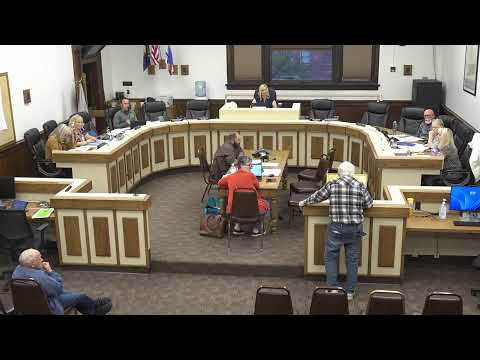
The Butte‑Silver Bow Study Commission spent a substantial portion of its May 12 meeting reviewing proposed changes to the county charter, focusing on how departments are created or listed in the charter, how personnel and finance “systems” are described, and how the charter should address fire services if House Bill 547 becomes law. Commissioners also amended the agenda to place public comment at the start of meetings.
On department language (charter Article VII) commissioners debated whether to keep department names in the charter or rely on broader language that authorizes the council to establish departments by ordinance. Legal staff advised that the current Section 7.01 language already provides the council the authority to establish departments by ordinance and recommended keeping flexible, general language so future needs can be addressed without repeated charter amendments. As staff put it: “I would say the language that is in 7.01 is perfectly fine, as it stands.”
Several commissioners argued some departments deserve explicit charter recognition. Parks and recreation was discussed repeatedly as an example commissioners might want codified as a standalone department rather than left under a broader public works umbrella. Commissioners agreed to seek public input before finalizing any decision to move specific functions from ordinance into the charter.
Commissioners also discussed terminology in the charter distinguishing “systems” and “departments.” Several members noted that a “personnel system” (training, hiring and promotion rules) is different from a standalone human resources department and recommended clearer, consistent terminology so readers and future implementers understand whether the charter requires a department, a system or both.
Public works drew focused discussion about whether the public works director should be a professional engineer or be qualified by training and experience. Commissioners and counsel agreed institutional knowledge and local experience matter; some commissioners said a degree or professional engineering license can be useful for certain projects (for signature of engineering documents), while others said the director role should remain based on “training or experience” and that specialized engineering work can be contracted or provided by an engineering department if needed.
A major item was House Bill 547, a state bill that would change the relationship between career fire services and volunteer fire districts. Counsel said the bill at the time of the meeting was on the governor’s desk and that, if enacted, the county would need to clarify charter language to align local practice and the new state law. Commissioners asked for a dedicated meeting to focus on fire services governance and for presentations from both career and volunteer fire leaders; legal staff cautioned the commission that changing charter language that affects elected volunteer trustees or budgets may have knock‑on consequences and should be carefully scoped.
On meeting procedure the commission amended its agenda to split public comment into two items: public comment on any item on the agenda and public comment on anything not on the agenda but within the study commission’s jurisdiction. Commissioner McCormick moved the amendment; after a second the commission voted unanimously to adopt the change. The motion was recorded as approved without opposition.
Public comment during the meeting included a resident who urged the commission to consider switching to a smaller, full‑time commission and to organize neighborhood‑level community councils to improve responsiveness. The commenter said, in part, “Part‑time commissioners just does not work,” and proposed consolidating current districts into six larger districts with a standing role for district commissioners in neighborhood coordination.
Next steps the commission identified: additional public listening sessions, dedicated meetings on fire services if HB547 is enacted, and further legal cleanup (consistent terminology for “department” vs “system,” explicit language on whether and how the council may rescind departments by ordinance or whether that requires charter language).
Sources: Study Commission meeting, May 12; legal staff remarks; commissioner questions and public comments recorded in the meeting transcript.