Get Full Government Meeting Transcripts, Videos, & Alerts Forever!
Get email alerts on the Public Health Budget topic
No spam. Unsubscribe anytime.
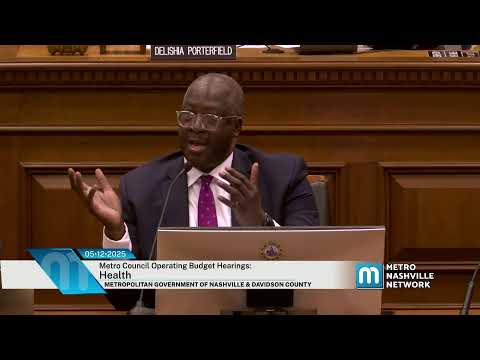
Metro Public Health director details $11M in lost grants, budget priorities and service changes
Summary
Director Somi Areola told the Metro Nashville Council budget committee the department lost three grants totaling just over $11 million and outlined how the mayor’s proposed budget, internal shifts and federal/state partnerships would be used to sustain services including school nursing, vaccinations, behavioral-health supports and animal-control.
Director Somi Areola, director of the Metro Public Health Department, told the Metro Nashville Council Budget & Finance Committee that the department has lost three grants totaling a little over $11 million and described steps the department and the mayor’s proposed budget are taking to limit service disruptions.
Areola said the department is prioritizing infectious-disease work, behavioral-health and chronic-disease prevention while moving staff across funds and using mayoral budget adjustments to replace some lost grant positions. "Public health is everything that you do, everything that happens to you before you need to seek clinical care," she said.
Why it matters: The department is responsible for immunizations, tuberculosis and sexually transmitted infection control, school nursing, community violence prevention, opioid response and Metro Animal Care and Control (MAC). Cuts to grants have already led to staff reassignments and six layoffs; further reductions, she warned, could affect resident health outcomes.
Key points
Funding and staffing
- Areola said three grants were lost, totaling a little over $11 million. She credited the mayor’s proposed budget with covering some of the immediate gaps and enabling the department to move several staff members between funds to retain services.
- The department reported six staff were let go because of funding losses; other at-risk positions were moved into remaining funds or into mayoral budget allocations.
- The Metro Board of Health approved a salary adjustment for some high-turnover positions (noted by Areola as applying to animal-control officers and other roles); the board’s approval was described in the meeting but no council vote on that action was recorded.
Programs and public-health trends
- Infectious disease: Areola said Nashville is seeing increases in new HIV infections, tuberculosis and syphilis, including congenital syphilis, and that some grants that support STI and TB work have remained flat for years, forcing prioritization of which conditions staff can target.
- Immunizations and school health: The department lost a COVID immunization grant but has used mayoral funds and internal transfers to preserve immunization work and school-health services. Areola described a "strike team" providing school physicals and immunization record services and said recent budget moves place school-nurse funding directly in the health department’s budget rather than routing it through Metro Nashville Public Schools (MNPS).
- Maternal and infant health: Areola highlighted the "Nashville Strong Babies" effort, reporting a 9% reduction in infant mortality across seven ZIP codes where the program is active. She said federal Healthy Start funding is at risk in federal proposals and that the department is coordinating with the mayor’s office and state partners to identify options.
Behavioral health and opioid response
- Community violence and behavioral-health work: Areola said the department is emphasizing partnerships outside public health to address community violence and behavioral-health needs and has been distributing community safety funds to local providers with metrics to track impact.
- Opioid settlement funds: Committee members noted roughly 22 positions had been funded from opioid-settlement dollars. Areola said settlement funds are being used to build infrastructure and resilience rather than paying for direct clinical care, and that the department is prioritizing broad Narcan availability and harm-reduction services. She noted the department had supplied police with Narcan (police requested 1,000 doses) and piloted a Narcan vending machine in a convenience store; wider distribution through libraries, social services and homeless-service providers is a stated goal.
Animal control and sheltering
- Metro Animal Care and Control (MAC): Areola said the department took in 5,257 animals in 2024, up more than 200 from 2023. The mayor’s proposed budget includes additional animal-control officers and the department is pursuing a multi-year strategy for staffing, vehicles and a new or replacement shelter; design/architecture work has been funded and General Services is preparing an RFP to refine specifications.
Budget mechanics and council questions
- Council and finance staff clarified that moving school-nurse funding from MNPS into the health department budget changes how the money is budgeted and allows the department to treat the positions as part of its base allocation; Finance staff said the transfer also interacts with fund-balance policy accounting.
- Committee members pressed for clearer reporting on community providers funded by the department, countywide Narcan distribution points, and specific staffing numbers for MAC; Areola and staff said they would follow up with detailed data.
Selected direct quotes (accurate to the transcript and speaker list)
- "Public health is everything that you do, everything that happens to you before you need to seek clinical care." — Director Somi Areola.
- "What we do need is more resources, not less resources." — Director Somi Areola.
What the meeting decided versus discussed
- Discussion: The department described lost grants, program risks, rising STI/TB trends, opioid strategy and MAC staffing and facility needs.
- Direction/administrative actions: Areola said staff were moved between funds and the mayor’s budget includes positions or funding for several priorities (school nurses, additional animal-control officers, some immunization and behavioral-health items). Committee members asked for follow-up data; finance staff provided explanations on how the school-nurse funding shift will be reflected in the budget book.
- Formal action recorded in the meeting transcript: the Metro Board of Health approved salary adjustments for some high-turnover roles (described by Areola); no council vote to adopt the mayor’s budget or approve supplemental funding was recorded in this hearing.
What’s next
Council members requested more granular information on where opioid-settlement dollars and community-safety funds are being spent, a countywide Narcan distribution plan, exact MAC staffing targets and timelines for the shelter project. Areola and department staff committed to follow-up reports to the committee.