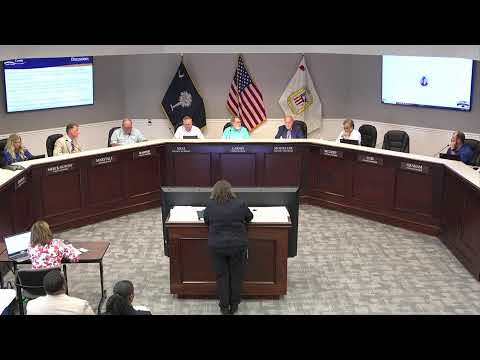
Lancaster County staff outline Carolina heelsplitter mitigation program as credits sell out and staff weighs internal options
Loading...
Summary
Development Services Director Lisonbee Harden told council the Carolina heelsplitter mitigation‑credit bank is sold out; the county holds budgeted funds and is exploring using those funds for internal watershed projects while awaiting a Fish and Wildlife project to replenish credits.
Development Services Director Lisonbee Harden told Lancaster County Council that the county’s Carolina heelsplitter overlay—an agreement requiring developers to purchase mitigation credits for impacts in the 6 Mile Creek watershed—has had its external credits sold out and staff are exploring alternatives, including an internal mitigation program funded from a county budget line item.
Harden summarized the program’s history: the Carolina heelsplitter was federally listed as an endangered species in 1993; critical habitat was identified in 2002 and the county signed an overlay agreement with the U.S. Fish and Wildlife Service and the Environmental Banking Exchange (later Resource Environmental Solutions) in 2008 to require purchases of mitigation credits for development within the 6 Mile Creek watershed. "The credits themselves... help fund projects, and then the UDO regulations, which help keep the natural riparian buffers in natural situations," Harden said.
Under the overlay, credit requirements are prorated by proximity to the stream, the type of stream (perennial vs. intermittent) and the amount of impervious surface disturbed; Harden described an example credit calculation worksheet used by staff. Harden said the credits have been managed in multi‑phase projects: project 1 (issued 2010) was estimated at about 388.1 credits and completed in 2017; project 2 (issued 2018) was estimated at about 573.4 credits and sold out in 2023. Staff do not yet have an approved project 3; Fish and Wildlife must approve any subsequent bank projects.
Harden gave historical credit price points: $6,900 per credit in 2020, $8,900 in May 2023, and staff are holding budget estimates at $9,500 per credit for planning. Because credits are currently unavailable from the bank, the county now requires credits to be in place by certificate of occupancy for affected projects (previously staff required purchase before permit issuance when credits were available). Harden said the county included a line item in last year’s budget to hold funds for credit purchases and that staff are considering using funds to contract with Fish and Wildlife and to fund in‑county projects to stabilize the 6 Mile Creek watershed.
Council members asked for documentation of the original contract and for staff to share records. Harden said some Fish and Wildlife documents are proprietary or redacted and that staff have been compiling records since 2023; she offered council members the notebook she brought and said staff will scan and share records where possible. Harden also said staff have been in contact with regional and local Fish and Wildlife coordinators and the RES bank representatives and have sought examples from other states.
No new formal policy or credit purchase was approved at the meeting. Council members directed staff to continue work on alternatives and to provide copies of the original agreement and supporting documentation when available.