Get Full Government Meeting Transcripts, Videos, & Alerts Forever!
Get email alerts on the County Budget topic
No spam. Unsubscribe anytime.
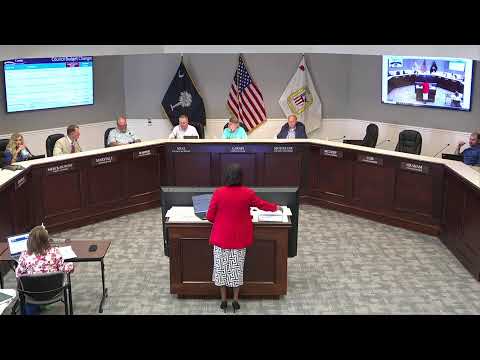
Lancaster County council finalizes no-millage first-reading budget with half-year staffing, adds 30 public-safety cameras
Summary
Council members instructed staff to return a balanced budget for first reading May 27 without a millage increase, funding several new positions at half year, reallocating an accreditation role to an equipment manager and programming 30 additional Flock cameras from fund balance.
Lancaster County Council directed staff to present a balanced budget for first reading May 27 that avoids a millage increase while adding a set of staffing and public-safety items, funding some at half-year levels and using fund balance for one-time purchases.
The action came after Miss Harris, a county staff member, reviewed revenue projections and proposed adjustments, saying the county’s new-revenue projection is about $8 million and that staff had “some what we call wiggle room within our revenue forecast” to incorporate council requests. Councilors agreed to include half-year funding for additional emergency medical services (EMS) staffing, convert an accreditation position into an equipment manager role, add convenience-site technicians at reduced-year timing and program 30 additional Flock-brand cameras funded from fund balance.
Why it matters: the package moves public-safety and service expansions forward while keeping county taxpayers from seeing a millage increase on the preliminary first-reading ordinance. It also shifts several recurring hires to partial-year starts to limit near-term operating cost increases and uses fund balance for a recurring-but-startup camera program.
Most immediately, the council approved direction to fund half-year starts for three additional EMTs and three paramedics tied to a new Indian Land station; an EMS official, Mr. Cato, said the county’s “plans are to put them at the Indian Land Station” and that doing so would staff an additional truck and a quick-response vehicle there. Council members said they preferred half-year budgeting because hiring and onboarding likely would not occupy a full fiscal year. Miss Harris noted that if council wanted full-year staffing costs she would include those numbers for final readings.
Councilors also agreed to change a requested EMS accreditation officer to an equipment manager role after department leaders said the equipment position would address day-to-day preventive maintenance for stretchers, AEDs and monitors. The county’s presenter said the equipment role would include upkeep across county vehicles and facilities; deputies described thousands of dollars of life‑support equipment that require scheduled maintenance.
Public-safety cameras drew substantial support. Council member Harper proposed adding roughly 30 cameras at a projected first-year cost of about $125,000; Harper said the cameras “have helped with crime so much” and urged the county to expand the system. Sheriff Veil (Sheriff) told council the cameras were “very instrumental in us solving those cases” and confirmed the sheriff’s office would have access to the vendor-hosted video. The county’s staff noted five cameras were already included in the budget and recommended adding 30 more from fund balance, for a total of 35 when combined with the already-budgeted five.
On pay and compression, staff reiterated a proposed 5% across-the-board raise and described options for addressing internal compression once the county raises its hourly minimum to $15. Miss Harris presented a scenario grouping employees into tiers (roughly $15–$16.50 and $16.51–$17.92) and proposed modest additional percentage increases to reduce compression; she said the modeled cost for one approach was roughly $180,000. Councilors emphasized the uncertainty of employer health-insurance costs (PEBA guidance could increase employee premiums) and asked staff to model net effects before final adoption.
Other items addressed during the session: the county will continue funding the Town of Kershaw Y pool contract (staff said the contract is year two of three and the county’s share was adjusted to reflect a 50/50 split with the town), the council kept an allocation for an affordable-housing study and approved rolling in a procurement-audit cost for presentation at first reading. Councilors removed economic-development intern positions from the first-reading package and agreed to revisit several positions and supply-line increases during final readings.
No formal vote was recorded on the substance of the budget items; the council approved a motion to adjourn moved by Council member Mosteller and seconded by Council member Neil. Staff will return a first-reading budget ordinance on May 27 showing a no-millage scenario that incorporates the items council directed at this meeting.