Get Full Government Meeting Transcripts, Videos, & Alerts Forever!
Get email alerts on the School Finance Funding Legislation topic
No spam. Unsubscribe anytime.
Goshen treasurer warns House Bill 96 carryover cap could hinder district planning; reports fund balances, CEP boost and grants
Summary
Treasurer Todd Schenkel told the board the district is in a strong fiscal position with recent revenue increases and federal offsets, but warned that proposed state changes — notably a 30% carryover cap in House Bill 96 — could constrain reserves and long‑term planning.
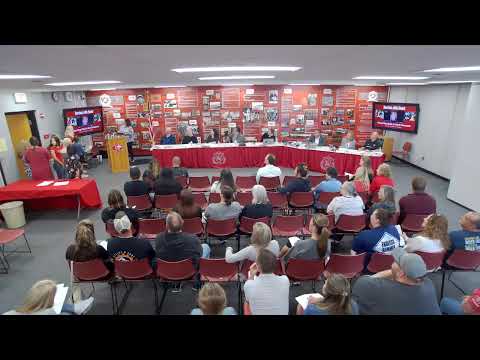
At the Goshen Local School District board meeting, Treasurer Todd Schenkel gave the board a multi‑part financial update, reporting current revenue, fund balances, recent grants and potential state policy risks that could affect long‑term planning.
Schenkel said the district began the fiscal year with about $15 million in the general fund, has collected roughly $35 million in revenue year‑to‑date and currently shows an ending fund balance in the high‑$19 million range. He stressed those balances have enabled investments such as the Goshen Middle School cafeteria renovation and community programming. "We're doing a pretty good job here," Schenkel said, adding the district has been under budget for 12 consecutive years according to his presentation.
He highlighted three state and federal factors affecting the budget: the district’s move to the Community Eligibility Provision (CEP) for free school meals, which he said added roughly $1.5 million in state resources; ESSER funds used to offset general fund expenses (about $3.8 million), and recent grant awards, including approximately $685,000 for school safety technology. Schenkel also showed year‑over‑year revenue growth, with the district reporting roughly $33 million the prior year and about $35.04 million in the current year.
The chief concern Schenkel raised was House Bill 96’s proposed 30% carryover cap. He explained that if the state enforces a 30% cap on allowable carryover, districts that prudently saved for capital needs and unexpected costs could see state funding reduced or reallocated. "The bill proposes capping school districts off with carryover to 30% of their expenditures, penalizing districts with a higher reserve by reducing funding," he said, warning that would complicate five‑year forecasting and could increase interest costs on future borrowing.
Board members discussed legislative outreach and asked Schenkel about differences among nearby districts and the drivers of state funding. Schenkel said much of the district’s revenue mix is state dollars and that property valuation shifts and state formulas affect grants and state share.
The board approved consent financial items and negotiated contracts presented during the meeting by roll call later in the agenda. Schenkel closed by noting the district continues to monitor state proposals and will communicate implications to the board and community as they develop.