Mesa Council unanimously approves photo-enforcement contract after public debate over safety and due process
Loading...
Summary
Mesa City Council voted 6-0 to approve a contract renewing and upgrading the city’s photo-enforcement program after public comments opposing the cameras and staff and advocates defended their safety benefits and review procedures.
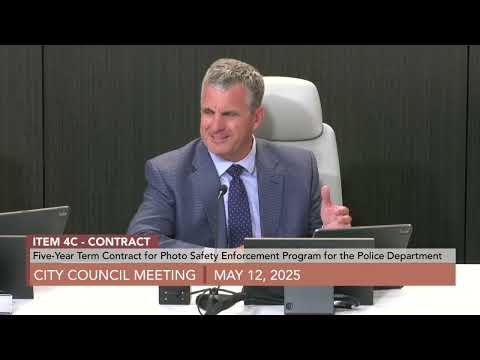
The Mesa City Council on May 12 approved a contract to continue and upgrade the city’s photo-enforcement program for red-light intersections and school zones, voting 6-0 after public comment and extended council discussion.
The program currently covers 16 intersections and six active school zones; city staff said the contract will replace outdated equipment and support an expansion to 20 intersections and to nine school zones in coming months. Councilmember Jennifer Pillsbury moved approval; Vice Mayor Summers seconded, and the motion passed unanimously.
The issue drew three public speakers and extended questioning from council. Linda Patrick Hayes, a resident, told the council she was “here to speak in opposition to the photo enforcement” and described being startled “one night quite late” when camera lights flashed, saying the flashes “scared the living daylights out of me” and raising safety and constitutional concerns about automated citations.
David Winstanley, chair of the Transportation Advisory Board, urged the council to approve the cameras. “I am speaking in favor of red lights,” Winstanley said, citing a Safe Streets planning document he said identified locations where cameras could reduce collisions and saying empirical studies indicate “lives are saved with red light cameras.” He asked staff to explain how the contract funding relates to the Safe Streets report.
City staff and police officials described how the program is administered. Eric Brady, Transportation Department staff, said that “there are currently 16 active intersections and 6 active school zones where we have photo radar enforcement” and that the study-identified intersections in the Safe Streets for All planning document are separate from the locations covered by this contract. Brady said the contract would help replace older equipment to make enforcement more efficient.
Mesa Police Department leadership said the city has multiple safeguards before a citation is issued. Police Chief Shauna Nesbitt said an investigator reviews images and supporting data before a citation is mailed; she told the council that in 2024 about 7,000 events where lights flashed did not lead to issued citations because they did not meet the standards for a violation. “With any citation, when you do receive it, it is being reviewed by a police investigator who’s looking at the data and determining whether or not there is reasonableness that that violation occurred,” Nesbitt said.
Council members pressed staff on safety concerns raised by opponents who say the flashing lights can cause drivers to brake suddenly or accelerate. Brady and Nesbitt said the departments are reviewing collision reports to look for any evidence that the presence of camera flashes increases crash risk; officials said existing data show reductions in collisions at many camera locations and that revenues from photo enforcement are reinvested in pedestrian and bicycle safety projects and school-zone upgrades.
Mesa City Attorney Jim (first name given in the meeting as “Jim”) addressed due-process questions raised by speakers. “The due process is exactly the same,” he told the council when comparing a citation issued by a traffic officer with one generated from a camera image. He noted municipalities across Arizona use similar programs and that court review and magistrate proceedings remain available to contest citations.
Discussion vs. decision: council members debated safety data, equipment upgrades, citation review procedures and the program’s reinvestment of revenue into safety projects. The formal action was the unanimous approval of the contract item (4C) to continue and modernize Mesa’s photo-enforcement program.
Council members and staff invited residents who reported being startled by flashes to work with police and the vendor VeriMobility on technology adjustments and said staff would consult the vendor about light intensity and false triggers. Staff also said the Safe Streets planning document lists additional intersections for future consideration but that the locations in this contract do not include those planning-report sites.
The contract approval follows the council’s long-standing policy that photo-radar revenue be reinvested in traffic safety projects; staff said this funding stream supports mid-block pedestrian crossings, canal crossings and school-zone improvements. The council did not adopt any changes to citation appeal processes during the meeting.
For residents seeking further information, staff encouraged follow-up with the Police Department and Transportation Department to review how citations are validated and how the city evaluates camera placement and performance.