Get Full Government Meeting Transcripts, Videos, & Alerts Forever!
Get email alerts on the Public Safety Forum topic
No spam. Unsubscribe anytime.
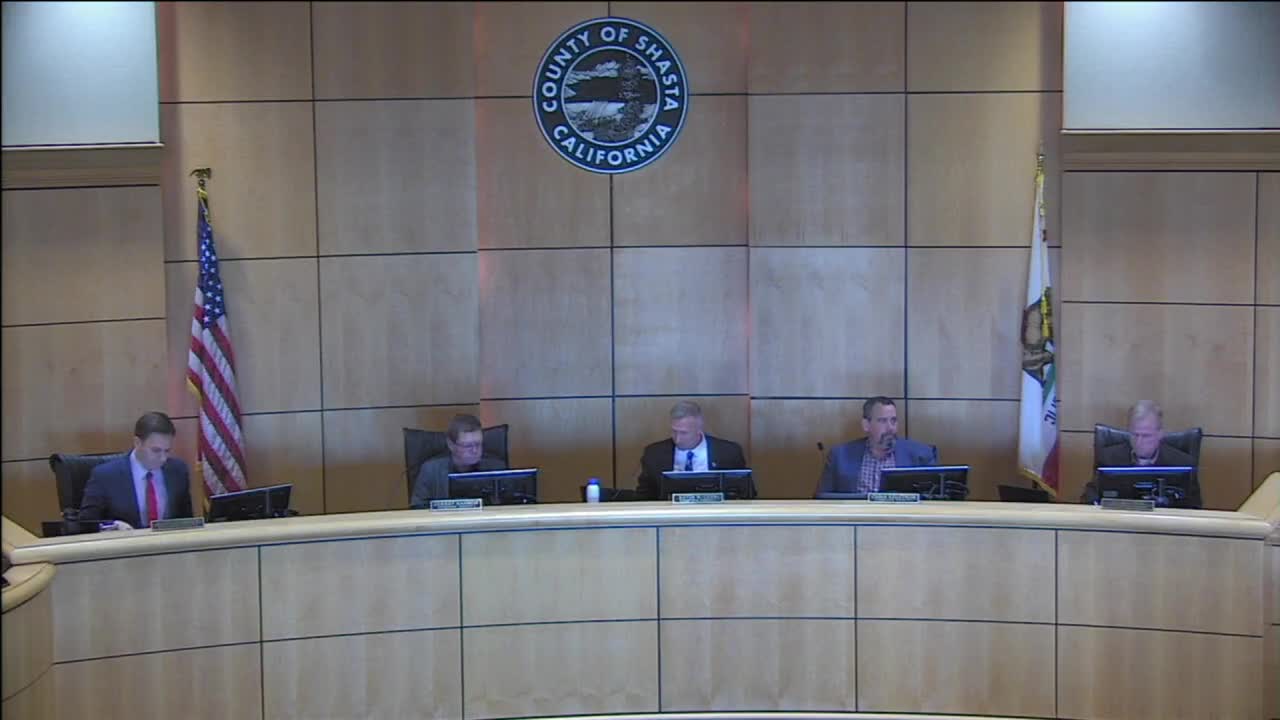
Shasta County leaders press for data fixes, staffing and interagency coordination to address public safety
Summary
At a special March 24 meeting, Shasta County supervisors heard agency leaders describe gaps in crime reporting, court capacity and staffing. Officials urged better data sharing, slower reliance on single fixes and proposals for short-term steps including a CCP-led review, a Proposition 47 program launch and a plan for records-management upgrades.
Shasta County supervisors and criminal-justice leaders spent more than three hours Monday detailing how inconsistent crime reporting, outdated records systems and chronic staffing shortages are hampering public-safety work and court processing.
The meeting centered on the county’s Community Correction Partnership, reporting changes from the Uniform Crime Report to the National Incident-Based Reporting System (NIBRS), and capacity issues across the sheriff’s office, Redding Police Department, district attorney and public defender offices. Officials described a mix of immediate steps and longer-term projects they said are needed to produce usable data, reduce repeat offending and ease pressure on courts and jails.
Why it matters: County leaders said they need clearer, reliable numbers and interoperable systems to target limited resources and measure whether strategies — from diversion programs to bigger alternatives to custody — are working. Officials repeatedly warned that staffing and data problems are slowing prosecutions, delaying hearings and making some misdemeanor cases time out under statutory limits.
County Probation Chief Tracy Neal, chair of the Community Correction Partnership (CCP), outlined the CCP’s history and current role. “It was in 02/2009 that the Community Correction Performance Incentive Act passed … that legislation created the Community Correction Partnership,” Neal said, describing a committee that includes probation, the sheriff, the district attorney and others and that produces a local CCP plan. Neal said the partnership will return to updating its plan and “come up with some more specific … measurable” metrics to track results.
Redding Police Chief Chris Barner and Sheriff Michael Johnson described how a multi‑year change in crime-data standards and a troubled commercial records system have produced inconsistent public statistics. Barner said agencies moved to NIBRS reporting in mid‑2023 and that “you have to look at NIBRS and you have to look at UCR … and combine the two to get the data.” He emphasized the short term: “we do have our data and I’m happy to see that in 2023 and 2024, our crime is down in the city of Redding.” Sheriff Johnson called the records-product installation “just horrific,” saying the vendor integration failed to match the county’s multi‑agency needs.
District Attorney Stephanie Bridgette urged that staffing remain central to any solution: “If nothing changes … we might have to not prosecute certain crimes just to get it to a manageable level,” she said, citing vacancies across prosecutors, investigators and support staff that increase individual workloads and case processing time. Public Defender Ashley Jones and several deputy public defenders who spoke during public comment described heavy calendars, repeated nights and weekends of work and support‑staff shortages that they said make effective representation and quicker pretrial resolution harder.
Superior Court Executive Melissa Fowler Bradley reviewed courtroom capacity and the state judgeship process. She said the judgeships authorized by Senate Bill 75 remain unfunded and that Shasta currently operates with 11 judges and two commissioners (13 bench officers). The courthouse can use one additional courtroom regularly (bringing active capacity to 14) and could convert space for two more in the future; Bradley said assigned (visiting) judges are a limited statewide resource and that scheduling them requires planning.
Officials described programs and near‑term efforts: Probation said it will restart a frequent‑offender list to coordinate supervision and enforcement with RPD and the sheriff; Probation was awarded a Proposition 47 grant (round 4) to fund community interventions and contracts expected to serve roughly 150–180 people annually and go live April 1; the DA’s office is developing an internal data dashboard fed by its case‑management system, with a target public launch of January 2026; and the sheriff is expanding alternative custody and reentry efforts that he says focus on reducing serious recidivism as well as nuisance offenses.
Not all proposals can be acted on during the special meeting. County counsel reminded supervisors that the CCP is a Brown Act body and that formal CCP business must be handled on a properly posted agenda; staff can, however, be asked to return with recommendations for a future meeting. Several supervisors asked staff to bring options that would let the CCP (or related bodies) produce measurable recommendations in six months.
The public comment period included multiple law‑office staff and prosecutors describing unsustainable workloads, and several victims and community members urging faster and more consistent responses to violent crime and domestic violence.
What’s next: Agencies said they will press forward on several tracks: (1) local leaders asked CCP members to return to the Board with measurable data and prioritized recommendations; (2) the DA’s office will work with county IT to produce the Power BI dashboard from its case‑management system; (3) Probation will bring back the frequent‑offender coordination list and launch the Prop 47‑funded services; (4) law‑enforcement leaders will continue work toward a replacement or fixes for the county’s records‑management system and improved data links to courts and the DA. The Board did not take formal votes at the meeting.
“Getting back to Supervisor Plummer … I think identifying some of those additional data marks and outcomes to look at as a team” was the path forward, Neal said; Bridgette added that without funding and staffing, “something is going to have to change.” The board asked staff to return possible agenda language and implementation options at a future meeting.