Get Full Government Meeting Transcripts, Videos, & Alerts Forever!
Get email alerts on the Public Safety Sheriff topic
No spam. Unsubscribe anytime.
Sheriff highlights rising jail medical costs, staffing and fentanyl enforcement needs in budget workshop
Summary
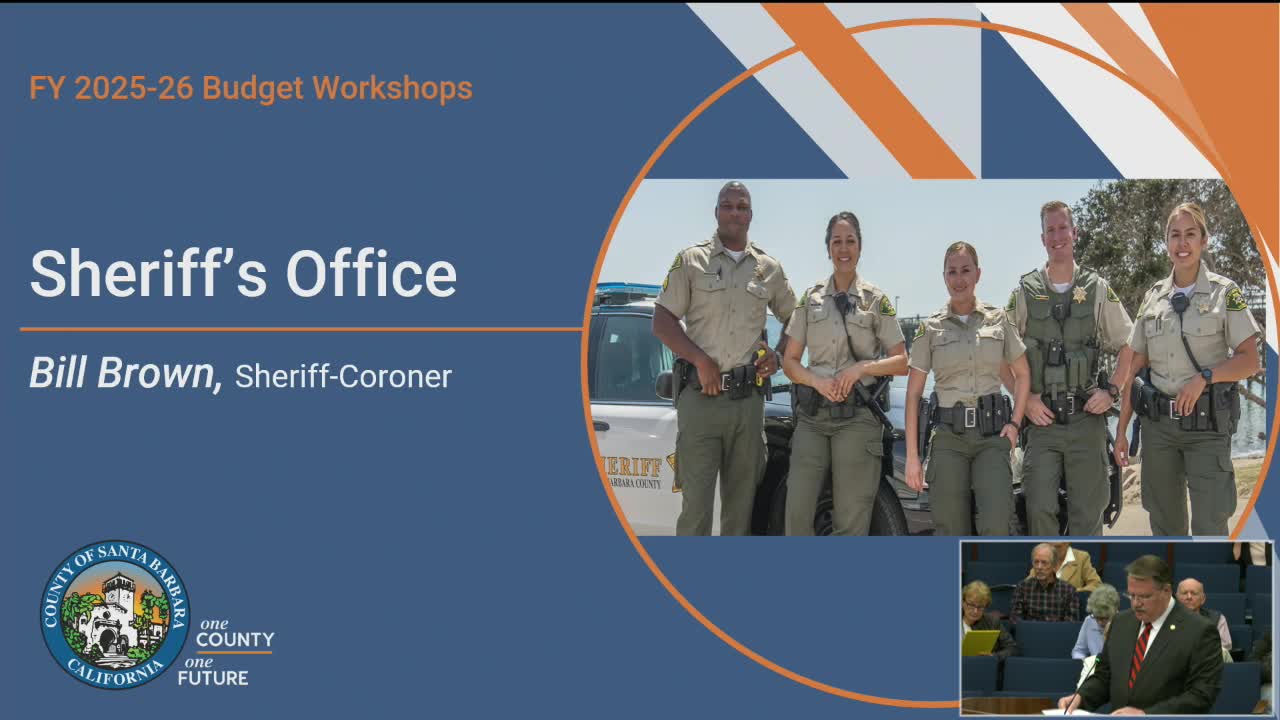
Sheriff Bill Brown told the Board April 14 that rising jail medical and operation costs, the Northern Branch Jail funding plan and jail population increases are the principal drivers of the Sheriff Department’s budget shortfall for fiscal year 2025–26.
Sheriff Bill Brown and department leaders told the Board April 14 that rising jail medical costs, ongoing jail population pressures and costs tied to the Northern Branch Jail funding plan are the principal drivers of the Sheriff Department’s increased General Fund requests for fiscal year 2025–26.
Sheriff overview: Brown described multiple operational strands — patrol, custody, coroner, court services and specialized units — and emphasized long‑running staffing shortfalls, retention challenges and rising costs for jail medical contracts and pharmaceuticals. The Sheriff’s presentation showed a custody‑driven budget increase and noted that, as of a recent count, about 812–823 inmates were in the county jail system; roughly 49 of those were misdemeanor cases, the rest charged as felonies.
Northern Branch Jail funding: With operations of the Northern Branch Jail now funded directly to the Sheriff, Brown and the budget team described a historic funding plan to build general‑fund support ahead of the facility opening. Costs have grown beyond earlier estimates, the presentation said, and debt‑service estimates for the Northern Branch expansion were updated to about $12.4 million per year; staff recommended closing the ongoing gap previously covered by one‑time balances.
Jail medical and contracts: Budget Director Paul Clemente and the Sheriff quantified jail medical contract increases at about $8.8 million, which — together with other cost pressures — contributed materially to the need for additional GFC for the Sheriff’s budgets in FY 25‑26.
Jail treatment expansion: Undersheriff Craig Bonner said the Sheriff’s Office has expanded medication‑assisted treatment (MAT) in custody and that more than 200 incarcerated people are now receiving MAT; the department credited a sharp recent decline in overdose fatalities (from the county high in 2023) to coordinated efforts including harm reduction and investigation.
Narcotics and enforcement: The Sheriff described a temporary reorganizing of personnel to create two 4‑deputy narcotics teams (North and South) to focus on fentanyl enforcement; leadership asked the board to consider sustaining such teams beyond one‑time funding. The Sheriff also sought continued funding for license‑plate‑reader participation, rapid DNA tools and patrol equipment, some of which were previously funded with one‑time or grant dollars.
Co‑response and behavioral health: Deputies, the Sheriff and several board members discussed co‑response teams pairing clinicians with deputies to respond to behavioral‑health calls. The Sheriff said three county co‑response teams are operating, funded in part by one‑time sources; county staff noted ongoing costs for sustaining those teams are a concern for future budgets. Several public commenters and supervisors emphasized the co‑response teams’ role in reducing incarceration of people with mental illness and urged permanent funding.
Federal grants and legal constraints: Brown warned the board that recent new federal grant requirements could require increased communication with federal immigration/customs authorities, a step that California law may not permit; he said several grants (including SCAP, JAG, Stonegarden and some homeland-security allocations) could be jeopardized due to new federal conditions.
What the board heard: Supervisors pressed the Sheriff on staffing, in‑car cameras, radio, training and the sustainability of co‑response teams. Several supervisors and speakers urged additional crisis‑intervention training (CIT) and better data‑sharing so elected officials can evaluate who is in the jail and why.
Next steps: The Sheriff asked the board to consider funding priorities for narcotics enforcement, co‑response sustainability and technology replacements; budget staff flagged both one‑time and ongoing choices that will be part of recommended budgets and five‑year forecasts.
Ending: The Sheriff emphasized the operational breadth of his office and urged board support to stabilize operations in the near term while longer‑term revenue or cost‑reduction strategies are developed.