Get Full Government Meeting Transcripts, Videos, & Alerts Forever!
Get email alerts on the County Budget topic
No spam. Unsubscribe anytime.
Santa Barbara County previews $1.67 billion preliminary budget emphasizing stability amid uncertainty
Summary
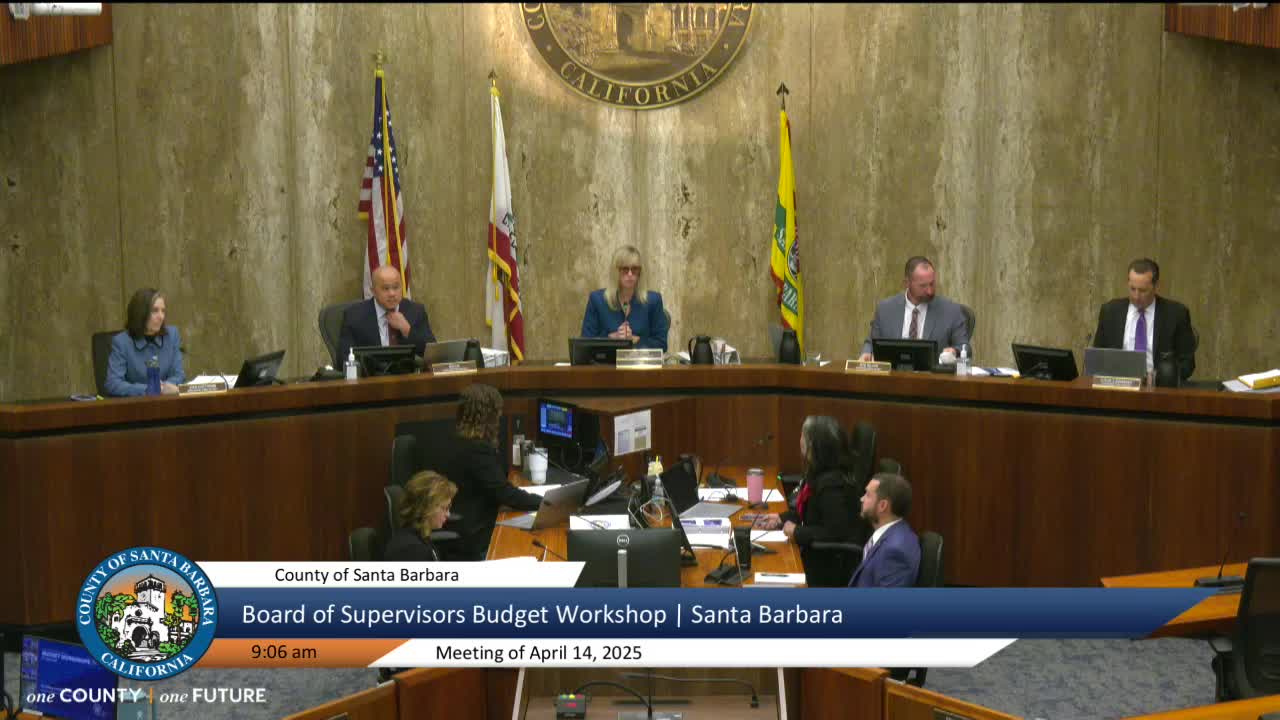
Santa Barbara County CEO Mona Miyasato and Budget Director Paul Clemente presented a $1.67 billion preliminary budget at April 14 budget workshops that limits ongoing growth, proposes targeted one-time uses and asks the Board of Supervisors for direction on filling several funding gaps and on redirecting capital to help pay Northern Branch Jail expansion debt.
Santa Barbara County CEO Mona Miyasato and Budget Director Paul Clemente presented a $1.67 billion preliminary budget at April 14 budget workshops, asking the Board of Supervisors to provide direction on proposed one-time uses and the county’s approach to an upcoming $178 million Northern Branch Jail expansion.
The preliminary plan uses limited ongoing growth and relies on prior reserves and set-asides to avoid service-level cuts, while warning of rising costs for jail operations, employee pay and benefits, insurance and IT. Miyasato framed the budget as “stability amid uncertainty,” noting federal and state funding risks and urging strategic trade-offs.
The presentation explained why the county is limiting ongoing expansions. Clemente said discretionary general revenue growth is modest — general fund operating revenues are up only about 0.5% countywide — and departments still requested roughly $19.7 million more General Fund Contribution (GFC) than available after the allocation formula. Of that gap, $15.7 million is attributable to the Sheriff’s Department, largely tied to jail health and the Northern Branch funding plan. To balance the preliminary numbers, the CEO’s office recommends using about $6.8 million from ongoing revenue set-asides this year, leaving roughly $8.7 million in ongoing set-asides for future years.
Why it matters: the county is facing a confluence of pressures — higher personnel and jail health costs, lower or volatile state and federal funding, and one-time capital needs — and is seeking board direction now on which short-term priorities to fund with one-time money.
Key figures and near-term requests: the preliminary budget highlights several items that require board direction before the recommended budget is released in late May: approval of proposed one-time uses (including a $3.4 million fill of the Social Services funding gap to avoid layoffs), whether to redirect $10 million of previously approved CIP surplus toward the Northern Branch Jail expansion to reduce future debt service, and whether to adjust cannabis-tax-funded ongoing expenditures to match expected revenue (a projected $1.2 million ongoing gap). Clemente said the county proposes no ongoing expansions except under offsetting reductions and recommends limited one-time expenditures for equipment, software and transitional support.
Longer-term structural issues: Clemente and Miyasato stressed that the county has drawn down previously saved revenue growth (property-tax–driven set-asides) to smooth recent deficits and meet obligations such as the Northern Branch Jail operations (about $32 million of GFC set aside to date). They warned that continuing to use those set-asides will exhaust them in the coming years unless new revenues or significant cost reductions are found. The five-year forecast shown to the board estimated a cumulative ongoing shortfall on the order of $20.6 million without changes, driven largely by debt service and jail and medical costs.
Other budget highlights presented: - Deferred maintenance backlog: the county continues a policy dedicating 18% of available discretionary general fund for deferred maintenance; next year $16.5 million is proposed from that ongoing pool. - Retirement/OPEB: county OPEB is roughly 46% funded with $51 million in assets; annual paygo is about $16.3 million. - Public safety spending: public safety remains the single largest functional group demand, with the Sheriff receiving a large share of new GFC requests for jail medical and related costs. - Cannabis tax: ongoing cannabis expenditures exceed anticipated ongoing cannabis revenue by about $1.2 million; staff asked whether to reduce ongoing cannabis-funded programs now or use one-time fund balance to hold them steady for one more year. - One-time recommendations: staff proposed about $7.3 million in specific one-time allocations (including jail equipment, in-car computing replacements, and short-term public-safety contractual gaps) drawn from prior set-asides and 2023–24 surplus.
Board direction sought: Miyasato/Clemente requested that the board decide at the workshops (a) approval of the recommended one-time uses including filling the $3.4 million social services gap; (b) whether to redirect some previously approved CIP funds toward Northern Branch Jail construction; and (c) whether to balance ongoing cannabis expenditures now or defer adjustments for one year.
What was not decided: the preliminary budget is a starting point; the recommended budget will be released May 30 with adoption hearings scheduled for June 17–18. The board did not vote on any final budget items in the April 14 workshop; staff asked for policy direction on the three items above and said many numbers remain subject to the May revision of the state budget and federal developments.
Next steps: staff will incorporate board direction into the recommended budget and return with more detailed CIP deferral recommendations and a proposed strategy to build multi-year plans to address structural deficits.
Ending: Miyasato and Clemente emphasized fiscal prudence and asked the board to weigh trade-offs now so that departments can plan long-term. The board signaled active questions but did not adopt final allocations at the workshop.