Get Full Government Meeting Transcripts, Videos, & Alerts Forever!
Get email alerts on the Housing topic
No spam. Unsubscribe anytime.
Board directs RFP for workforce housing at probation building, prioritizes housing over downtown solar
Summary
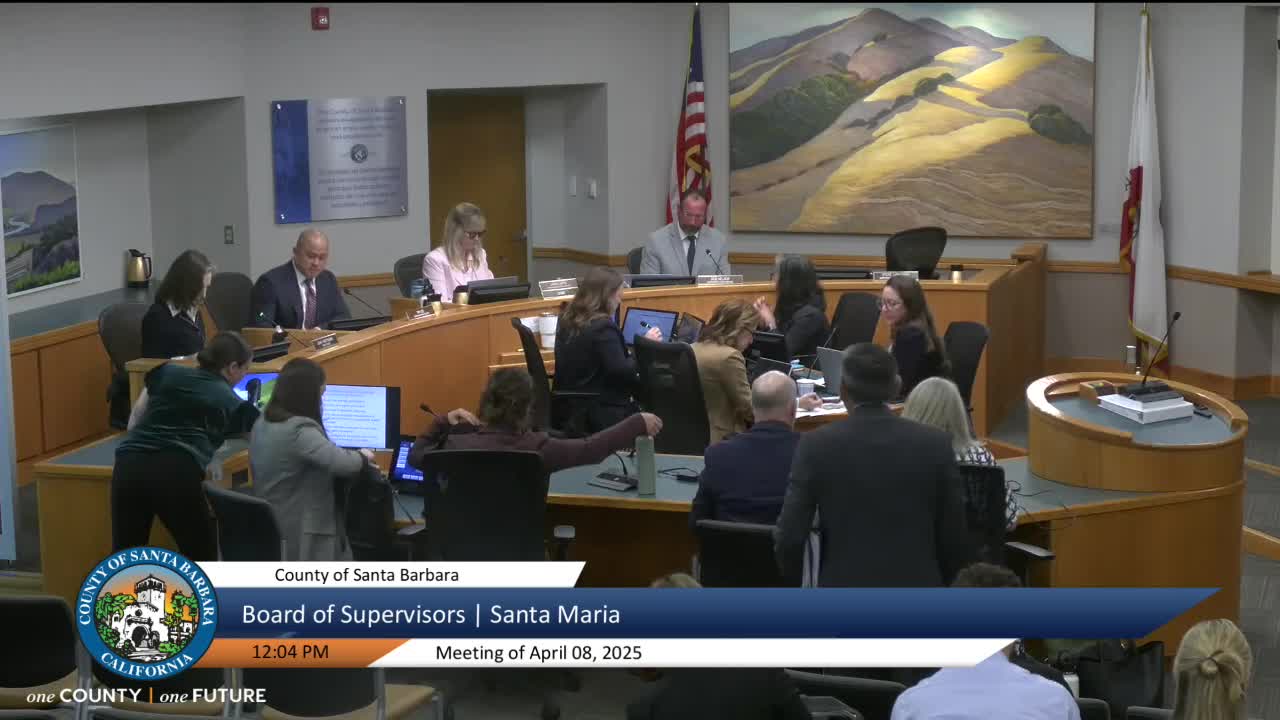
Following a workforce housing study, the Board authorized staff to prepare a request for proposals to develop affordable workforce housing on the county’s probation building site and told staff to prioritize housing — not a planned solar array — at the downtown campus.
The Santa Barbara County Board of Supervisors on April 8 accepted a consultant workforce‑housing study and directed staff to pursue near‑term development options for county‑owned parcels.
Key actions: the board directed staff to prepare a request for proposals (RFP) for a lower‑to‑moderate‑income workforce housing development at the county Probation building site at 123 East Carrillo Street in Santa Barbara and to return to the board for authorization to issue the RFP. The study estimated that the probation site could yield roughly 60 dwelling units. The board also instructed staff to prioritize housing over a previously discussed solar array at the downtown campus parking lot and asked staff to examine using the engineering and human resources buildings and adjacent parking for potential housing development; the downtown parcels were modeled in the study as potentially producing roughly 100 units depending on final program mix and constraints.
Why it matters: County‑owned land is a scarce resource in Santa Barbara. The workforce housing study, prepared for the county, found a large affordability gap for households earning up to 120% of area median income and emphasized that state funding and technical incentives reward jurisdictions that adopt “pro‑housing” practices. The board’s direction launches an implementation step — the RFP process — that could convert county assets into deed‑restricted workforce housing or mixed uses designed to serve county workers and other essential employees.
Study highlights: Consultants and county staff reviewed 21 county‑owned or underutilized sites and filtered them by feasibility, environmental constraints, proximity to transit and services and readiness for development. The study recommended immediate steps (apply for HCD’s “Pro‑Housing” designation, update inclusionary housing rules, and explore short‑term rental rules to preserve long‑term housing) and longer‑term measures (private equity engagement, a community land trust and revisiting inclusionary rules). It also recommended pursuing new funding streams and incentivizing employer‑sponsored housing models; Cottage Health, Habitat for Humanity and other local stakeholders participated in the outreach that informed the report.
Board action and vote: Supervisor Hartman moved the staff recommendation; Supervisor Nelson seconded. The board voted 4‑1 to proceed with the recommended steps and to withhold the downtown campus solar installation while staff completes further due diligence on housing options. Supervisor LaVonino voted no on the final action during roll call.
Speakers and context: Community Services Director Jesus Armas introduced the report and was joined by deputy director Joe Desbonic, housing manager Lucille Boss and senior housing specialist Andrew Kish. Testimony during the public comment portion included local housing advocates, Cottage Health and Habitat for Humanity representatives and the League of Women Voters, all of whom urged swift action to produce deed‑restricted units for low and moderate income workers.
Next steps: Staff will return with an RFP for the probation building site and will perform additional feasibility work for the downtown campus parcels if the board confirms continued interest. Staff also intends to prepare the county’s application for HCD’s Pro‑Housing designation (a separate board action anticipated in May) and to pursue targeted changes to the inclusionary housing ordinance and other policies recommended in the study.
Ending: The board’s action sets an initial pipeline for county‑led workforce housing on public land while reserving longer deliberation on the downtown campus’ highest and best use.