Get Full Government Meeting Transcripts, Videos, & Alerts Forever!
Get email alerts on the Jail Expansion topic
No spam. Unsubscribe anytime.
Board narrows jail expansion to 1.5 housing units, directs diversion study; vote 3-2
Summary
The Santa Barbara County Board of Supervisors on April 1 approved a plan to advance design for a 1.5‑housing‑unit expansion of the Northern Branch Jail in Santa Maria, directing staff to maximize behavioral‑health bed capacity, pursue net‑zero energy design features, and ask the Community Corrections Partnership to complete a diversion study; the motion passed 3–2.
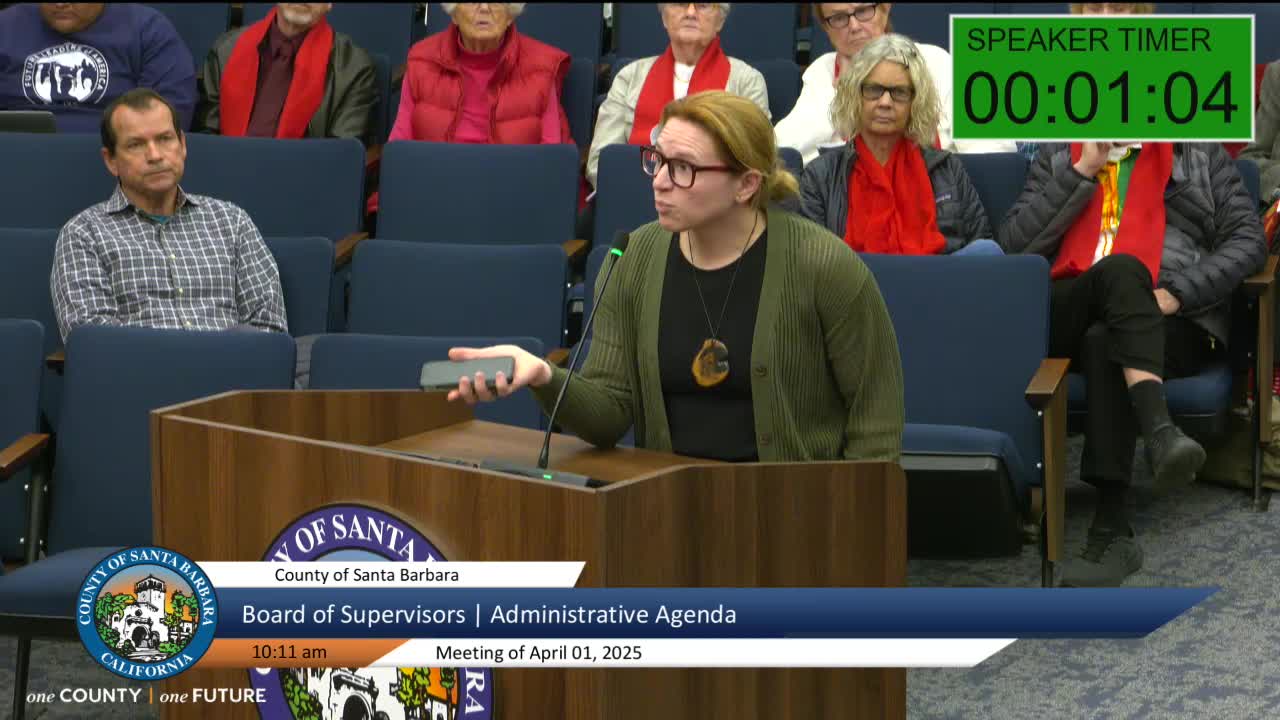
The Santa Barbara County Board of Supervisors on April 1 approved a plan to proceed with a 1.5‑housing‑unit expansion at the Northern Branch Jail in Santa Maria, with direction to maximize behavioral‑health bed capacity and to pursue net‑zero‑energy features. The motion, made by Supervisor Hartman and seconded by Supervisor Lee, passed on a 3–2 roll call after a daylong hearing with dozens of public speakers.
The action follows a court‑ordered stipulated judgment and remedial plan tied to the Murray/Disability Rights California litigation requiring the county to address jail conditions and accessibility. County staff presented three conceptual expansion options — one housing unit (256 beds), 1.5 units (384 beds) and two units (512 beds). Staff and the sheriff’s office said the larger options would better satisfy long‑term capacity and classification needs; advocates and behavioral‑health groups urged investment in community treatment and alternatives to incarceration.
The board's motion directs staff to advance design for the 1.5‑unit option, to pursue net‑zero energy alternatives during design work, and to configure the new capacity to maximize clinically appropriate behavioral‑health beds and step‑down spaces. The motion also directed staff to: (a) work with the Community Corrections Partnership (CCP) to complete an analysis of diversion programs and jail population drivers; (b) develop memoranda of understanding to better share and analyze jail and treatment data across county agencies; and (c) return with design, cost and financing details for the chosen option.
Supporters of the 1.5‑unit option said it strikes a balance between the sheriff’s stated operational needs — particularly classification space to separate incompatible populations — and community demands to increase treatment capacity and non‑carceral alternatives. Sheriff Brown and jail staff told the board that their planning assumptions incorporate an industry standard “classification factor” (about 15%) that reserves beds for separating inmates for safety and programmatic reasons. Sheriff’s staff warned that inadequate capacity can lead to crowded housing, increased safety risks and litigation exposure.
Opponents — including families of people with mental illness, the county Behavioral Wellness Commission, NAMI Santa Barbara County and community organizers — urged the board to pause and form a task force to design a countywide plan prioritizing community mental‑health and substance‑use treatment, housing and crisis response instead of new jail construction. Several speakers recounted family members who they said would be better served in locked or voluntary treatment facilities rather than in jail. Behavioral‑health leaders told the board they are expanding crisis and treatment capacity, are pursuing state grants, and recommended the CCP assemble a short, expert task force to map capacity needs and diversion pathways.
The board also directed staff to pursue a state grant application already submitted for a crisis residential treatment facility adjacent to the Northern Branch site (the county applied for Behavioral Health Continuum Infrastructure Program funds) and to return with a clearer financial plan. Staff cautioned the board that construction costs have risen substantially since the county first studied expansion plans and that delivering any option on the board’s new schedule will be tight; the remedial plan deadline is July 1, 2029.
What’s next: staff will finalize bridging documents for design and release a request for qualifications for a design‑build team, while the CCP will be asked to deliver a diversion study this summer. The board’s decision authorizes design and program work for the 1.5‑unit approach but leaves detailed construction funding and final contract approvals to future votes.
The board vote was 3–2 in favor (motion by Supervisor Hartman; second by Supervisor Lee). The board also directed the Community Corrections Partnership to prepare a coordinated data and diversion analysis for consideration during the next budget cycle.