Get Full Government Meeting Transcripts, Videos, & Alerts Forever!
Get email alerts on the Land Use Development topic
No spam. Unsubscribe anytime.
Board deems Richards Ranch builder's‑remedy application complete, restarting 60‑day consistency review
Summary
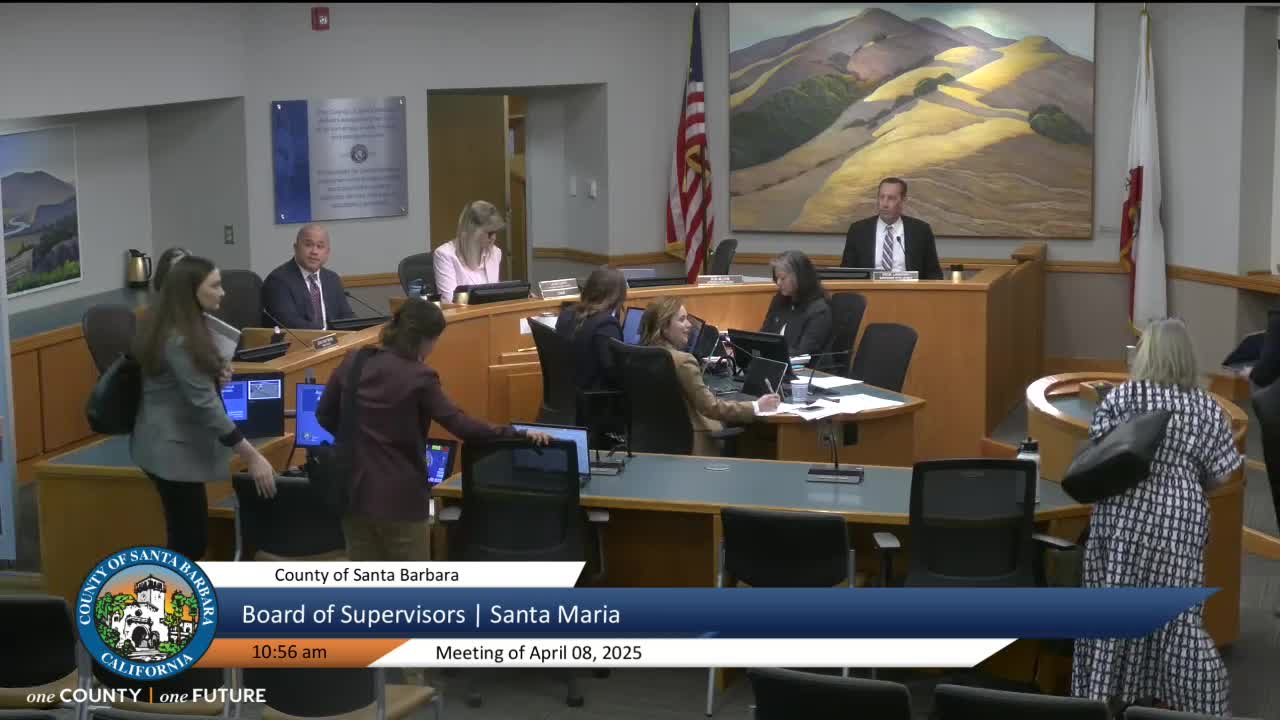
After a full‑day hearing, the Santa Barbara County Board of Supervisors upheld an appeal and found the Richards Ranch SB 330 / builders‑remedy application complete, obliging county staff to begin a 60‑day review of the project’s consistency with objective local standards.
The Santa Barbara County Board of Supervisors on April 8 upheld an appeal and determined that the Richards Ranch builders‑remedy application is complete, restarting the county’s statutory 60‑day consistency review period.
The action was taken after hours of testimony in which county planners said the latest submittal remained incomplete for two technical reasons — detailed floor plans and outstanding public‑works (transportation/roadway) items — while the applicant and its attorneys argued the county’s completeness deadline under the Permit Streamlining Act (and related state housing laws) had been missed and that Housing Accountability Act protections applied. The applicant also submitted a late technical letter from the California Department of Housing and Community Development (HCD) that the applicant said supported its position.
Why it matters: The Richards Ranch site in the Orcutt/Orchid area is the subject of a builders‑remedy application under state housing law. A formal finding that an SB 330 application is complete starts tight state timelines for county review and can preserve a project’s vesting and state protections against certain local subjective controls. Opponents and county staff warned that missing technical details can impede the county’s ability to evaluate public‑safety, traffic and infrastructure impacts; the applicant said those are either provided or properly deferred to later CEQA/consistency work.
At the hearing, county staff summarized their position: planning staff issued an incompleteness letter after reviewing the applicant’s resubmittal and identified remaining questions about whether the submitted floor plans matched the site plan and whether Public Works had the information it needed to confirm compliance with roadway and driveway standards. Public Works staff detailed the typical engineering and right‑of‑way information they expect for a project of this size — driveway profiles, right‑of‑way widths, sight‑distance studies and detailed grading/driveway radii — and explained those items are standard completeness requests for circulation and safety review.
The applicant’s counsel, Beth Collins of Brownstein, said the project team had submitted the materials via the county’s filing system on the federal holiday (Martin Luther King Jr. Day) and that under the Permit Streamlining Act the county’s thirty‑day clock to issue any completeness letter should be measured from that submittal day. Collins and the applicant also pressed that the discrepancies in some interior floor‑area figures (for a convenience store and car wash) amounted to a few hundred to a few thousand square feet on a roughly one‑million‑square‑foot mixed‑use plan — technical differences that they said are normally resolved by staff and do not justify taking away SB 330 vesting. Collins also pointed to a late HCD technical letter submitted by the applicant and argued that HCD’s guidance supported the applicant’s legal position.
County planners told the board they had re‑computed square‑footage and found mismatches between site plan figures and the pre‑application numbers and that Public Works had not received complete transport/circulation packages needed to check objective engineering standards.
Supervisor John Nelson made the motion that the board uphold the appeal and determine the application complete as of April 8; Supervisor Hartman seconded. County counsel and staff clarified that, by statute, the first calendar day after the board’s determination is excluded from the 60‑day clock, so the consistency review period begins the next day. The motion passed.
Next steps: With the board’s completeness determination, county staff must complete a consistency review of the application against objective local standards within the statutory period. That review will address transportation, utility and other objective standards and identify any remaining evidence needed for CEQA review and final decision‑making. The action does not itself approve entitlements; it starts the county’s required review under state housing law.
Speakers quoted or recorded in the hearing included applicant counsel Beth Collins; county planner Aliyah Vosberg; Public Works representative Will Robertson; Planning Director (Plowman) and the Board’s members who spoke in deliberations, including Supervisor John Nelson and Supervisor Hartman.
Ending: The decision resets state deadlines and keeps the developers’ SB 330 pathway active; it also signals that the board expects staff to complete a focused consistency review within the statutory window so that the project can either proceed or be denied under the precise legal standards Congress and the state have set for housing‑urgent cases.