Get Full Government Meeting Transcripts, Videos, & Alerts Forever!
Get email alerts on the Cannabis Odor Regulation topic
No spam. Unsubscribe anytime.
Santa Barbara supervisors hold Carpinteria forum on cannabis odor, near-term vote expected on carbon scrubbers
Summary
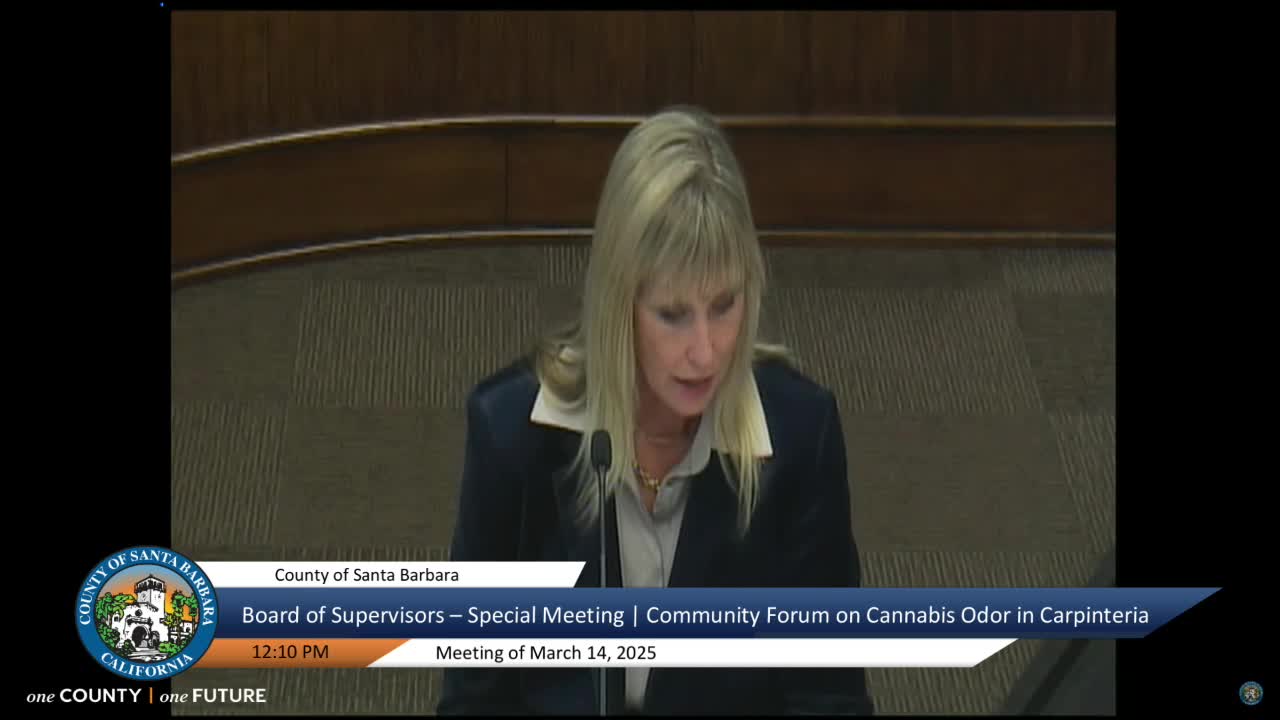
Chair Laura Capps called a special meeting of the Santa Barbara County Board of Supervisors on March 14 in Carpinteria to hear residents, growers and engineers about cannabis-related odors, measurement methods and technology options.
Chair Laura Capps called a special meeting of the Santa Barbara County Board of Supervisors on March 14 in Carpinteria to hear residents, growers and engineers about cannabis-related odors, measurement methods and technology options. The session was a public forum rather than a decision meeting; supervisors Hartman and LaVonino were recorded as absent.
The discussion focused on three related issues the board plans to act on at an upcoming board hearing: how to set an odor threshold (measured as D/T, dilution-to-threshold), which monitoring technology to use (portable "Nasal Ranger" devices versus lab-based gas chromatography or continuous vent monitoring), and a proposed requirement that commercial cannabis operations install multi-technology carbon filtration (carbon scrubbers) and phase out vapor-phase/misting systems.
The hearing opened with a reminder from Chair Laura Capps that the forum was limited to Carpinteria odor concerns and would not include formal votes. Capps said the matter is largely settled in one respect: "there has been a new consensus ... a five vote ... to direct staff to come back and to direct the planning commission on a new requirement for mandatory multi-technology carbon filtration." She said the board would revisit remaining ordinance details at a scheduled board meeting on Tuesday.
Planning staffer Aaron Bridal explained the primary measurement term: "D over T is dilution to threshold," describing how a Nasal Ranger device dilutes an air sample in set steps (the device's calibration steps include 2, 4, 7, 15, 30 and 60 D/T). He noted the planning commission recommended a cannabis-specific threshold not to exceed 7 D/T and that the draft ordinance language to be considered next week refers specifically to "measurements of cannabis odor".
Speakers from across Carpinteria said they want stronger protections. Resident Nancy Robertson and other neighbors urged immediate enforcement and said the existing complaint system has not worked: Robertson noted repeated complaints and asked why tests were not timed to match when vents open at night or early morning. Several residents described odor residue on outdoor surfaces and reported health or allergy effects.
Representatives of local growers and engineers described carbon filtration progress and technical limits of the Nasal Ranger. Paul Ekstrom, who lives 65 feet from an operation that installed scrubbers, said the installation produced "95% improvement." Mike Palmer, operator at Everbloom, described engineering steps to build carbon systems that maintain high single-pass efficiency and avoid frequent carbon replacement: "you have to have ... a carbon bed that's properly engineered with the fan that goes over it, and you have a single pass, 90% efficacy over that single pass, and it has to maintain over time." He and other growers said well‑designed scrubbers can strongly reduce emissions but require correct sizing and maintenance; the operators said typical engineering calculates roughly 8–12 scrubbers per acre, with manufacturers often recommending about 10 per acre.
Experts and some community members disputed a single numeric threshold. Growers and some engineers argued nuisance-level odor is typically found above 7 D/T, citing the GeoSyntec county study the planning department commissioned and the Nasal Ranger’s calibration steps; operator testimony warned "false positives" below that level and said lab-based gas chromatography is more specific but costlier. Opponents and some residents urged a stricter standard (some called for 0 detectable cannabis odor beyond property lines), arguing that lower thresholds — or direct vent monitoring — would better protect nearby homes.
Several speakers, including Mike Bridal Lasky and Lionel Niff of the Carpinteria Coalition, pushed for proactive, vent-based monitoring rather than complaint-driven fence-line checks, describing how nighttime inversion layers can move emissions away from a fence line before residents smell them down-valley. Niff and others reported the coalition had invested in litigation and tests; one coalition speaker estimated the coalition’s legal spending at "at least a half a million" dollars. The public record cited about 3,700 complaints filed to county staff on cannabis odor.
City of Carpinteria Community Development Director Nick Bobroff told the board the city supports the move to carbon filtration and asked the county to consider measurement methods used in other noxious industries, including laboratory or continuous instrumentation used for wastewater or compost facilities.
Planning staff said the draft ordinance coming next week will be cannabis-specific and will include language that measurements of cannabis odor "shall not exceed 7 D/T" as recommended by the planning commission; staff also described plans to phase out vapor-phase/misting mitigation systems during the implementation period for scrubber installation. The board signaled it will seek enforceable requirements tied to compliance; Supervisor Lee said the county will likely require sworn affidavits and noted potential license revocation and criminal penalties for operators who fail to install required scrubbers.
The forum closed with broad agreement among supervisors that requiring properly engineered carbon filtration is the immediate priority; additional ordinance details, monitoring technology choices and enforcement mechanisms will be considered at the board’s next hearing. Chair Capps said she will compile notes from the forum and prepare for the Tuesday agenda item. The meeting was adjourned and the board scheduled the formal hearing for the next Tuesday.
Ending: The March 14 forum made clear the county and Carpinteria neighbors remain sharply divided on an exact measurable odor standard and on monitoring technology. Supervisors said they view near-term mandatory carbon filtration as the most practicable step to reduce neighborhood impacts; remaining policy choices — the D/T numerical standard, whether to use Nasal Ranger devices, and enforcement protocols — will be addressed at the scheduled board hearing.