Get Full Government Meeting Transcripts, Videos, & Alerts Forever!
Get email alerts on the Housing Policy topic
No spam. Unsubscribe anytime.
Board updates inclusionary housing rules: ADU language, 90-year affordability and rental coverage
Summary
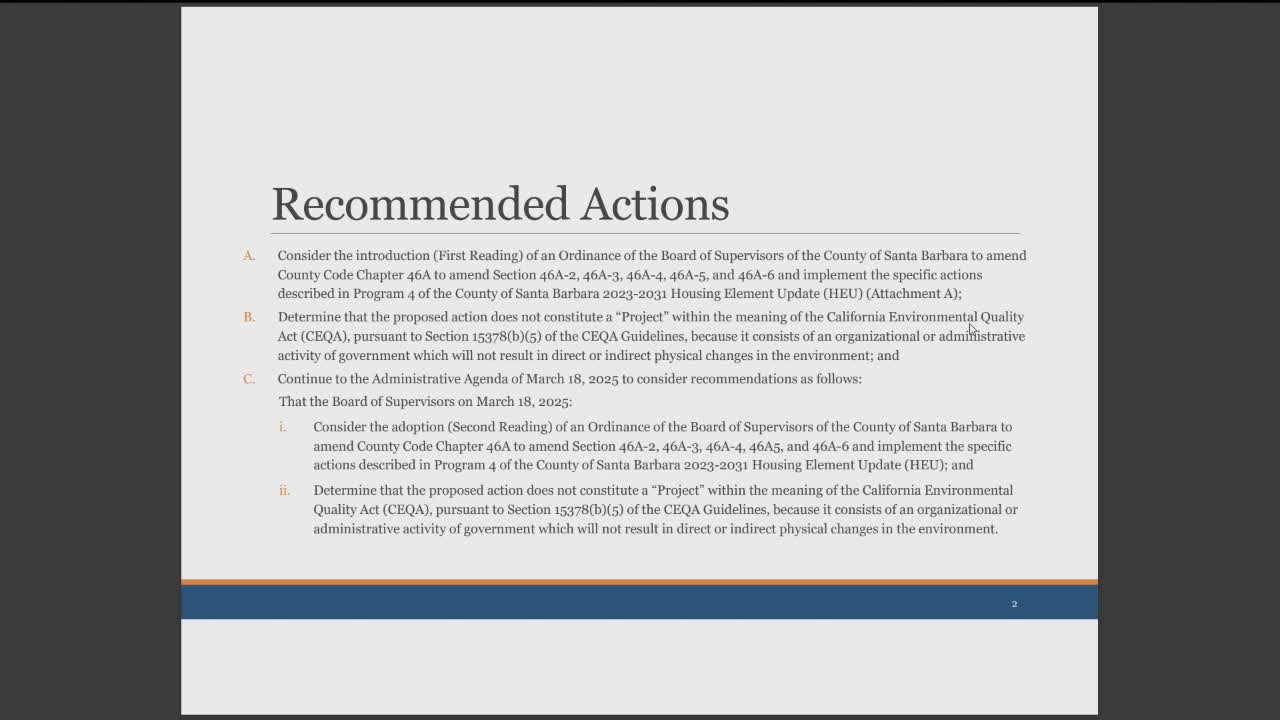
Supervisors approved amendments to the county’s Inclusionary Housing Ordinance including replacing 'residential second unit' with 'accessory dwelling unit (ADU)', extending ownership-unit deed restrictions to 90 years, and applying inclusionary requirements to 100% rental projects with specified waivers tied to local median rents.
Santa Barbara — The Board of Supervisors on March 4 adopted amendments to Santa Barbara County’s Inclusionary Housing Ordinance to increase the longevity of deed-restricted affordable homes and to extend the ordinance’s reach to certain rental-only developments.
Community Services staff said the ordinance had not been updated for more than a decade and that the county’s updated housing element directed staff to align the inclusionary rules with current state law and local housing needs. Among the actions approved, the board:
- Replaced the ordinance term "residential second unit" with "accessory dwelling unit (ADU)" to align zoning and state ADU law; - Increased the affordability term for ownership units produced under the IHO from 45 years to 90 years, a change staff said would preserve affordable units for multiple future owners; - Extended application of IHO requirements to 100% rental housing developments, so long as requirements are adjusted by housing market area (HMA) and subject to a waiver where the median market rent in the HMA is already affordable to a given income tier; and - Removed an equity-sharing provision tied to state density-bonus ownership units so that the county’s model resale restrictive covenant, rather than the state equity-share approach, will preserve long-term affordability.
Staff and a consultant from Harrison Associates presented a pro forma feasibility analysis showing that prototype rental projects in Santa Maria would remain financially feasible if inclusionary rental shares were required, based on current market rents, development costs and land values. The proposed rental approach calls for percentage targets across income levels (for example, 5% each for very low, low, moderate and middle income tiers in the model), with an annual data-driven waiver mechanism for income tiers where median market rent is below the affordability threshold.
The board approved the ordinance amendments on a 4-1 vote. Supervisor Nelson voted no; other supervisors supported the measure. Staff said the amendments are intended to increase long-term housing affordability, help the county meet its Regional Housing Needs Allocation (RHNA) goals and align county rules with state housing law.
The county’s amended ordinance will be implemented by Community Services, Environmental Health (for ADU matters where applicable), and Planning and Development for ongoing administration and monitoring.