Get Full Government Meeting Transcripts, Videos, & Alerts Forever!
Get email alerts on the Local Food Systems topic
No spam. Unsubscribe anytime.
Littleton board hears urban agriculture briefing; presenter urges water, land tenure and partnerships
Summary
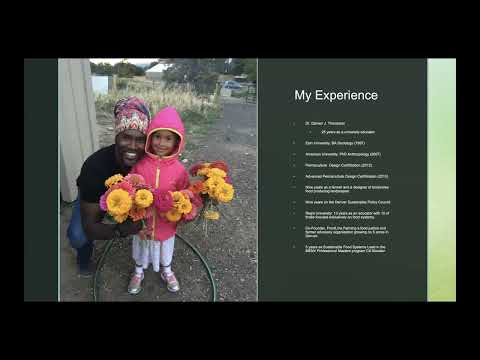
Dr. Damien Thompson, a sustainable food‑systems educator and co‑founder of Frontline Farming, told the Littleton City Environmental Stewardship Board that municipal partnerships with professional community farms can scale local food production, expand food access and support environmental goals.
Dr. Damien Thompson, a sustainable food-systems educator and co‑founder of Frontline Farming, told the Littleton City Environmental Stewardship Board that municipal partnerships with professional community farms can scale local food production, expand food access and support environmental goals.
Thompson said municipal support for land, water access and multi‑year leases are important because “no farmer is going to plant a tree that they're not going to see fruit on for 5 to 7 years if they're not going to be on the land.”
The presentation gave the board a high‑level overview of three municipal models — community farms, community supported agriculture (CSA) and community gardens — and a case study of Frontline Farming’s Majestic View site in Arvada. Thompson described Majestic View as a two‑acre site operated under a lease from the City of Arvada, with an initial five‑year term renewed for a second five‑year term; Frontline Farming reported growing about 22,242 total pounds of produce across its sites last year, roughly half of that from Majestic View. He said the operation combines market sales, a CSA that aims for about 90 members this year, and donated distributions to food‑access partners.
Why it matters: Thompson argued that local food systems can advance climate resilience, provide culturally relevant food, and create public‑facing spaces that increase civic engagement. He recommended Littleton start with existing assets — the Littleton Museum demonstration plots, local community gardens, and regional anchors such as Denver Botanic Gardens at Chatfield — while planning longer‑term steps to secure land and water for agricultural use.
Key details from the presentation and board discussion: - Case study: Majestic View partnership. Thompson said Arvada issued a request for proposals for a farming partner and required demonstrated farming capacity and insurance. The city provided land and water access; the farmer (Frontline Farming) managed operations, community engagement, classes and weekly CSA distribution. Thompson said the site now supports a range of activities including beekeeping, seed‑saving classes and value‑added products such as jam and hot sauce. - Scale and numbers. Thompson described Majestic View as approximately two acres and said Frontline Farming has three sites and a program goal of about 90 CSA members this year; he stated the organization distributes 20–25% of its produce through donation or partner channels and cited historical totals from the group’s distribution records. - Water and tenure as constraints. Thompson emphasized that water access is “potentially the most, expensive agricultural input” and that land tenure (multi‑year leases) matters so farmers will invest in infrastructure such as season‑extending hoop houses and solar cooling. He cited a Denver water tap cost figure referenced in the session and warned that water arrangements require municipal coordination. - Implementation levers. Recommended short‑term steps included mapping existing local food assets, expanding CSA pickup and farmers‑market connections (for example at the Littleton Museum), and convening focus groups to assess resident demand. Medium‑term ideas included revising the Environmental Stewardship Action Plan to incorporate urban agriculture in water, natural environment and community well‑being sections, and issuing an RFP for a municipal farming partner modeled on Arvada’s process.
Board members and other participants asked about distribution and equity: Thompson said the organization works with partner food banks and programs (including SNAP/WIC outreach and EBT matching programs) to reach low‑income households and partner nonprofits for direct delivery to service providers. Participants also asked about siting, infrastructure (refrigeration and irrigation) and whether demonstration or historic‑interpretive farm uses at the Littleton Museum could be compatible with production; Thompson said museums can pair historic interpretation with contemporary regenerative practices.
No formal board action was taken; the session concluded with volunteers and staff discussing next steps for mapping local assets and potential partnerships.
Ending: The board agreed to continue the topic at future meetings, with members flagging water access and land tenure as issues requiring staff follow‑up before any formal procurement or lease decisions.