Get Full Government Meeting Transcripts, Videos, & Alerts Forever!
Get email alerts on the Corrections Health topic
No spam. Unsubscribe anytime.
Supervisors receive report on jail health monitoring and plan to use CalAIM for justice‑involved care coordination
Summary
Public Health outlined audits showing gaps in contracted jail medical and mental‑health services, described a new county monitoring team and proposed using CalAIM/Enhanced Care Management to bill Medi‑Cal for pre‑release care and reentry coordination; board voted to receive and file the update.
County public‑health and behavioral‑health staff on March 11 described progress and continuing shortfalls in contracted correctional health services, and outlined how the state’s CalAIM Justice‑Involved Initiative could fund expanded pre‑release care coordination for people leaving jails and juvenile facilities.
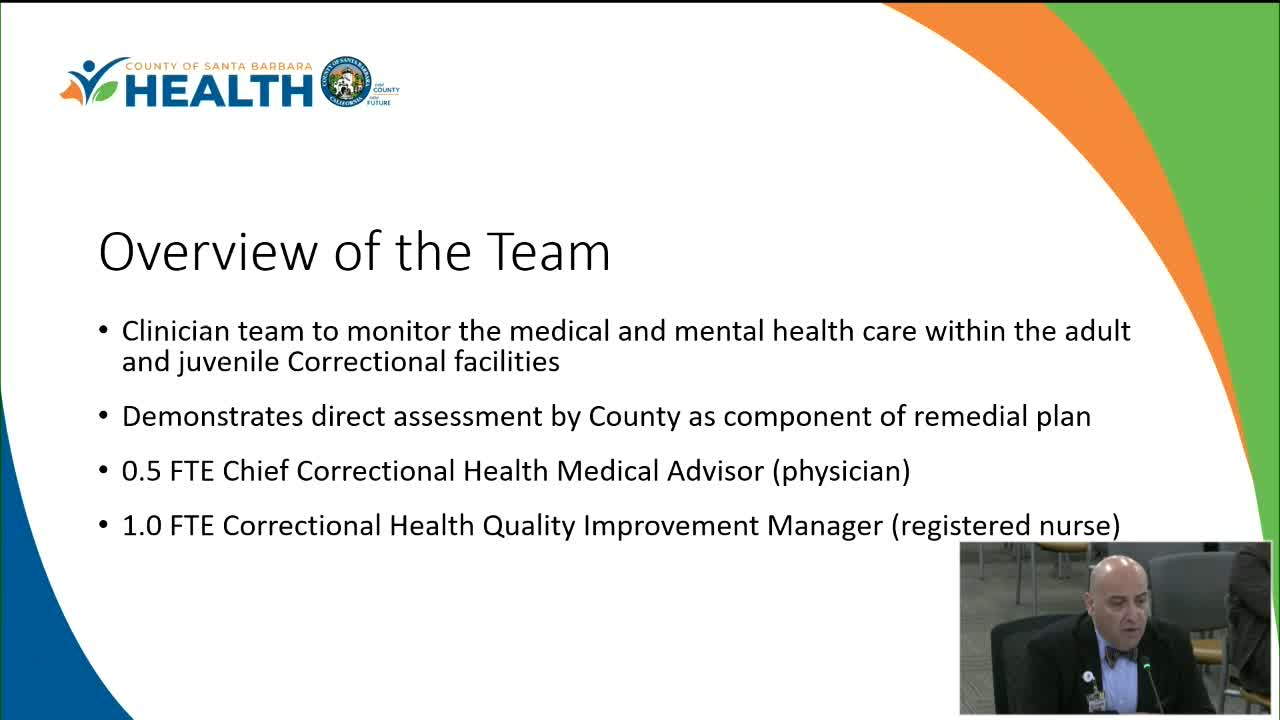
Public Health said it has established a correctional health monitoring team — including a part‑time physician advisor and a full‑time correctional health quality manager — to audit performance metrics in the three county detention facilities and to review deaths in custody, infection reporting and other clinical quality measures. The department reported variable compliance with service‑level measures: some metrics were satisfactory while others — including certain safety‑cell checks and timely comprehensive health assessments — were below targets in recent audits.
Behavioral Wellness and Public Health staff told the board that staffing gaps at the contracted vendor (Wellpath) and at times of high demand have contributed to repeated findings in some measures. Staff said they are working with the sheriff and probation to require corrective action plans, strengthen clinical oversight by a medical director, and expand the sample size and rigor of audits.
Public Health also described CalAIM implementation plans for justice‑involved populations, which would allow the county to bill Medi‑Cal (through Managed Care plans such as CenCal) for pre‑release clinical services, 30‑day discharge medications, and Enhanced Care Management (ECM) services including reentry planning and linkages to housing and behavioral‑health services. Staff said federal/state implementation grants are available to cover startup costs and that preliminary modeling suggests the county could bill several million dollars annually once the program is operational.
The Board voted to receive and file the county’s jail‑health monitoring update and the CalAIM justice‑involved implementation plan. Supervisors asked staff to return with more detail on staffing needs, the finance model (start‑up grants vs ongoing reimbursements), and how to ensure continuity of care for people released with short notice.
Ending: Staff proposed quarterly reporting to the board on correctional health performance until improvements are sustained; the board approved the receive‑and‑file motion at the meeting.