Get Full Government Meeting Transcripts, Videos, & Alerts Forever!
Get email alerts on the Energy Bess topic
No spam. Unsubscribe anytime.
Board hears safety, siting and coordination questions after Moss Landing battery fire
Summary
County officials and energy industry representatives briefed supervisors on March 11 about battery energy storage safety and permitting after the Moss Landing fire, highlighting differences between older indoor installations and newer outdoor, containerized systems and asking for clearer local standards and emergency coordination.
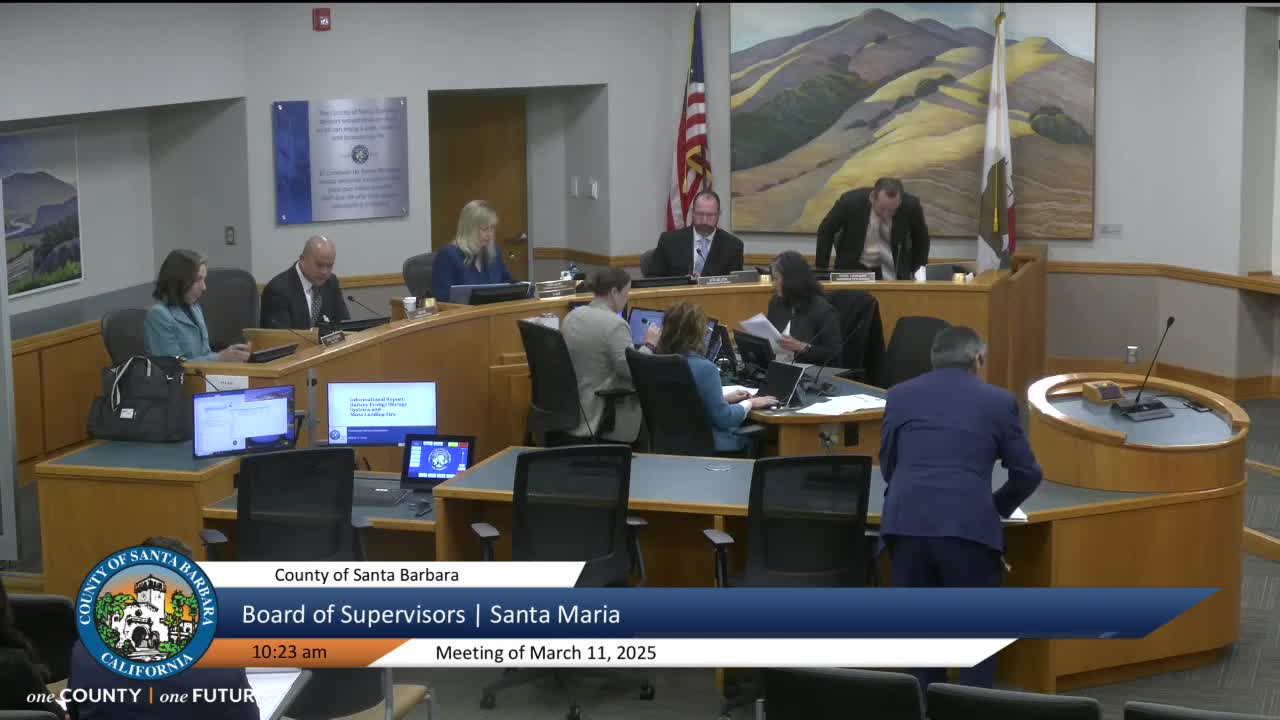
County officials and energy industry representatives told the Board of Supervisors on March 11 that battery energy storage systems (BESS) are an important tool for grid reliability but raised new safety and permitting questions after the recent fire at the Moss Landing facility.
Central Coast Community Energy Chief Executive Robert Shaw told the board that California needs large amounts of storage to integrate intermittent renewables and that the industry is shifting toward lithium‑iron‑phosphate (LFP) chemistry, which he said is less prone to thermal runaway than older chemistries. Shaw also said the Electric Power Research Institute’s incident database shows emergency responses to BESS incidents are rare and that standards and incident rates have improved as the technology and regulations evolved.
The county’s Fire Marshal, Greg Tan, described technical differences between the Moss Landing installation and newer systems proposed or operating locally. He said the Moss Landing site used an older battery chemistry and was largely an indoor, tightly enclosed installation. By contrast, the Goleta and Nipomo installations discussed in the meeting use outdoor, containerized LFP battery modules with ventilation, sensors and automatic monitoring that shut equipment off if temperatures exceed set thresholds.
County staff outlined the local permitting path for projects that are not certified at the state level: BESS projects typically require environmental review and a conditional use permit; those processes bring building, fire and public‑safety review and a public hearing before the planning commission. Staff noted an alternate “opt‑in” path exists under state law for very large projects to be certified by the California Energy Commission, a route that Assemblymember Addis’ AB 303 would remove and restore local permitting authority if enacted.
Fire department staff emphasized that modern systems are designed to vent heat and steam and to localize incidents within individual containers, and described response protocols that rely on monitoring, time‑distance shielding and evacuation decisions rather than immediate application of large water streams. Staff said water can sometimes worsen certain lithium battery fires and that incident response guidance varies by chemistry and system design.
Supervisors and public speakers asked for stronger notification and transparency for siting decisions, bonding or decommissioning requirements to cover costly remediation, and assurances that local first responders would be trained and equipped to respond. Several speakers and supervisors urged the county to support AB 303 to keep large projects subject to local review. Other public speakers and trade union representatives argued battery storage is safer than fossil‑fuel alternatives and critical to avoiding rolling blackouts and reducing greenhouse‑gas emissions.
Staff recommended the board receive and file the information report. No formal board action on siting or permitting policy was taken at the hearing; staff said they would return with options and requested the board’s guidance on whether to pursue state legislation or additional local rules.
The board requested staff follow up on public‑safety and emergency‑response coordination with San Luis Obispo County for the Nipomo facility, on possible bonding/decommissioning requirements, and on whether local permitting standards and public notice should be revised to match the county’s ordinary standards for other energy projects.
Ending: County staff and the county fire marshal said they will continue coordination with state agencies and neighboring counties while the CPUC’s investigation of Moss Landing continues and staff prepares any regulatory or ordinance options for the board to consider.