Get Full Government Meeting Transcripts, Videos, & Alerts Forever!
Get email alerts on the Groundwater Management topic
No spam. Unsubscribe anytime.
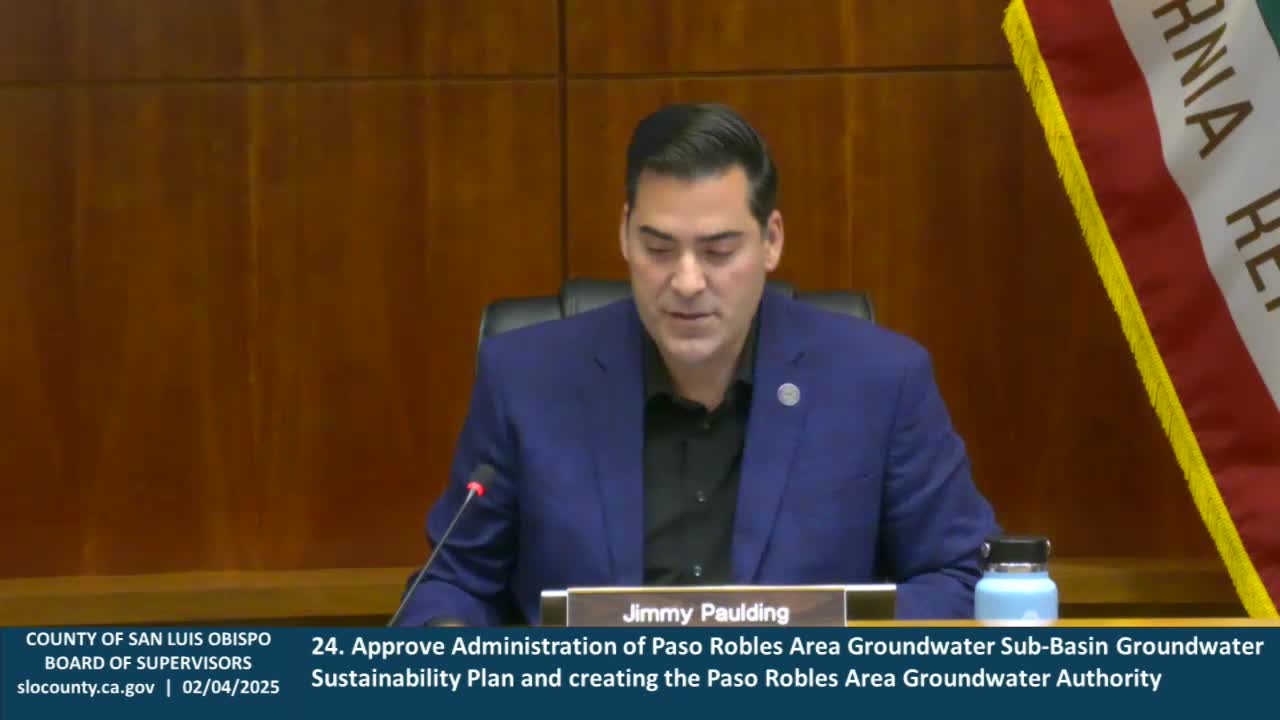
Board approves Paso Robles groundwater joint-powers authority after contentious public debate
Summary
After hours of public comment and a split debate among supervisors, the San Luis Obispo County Board of Supervisors voted to authorize formation of a joint-powers authority for the Paso Robles Groundwater Basin, directing staff to distribute revised agreements and to carry out expanded public outreach before the fee-setting process.
The San Luis Obispo County Board of Supervisors on Thursday authorized staff to proceed with creation of a joint-powers authority (JPA) to coordinate groundwater management across the Paso Robles Groundwater Basin, approving the step by a 3-2 vote after extensive public comment and a long exchange among supervisors.
Supporters said the JPA is a pragmatic next step for local agencies implementing the state's Sustainable Groundwater Management Act and will create a single governance body to coordinate fees and program administration across five existing groundwater sustainability agencies. Opponents warned the JPA could concentrate decision-making and fees in ways that would disadvantage small well owners.
Why it matters: The Paso Robles groundwater basin has been designated by the state as needing active local management to halt overdraft. The JPA is intended to allow the basin’s multiple local agencies to implement a single, coordinated Groundwater Sustainability Plan (GSP) and — if needed — a single fee and program structure to fund monitoring, programs and voluntary demand-reduction incentives. Backers say a JPA makes it administratively easier to propose an extraction-fee program that can be presented to property owners for a Proposition 218 protest vote; opponents say the authority centralizes power and risks new charges on rural residents.
What the board decided - The board approved moving forward with a JPA authorization and accepted revised draft documents that staff circulated during the meeting to reflect recent consensus-building among the five local GSAs. The board also directed staff to conduct expanded outreach and return documentation showing public engagement before fee proposals are released. - Vote: Yes — Supervisor Gibson, Supervisor Paulding, Chair Ortiz Lake. No — Supervisor Pashong, Supervisor Moreno. Outcome: approved (3–2).
Key details from staff and technical experts - Blaine Realey, the county’s Director of Groundwater Sustainability, described the JPA as “bringing together elected members from each of the five GSAs” and said the JPA would receive only “limited authority” that GSAs are willing to delegate for the purpose of implementing the GSP. He emphasized the agreement was designed to preserve the GSAs’ existing powers except for specific authorities they convey to the JPA. - Realey said the JPA approach was chosen because having five separate, independent fee programs would be difficult to implement and coordinate; a single governing body makes it feasible to adopt a single extraction-fee program for the basin. - Staff and counsel told the board there is no immediate change to individual water rights from the action; those rights are governed by state law and court decisions and would not be extinguished by forming a JPA.
Public concerns and technical clarifications - Many residents of rural communities told the board they fear a JPA would lead to new ongoing fees or pumping limits that could affect small-scale well owners. Speakers repeatedly asked whether the board would “take water away” from private well owners; staff and several supervisors said that constitutionally protected water rights are not being removed by forming a JPA. - On the question of whether small, so-called “de minimis” domestic users would be assessed fees, staff said state law limits the ability to exclude some users entirely: de minimis domestic users may still be assessed modest administrative fees if they benefit from basinwide management activities. Staff gave a planning-level figure for an administrative charge “about a dollar a month” as a current estimate used in outreach discussions, not a final approved fee. - Metering: staff said the basin has not proposed to require physical meters on every private well. Instead the agencies are evaluating satellite-based evapotranspiration (ET) analysis as an alternative method to estimate irrigation water use as a proxy for metered data in many agricultural settings. - If local agencies fail to demonstrate they are on a path to sustainability, the state can intervene, staff said — an outcome that local officials term a potential loss of local control.
What the board directed - Approve the JPA authorization documents (as revised during the meeting), subject to final edits and consistency checks by counsel. - Direct staff to continue consensus work among the five GSAs and to distribute the updated draft agreements for additional public review and comment prior to final adoption and prior to any fee-setting or Prop 218 process; staff were asked to mount a robust public outreach program, including multi‑jurisdictional briefings and translated materials where possible. - Staff to return with the final documents and a schedule for the extraction-fee process (including the required notice and protest mechanics under Proposition 218) once the GSAs indicate willingness to execute the JPA.
Context and next steps - The Paso Basin GSP is already in place; the JPA is an implementation mechanism. The JPA would not itself automatically impose fees or allocations — any extraction-fee program would need its own public notice and a formal protest process under California’s Proposition 218. - Staff estimated the Prop 218 protest process for basin fees can take several months and asked the board for permission to begin preparing public materials and to finalize the JPA documents. The board’s majority supported moving ahead quickly because the alternative — state takeover — is a statutory consequence if the basin does not demonstrate progress toward sustainability.
Speakers (attributed) - Blaine Realey — Director of Groundwater Sustainability, San Luis Obispo County (county staff) - Supervisor John Pashong — Board of Supervisors (opposed) - Supervisor Paul Paulding — Board of Supervisors (supported) - Supervisor Heather Moreno — Board of Supervisors (opposed) - Supervisor Gibson — Board of Supervisors (supported) - Chairperson Ortiz Lake — Board of Supervisors (supported) - Public commenters (citizens): Mike Brown, Dorian Baker, Darsha Stebbins, Gary Kirkland, Alan Duckworth, Greg Grewal, Randall Jordan, Murray Powell and others.
Clarifying details extracted from the discussion (not exhaustive) - De minimis/domestic user charge: staff said de minimis users could still face a small administrative assessment under state law; staff used a rough estimate of about $1 per month in outreach discussions (estimate only). - Metering alternatives: staff described the use of satellite-based evapotranspiration monitoring as a potential alternative to property-level metering for estimating agricultural extractions. - Prop 218: any extraction-fee program proposed by the JPA would be subject to the public protest/ballot-like process defined under California’s Proposition 218; a majority protest would block a fee.
Why the story matters: The Paso Robles Basin supplies irrigation and domestic wells for thousands of residents and is a major agricultural resource in San Luis Obispo County. How local agencies organize to meet state SGMA deadlines will affect which local users pay for new programs, who controls decisions going forward, and whether the state steps in if local plans fail to achieve sustainability.