Get Full Government Meeting Transcripts, Videos, & Alerts Forever!
Get email alerts on the Land Use Zone Change topic
No spam. Unsubscribe anytime.
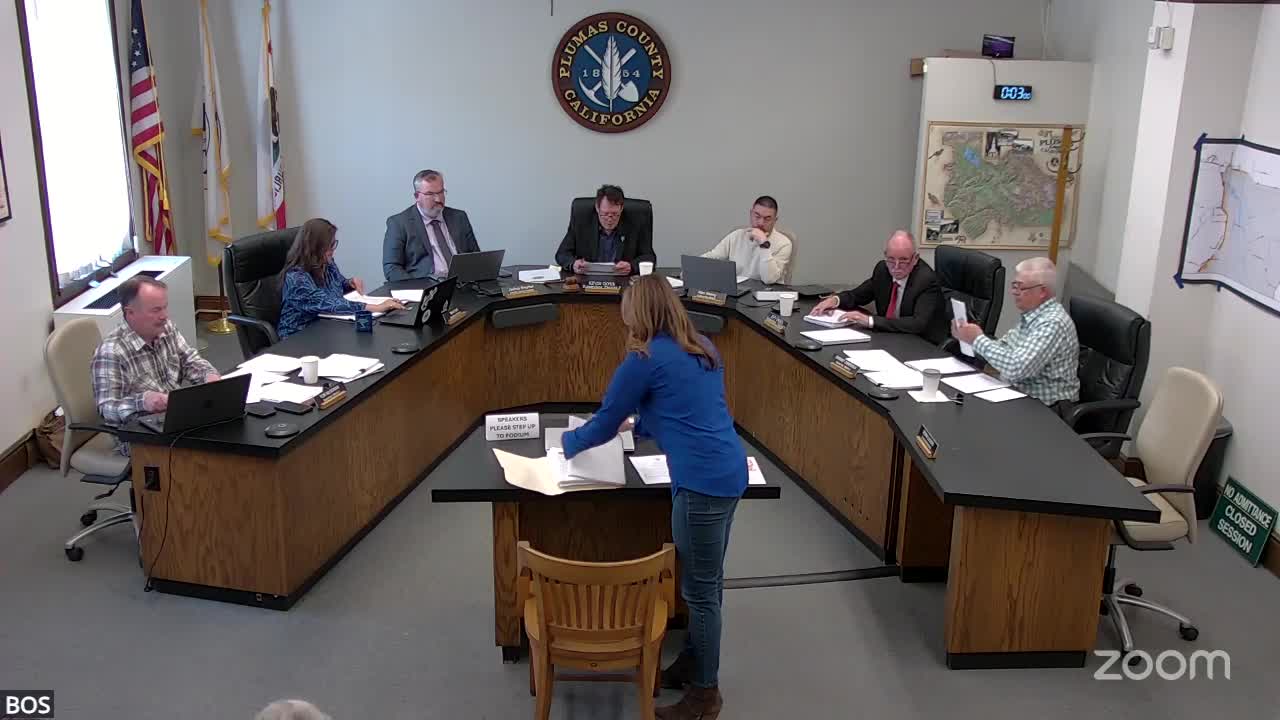
Plumas supervisors continue contentious Lake Almanor zone-change after hours of public comment
Summary
After hours of testimony from neighbors and supporters, the Board of Supervisors on April 8 continued a public hearing on a proposed zone change that would add a nine‑acre farm animal combining zone to a 16.93‑acre parcel on Highway 147 and directed staff to explore a larger buffer and return to the board on May 6.
The Plumas County Board of Supervisors on April 8 continued a public hearing on a zone‑change request that would add a farm animal combining (F) overlay to a 16.93‑acre S‑1 parcel on Highway 147 near Lake Almanor, after more than two hours of public comment and a detailed staff review of environmental issues.
Staff said the change, submitted by property owners Jason and Nicole Stanniger, would apply the F overlay to about nine acres of the parcel and would allow large‑animal husbandry (hooved livestock) where today only small animals such as chickens are explicitly permitted. Planning Director Tracy Ferguson told the board that staff found the proposal exempt from the California Environmental Quality Act under CEQA Guideline 15061(b)(3), concluding it “can be seen with certainty that there is no possibility the project may have a significant effect on the environment.” Ferguson summarized her written findings on noise, water quality, wildlife, wildfire risk and other topics and said accessory structures over 200 square feet would require building permits and review.
Neighbors told the board the change would harm neighborhood character, property values and water quality. ‘‘Anyone who says we will not be negatively impacted by odor and or noise of a potential 18 large animals is actually not true,’’ said Jill Theriault, who lives adjacent to the parcel. Lucinda Mansell said she routinely opens windows in summer and worried that odors and flies would make that impossible and that farm animals could attract predators near children who play outdoors. Other neighbors raised similar concerns about slope, runoff, well contamination and the precedent of changing a residential zone near an established neighborhood.
Supporters, including several longtime community members, defended the applicants and urged tolerance for small‑scale farming. ‘‘Nicole’s not asking for a handout. She’s developing the land, paying property taxes to Plumas County, and adding real value to this place,’’ said Kyle Greer, a friend of the family. Several speakers asked the board to stick to the county’s procedural rules and to respect the planning process.
Planning staff reviewed noise attenuation calculations that estimated a worst‑case sound level of 56 A‑weighted decibels at the nearest property line from animals located near the proposed boundary; staff said that is below the county’s 60‑decibel guideline for low‑density residential areas. Staff also noted a 150‑foot buffer to wellheads (50 feet more than a cited state standard) had been included in the proposed F overlay boundary. The staff report cited Plumas County Code sections governing the farm animal overlay, waste management and fencing designed to be wildlife‑friendly, and it referenced a timber harvest plan showing the parcel had been logged and that wildfire risk was reduced on the property.
Board members expressed sympathy for neighbors and for the applicants and discussed whether a smaller F overlay or an increased buffer would reduce impacts. The board voted to continue the hearing to May 6 to allow staff and the applicant time to consider an adjusted boundary that would increase the buffer and therefore reduce the overlay acreage and the theoretical maximum carrying capacity for livestock. The motion passed with a majority; one supervisor recorded opposition.
The board did not adopt the ordinance or resolution on April 8. If the board ultimately adopts an ordinance it would become effective 30 days after adoption; staff noted the ordinance would not be codified countywide but would apply to this parcel specifically.
The board asked staff to work with the applicant on an amended exhibit showing a larger buffer and a reduced F overlay and to return to the May 6 meeting with revised findings and paperwork. Planning Director Tracy Ferguson said any accessory construction associated with livestock would require building permits, compliance with grading/erosion rules and environmental health review for manure management.
The hearing record remains open for the board until it acts on the revised proposal at the May 6 meeting.