Get Full Government Meeting Transcripts, Videos, & Alerts Forever!
Get email alerts on the Land Use Zoning topic
No spam. Unsubscribe anytime.
Neighbors oppose farm-animal overlay as Plumas County Board continues zoning hearing for Stanniger property
Summary
The Plumas County Board of Supervisors opened a public hearing April 1 on a request to add a farm-animal combining zone to a 9-acre portion of a 16.93-acre parcel on Highway 147. Neighbors raised concerns about odors, predator attraction and water contamination; the board continued the hearing to April 8 for further consideration.
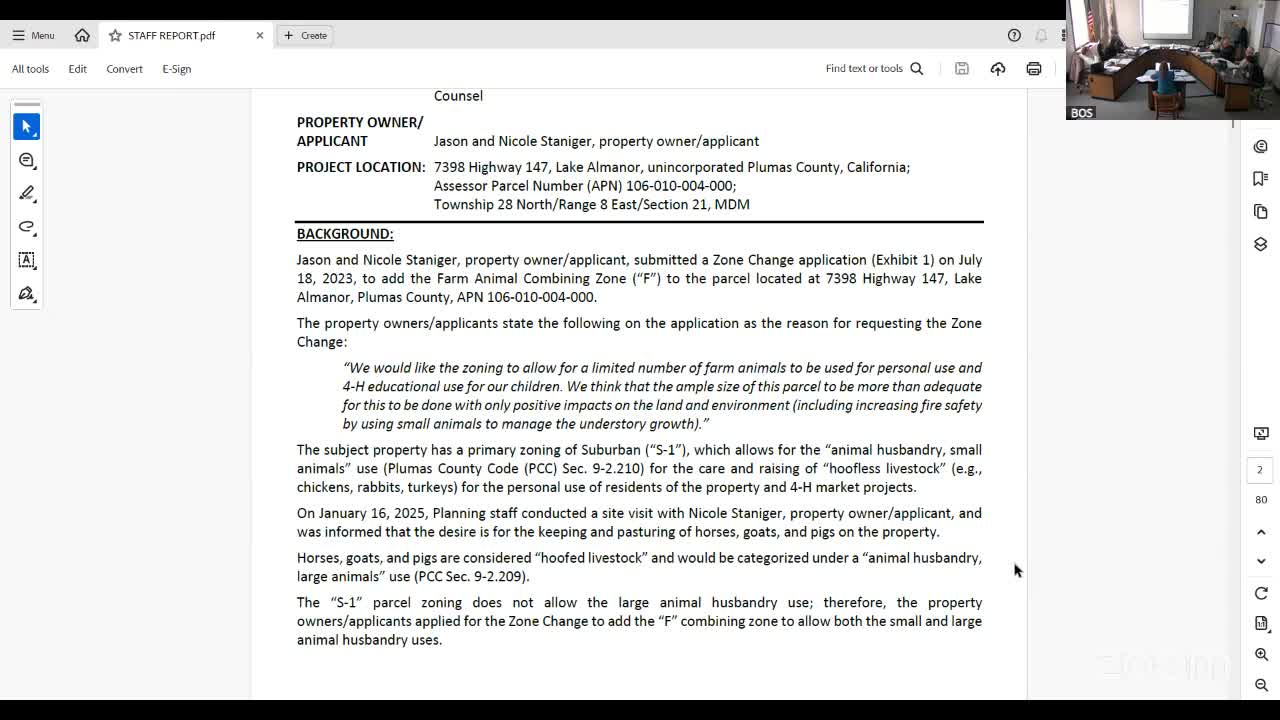
The Plumas County Board of Supervisors opened a public hearing April 1 on a request from parcel owners Jason and Nicole Stanniger to add a farm-animal combining zone to a 9-acre portion of their 16.93-acre property at 7398 Highway 147, on the East Shore of Lake Almanor.
The Stannigers told the board the overlay would permit a limited number of hooved animals for personal and educational use, and that they plan to practice rotational grazing and other measures they described as sustainable. "It is our goal to live sustainably because that is how rural farmers have done it for a very long time," applicant Nicole Stanniger said during public comment.
Neighbors and other residents pressed the board over potential impacts. Kurt Thirail, who lives downhill and adjacent to the parcel, said residents bought properties expecting S-1 (suburban) zoning and that allowing an F overlay would let future owners keep as many as 18 hooved animals on the designated 9 acres. "This zoning change, if it's approved, the lot just above our home will be allowed to have 18 cattle or 18 pigs," Thirail told the board.
Public commenters cited slope and drainage on the hillside, nighttime downslope winds that can carry odors into homes, and predators attracted to confined animals. Several letters submitted to the planning commission and the board raised the prospect of reduced property values and repeated nuisance complaints if management practices lapse.
Planning Director Tracy Ferguson presented staff’s analysis and the planning commission’s March 20 recommendation, including environmental review under CEQA. Ferguson said the county exempted the action under CEQA Guidelines section 15061(b)(3) and noted the county code contains an animal-waste standard (Plumas County Code §6-10.117) requiring manure removal at least three times per week or more often if ordered by Environmental Health.
Environmental Health and Agricultural Commissioner comment letters were before the board. Pat Sanders of Environmental Health told supervisors that county code and best-management practices address odors and flies, and said enforcement would be complaint-driven, using code-enforcement procedures if violations occur. Agricultural Commissioner Willow Vieira commented in staff materials that she did "not see a problem with granting a farm overlay with almost 9 acres of usable land."
Planning staff outlined how the county’s definition of large-animal husbandry sets a carrying capacity formula: two animals (with their young) for the first acre and one additional animal for each additional half-acre. Under that formula the proposed 9-acre overlay could allow up to 18 hooved animals, though Ferguson and commissioners noted terrain and practical management would likely limit actual stocking.
Several adjacent property owners told the board they had changed their positions after discussions with the applicants, while many others remained opposed. Realtors and long-time property owners warned the board that a permanent overlay running with the land could depress neighboring property values and that future owners could change the scale of animal keeping.
After more than an hour of testimony and questions, the board voted to introduce and waive first reading of the proposed ordinance and to continue the public hearing to the board’s next meeting on April 8. Planning staff will return with the formal resolution and draft ordinance for final consideration.
Why it matters: The board’s decision will determine whether a permanent land-use change — an F combining zone on S-1 property — is recorded in perpetuity and therefore binds future owners. Supporters say the measure supports small-scale, resilient food production; opponents say the overlay could invite nuisances and alter neighborhood character.
What’s next: The board will reconvene the public hearing on April 8 to consider adoption of the resolution and zoning ordinance. Planning staff said it will include any new comments provided before that hearing and suggested they will contact additional local agencies asked to comment.