Get Full Government Meeting Transcripts, Videos, & Alerts Forever!
Get email alerts on the Comprehensive Plan topic
No spam. Unsubscribe anytime.
Ashland County planning committee approves subcommittees, details public‑participation, survey approach for comprehensive plan
Summary
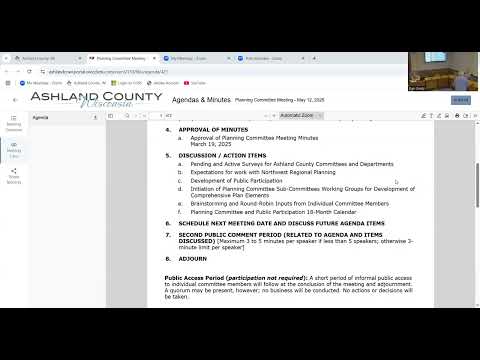
The Ashland County Planning Committee on May 12 approved a slate of subcommittees to develop elements of the county comprehensive plan, agreed to use a countywide digital survey and other outreach tools, and set a June follow‑up while finalizing a contract with Northwest Regional Planning.
The Ashland County Planning Committee on May 12, 2025 voted to create and empower subcommittees to develop elements of the county comprehensive plan, directed staff to pursue a countywide digital survey and other outreach, and set the next meeting for June 17 at 2 p.m. while the county completes a contract with Northwest Regional Planning.
The decision matters because the comprehensive plan will guide county priorities — from housing and transportation to natural resources — for the coming decade and because committee members emphasized that broad public engagement and statutory completeness are required before final adoption.
Dan Grady, chair of the Ashland County Planning Committee, told members the official planning timeline does not begin until the contractor’s agreement is in place: “The official timeline doesn't start until Northwest Regional's contract is signed. We expect that to happen sometime next month.” The committee has contracted Northwest Regional Planning to gather background data, facilitate outreach and run a series of public meetings; the scope provided to the committee lists eight facilitation meetings.
Committee members discussed multiple outreach tools and agreed to use a mix of approaches. Lisa Radke, a committee member leading the survey work with Erica Henegel, described a short online survey option using the University of Wisconsin Qualtrics platform and said the team planned to distribute the link and QR codes to committees and department meetings so members could complete the survey on site or later. “All the results are tallied and sent to us,” Radke said, explaining that investigators and designated staff would have access to the live tally of responses.
Erica Henegel said she had sent a departmental survey in April to 19 department heads and that, as of the May 12 meeting, four completed responses had been returned. Henegel said she would send reminders to nonresponding department heads and was holding follow‑up conversations with several departments that wanted more time before replying.
The committee discussed whether Northwest Regional should administer the countywide survey or whether extension staff should run multiple, smaller surveys for specific audiences. Several members said they preferred a single, countywide survey for broad outreach but left open targeted, topic‑specific questionnaires for subgroups. Alyssa (UW Extension staff) said she could amplify a regional survey by sharing links through active Extension social pages and local community social groups.
Members also debated how to group the statutory elements of the comprehensive plan. Some members expressed concern that changing the traditional grouping used in prior plans could cause extra work when the final product must meet statutory structure. Bradley Wright and others urged that all statutorily required elements be clearly covered and flagged that the committee should confirm how Northwest Regional will present elements so subcommittees’ work aligns with final statutory sections.
The committee voted to approve the subcommittee structure and chairs as proposed and to empower those chairs to recruit participants. The roster approved at the meeting assigns committee members these roles: Charlie Ortman — intergovernmental cooperation; Lisa Radke — trends and issues and risk and opportunities; Elizabeth Franek — cultural resources and community facilities; Pat Kinney — agriculture, forestry and natural resources; George Boussay — transportation and utilities; Bradley Wright — housing; Gary Mertig — land use and economic development. Bradley Wright moved to approve the subcommittees and Charlie Ortman seconded; the motion passed on a voice vote.
On outreach logistics, Mary Pardee, director of UW Extension, said she and others had proposed a generic outreach email such as extensioninfo@ashlandcountywisc.edu to collect public input; Rachel Lipka, the county’s IT director, declined to host some proposed county addresses, and UW IT is assessing whether a university (.edu) address can be used. The committee asked staff to coordinate a durable public contact point and to include meeting dates and a contact method on posted agendas.
The committee set its next meeting for Tuesday, June 17, 2025, at 2 p.m., and Dan Grady agreed to ask Northwest Regional Planning for a consistent schedule to reduce conflicts. The public‑participation plan and Northwest Regional’s scope of work will appear on the June meeting agenda for possible approval.
Members closed the meeting by asking staff to publish meeting dates and to produce accessible links and QR codes for outreach. The committee noted that some local audiences — including seniors and small businesses — would be targeted with paper surveys and direct outreach in addition to digital surveys.