Get Full Government Meeting Transcripts, Videos, & Alerts Forever!
Get email alerts on the Artificial Intelligence Policy topic
No spam. Unsubscribe anytime.
Garfield County commissioners direct staff to form AI working group after overview of benefits, risks
Summary
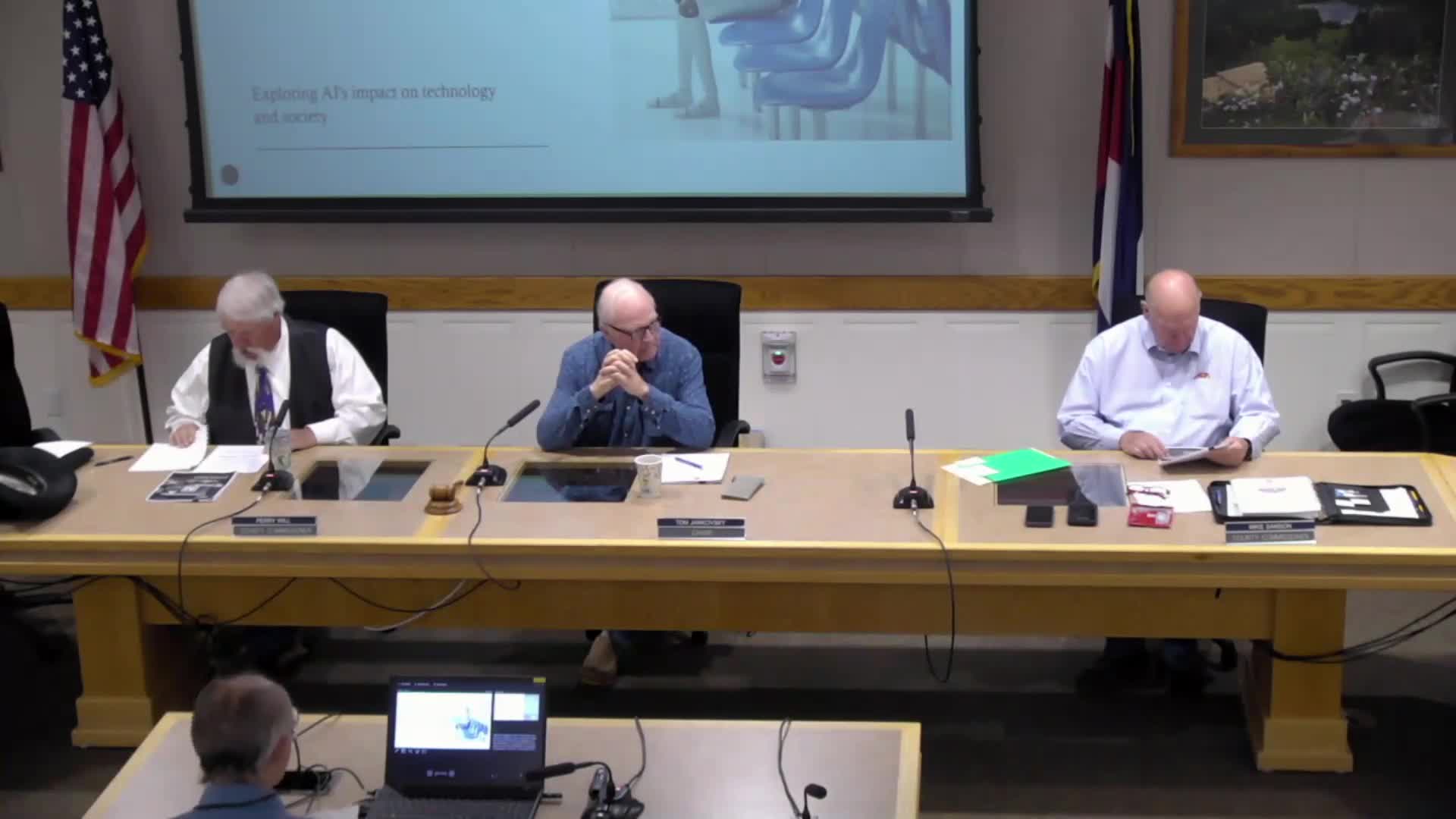
At a May 6 work session Garfield County staff reviewed uses, benefits and risks of artificial intelligence and commissioners asked staff to assemble a working group to inventory county AI use and draft a policy informed by legal requirements and national guidance.
At a May 6 Garfield County Board of Commissioners work session, county staff presented an overview of artificial intelligence and the board directed staff to convene a working group to inventory how employees use AI and to draft a county policy addressing risks such as privacy, bias and legal compliance.
The presentation, led by Gary (county staff), covered types of AI, common uses and potential county applications. Heather (legal staff) flagged state law and recent bills as a key constraint for county policy. Commissioners and other participants described current, informal uses inside county offices — including the sheriff's office, which uses AI to generate initial case-report drafts from body‑camera audio — and emphasized the need for guardrails before broader adoption.
Gary, a Garfield County staff member who led the presentation, said the session was an introduction and cautioned that the county was at “a toe in the water” stage. He described narrow AI (voice assistants, chatbots), machine learning and deep learning, and listed applications in government such as chatbots for public information, fraud detection, strategic planning and document summarization. “This will definitely not be a master class in AI. It's just, we'll just brush across the surface,” Gary said.
Heather, identified in the meeting as legal staff, told commissioners that Colorado’s recent legislation must inform any county policy. “Senate Bill 205 last year was the first in the country to regulate artificial intelligence. Colorado is the first state in the country to do it,” Heather said, noting there were subsequent bills that county staff were monitoring and that the statutory landscape could require specific limits — for example — where automated systems make eligibility decisions without human oversight.
Graham (staff member) described existing, informal uses inside county departments and warned that county employees may not fully know when software they use includes AI components. “We really don't know how all of the employees are using AI,” Graham said; he added that some widely used tools (for grammar checks, summaries and drafting) already embed language models. Commissioners and staff noted examples including Grammarly, vendor-embedded AI within purchased software and language models used experimentally for coding help and spreadsheet formulas.
Discussion participants raised benefits — efficiency for routine tasks, help with drafting and research, and potential customer‑service improvements — and risks, including privacy (training data and public‑records exposure), bias and job disruption. Participants said the sheriff's office uses AI to generate initial case-report drafts from body‑camera audio; staff said those drafts still require deputy review and editing.
Staff referenced resources from the National Association of Counties (NACo) and suggested drawing on county and national model policies. Heather and other staff said county policy development should include: an inventory of where AI is used, distinction between closed/internal models and public internet models, guidance about not inputting private data into free/public tools, transparency about AI‑sourced content, and legal review to ensure compliance with state requirements.
The board did not take a formal vote. Commissioners agreed — by consensus at the work session — to ask staff to form a working group, work with legal staff, review NACo and other models, and return with recommendations and a draft policy. Meeting participants did not set a firm deadline for the report back.
The meeting closed with commissioners reiterating that human review must remain central to decisions and that staff should prioritize an assessment of current uses before finalizing policy. The county staff members assigned to the follow-up are to inventory departmental AI use, identify high‑risk applications and draft recommended guidelines for commissioner consideration.