Get Full Government Meeting Transcripts, Videos, & Alerts Forever!
Get email alerts on the Public Safety Pay topic
No spam. Unsubscribe anytime.
Garfield County sheriff seeks $1.9 million to raise deputy pay, citing vacancies and overtime
Summary
The county sheriff and an outside consultant told commissioners April 8 that the sheriff's office is lagging regional pay, has persistent vacancies and high overtime, and needs a $1.9 million (optionally $2.135 million) increase to reach a market median and improve recruitment and retention.
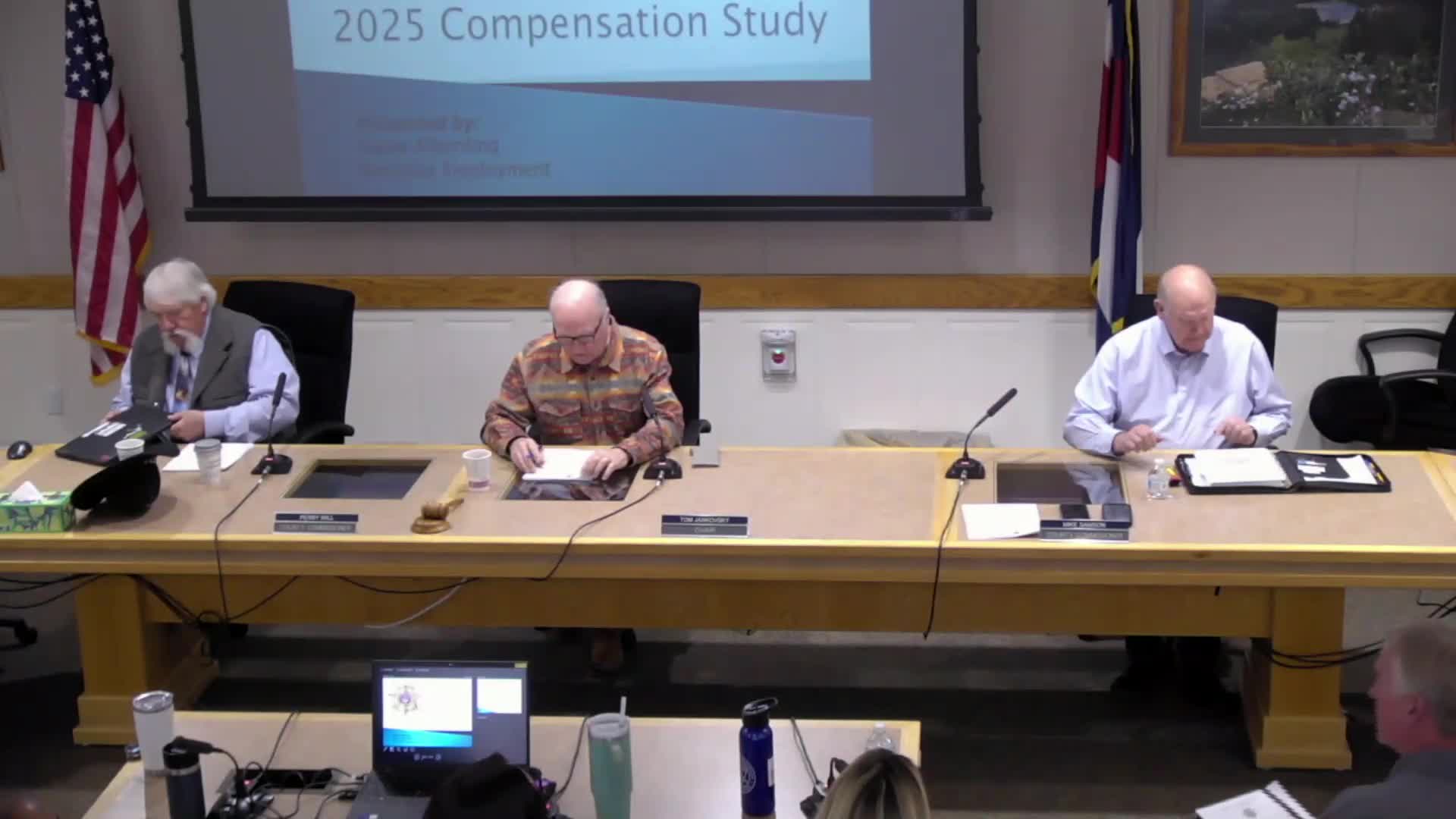
Sheriff Lou (Garfield County Sheriff) and an outside consultant presented a classification and compensation proposal to the Garfield County Board of County Commissioners on April 8, asking the board to approve a $1.9 million budget increase — with a higher option of $2.135 million — to raise pay for sworn and administrative staff and to backdate any approved adjustments to Jan. 1.
The proposal, prepared by Precision Employment and presented by Elaine Alberting of Precision Employment, recommended moving the sheriff's office toward a market median compa‑ratio to improve recruitment and retention. The study's authors and sheriff's staff told commissioners the office has persistent vacancies, high overtime costs and pay compression that together make it difficult to retain experienced officers and fill openings.
Garfield County sheriff's office officials said the department currently lists 16 vacancies, of which 6 are frozen, leaving roughly 10 active open positions; the office reported roughly $900,000 in overtime spending in 2024. The sheriff's office and consultant presented two budget scenarios: a baseline $1.9 million package intended to bring the office to the county's previously established midpoint and a larger $2.135 million “pretty please” request that would align the sheriff's office with the county's current midpoint if the board chose a faster catch‑up path.
"When my employees are making 2 to $4 less for the same job, I find myself in a position where not only am I struggling to fight other law enforcement agencies to retain deputies, but now I'm having to compete within Garfield County to keep our administrative staff," Sheriff Lou said while describing the internal equity and recruitment pressures.
Elaine Alberting, president of Precision Employment, described the study methodology: job‑matching by duties, knowledge, skills and abilities rather than title‑for‑title comparisons; a defined market of about 14 law enforcement agencies (including Eagle, Mesa, Montrose, Summit, Pitkin, Routt, Fremont and La Plata counties and several municipal police departments); and adjustments to entire salary ranges (minimum, midpoint and maximum) rather than single pay points. "It's not apples and apples. It's actually more like apples and oranges when we're doing the comparison over compensation," Alberting said, explaining why law enforcement classifications were analyzed separately from the county's administrative study completed in 2024.
Consultant and sheriff's office testimony listed a range of ripple effects tied to low pay: higher vacancy costs, increased overtime and workers' compensation exposure, and reduced community integration because some deputies live outside the county. The consultant said 11.5% of deputies cannot afford to live in Garfield County and noted the county's housing market is substantially more expensive than statewide and national averages.
Sheriff's staff estimated a first‑year cost to hire and train a replacement deputy at about $165,000 using 2023 cost data and argued a preventive pay adjustment may be less costly than repeated turnover and overtime. The presentation also described the department's legal and recruitment context: the loss of immunity protections for officers in recent state law changes has compressed the pool of candidates and increased perceived personal risk, a trend the consultant said contributed to a roughly 30% decline in available law enforcement candidates statewide during 2020–22.
The consultant recommended range adjustments by grade: increases ranging from roughly 7% to 15% at different pay grades for sworn ranks (for example, a 15% increase for deputy‑trainee in one bracket, 12% for deputy 1, 10% for deputy 2 and 15% for sergeants in the proposal), with smaller increases for some administrative positions. Staff said administrative adjustments would represent about $135,000 of the $1.9 million package, with the balance focused on sworn positions.
Garfield County human resources director Jessica Roberts (county HR director) told commissioners the county had completed a separate compensation review in 2024 for most county employees and that the county's administration had used that Evergreen study to move many administrative salary ranges earlier. Roberts said the county's administrative changes affected roughly 74% of county staff and that not every county employee received an increase when the county implemented its prior study. "Only 74% of our staff actually ended up receiving an increase," Roberts said, describing the county's implementation choices.
Commissioners and staff discussed implementation options including staggering increases, backdating pay adjustments, and funding the changes from vacancy savings. The sheriff's team asked that any approved change be retroactive to Jan. 1, 2025; the consultant also recommended budgeting an additional projected 4% ($603,000) for 2026 to continue closing the gap. The sheriff's office noted that between 2007 and the present it has returned $30.2 million in vacancy savings to the county general fund, and officials said that those vacancy savings partly offset the immediate budget impact of higher wages.
No formal action or vote was taken at the work session; commissioners asked for a smaller working meeting with administration, the sheriff and HR to review the market data and implementation options and return a refined recommendation to the full board. "We just need to find put something together. Calendars put together and sit and talk about it and get it on our schedule for further discussion," a commissioner said as the group set the next step.
The presentation also reviewed benefits and legal protections used by the sheriff's office: county coverage through the Colorado Counties Casualty & Property/Trust (CTSI) program for legal defense costs subject to self‑insured retention, and an optional supplemental legal plan the sheriff described as PORAC that provides counsel to deputies for a monthly per‑deputy premium; both were discussed as recruitment and retention tools but were not presented as substitutes for base pay.
Commissioners expressed support for taking action while noting fiscal constraints and the need to fit any pay adjustments into the county budget process. Several commissioners said they support improving pay to retain deputies but asked staff for more detailed market documentation, implementation scenarios and an analysis of how any changes would affect the county's 2025 and 2026 budgets. A smaller planning meeting of two commissioners, the sheriff, HR and administration was scheduled to refine the request before bringing a formal proposal back to the board.
Ending: The board took no formal vote; staff were directed to convene the suggested follow‑up meeting and prepare detailed budget and implementation options for commissioners to consider at a future public meeting.