Get Full Government Meeting Transcripts, Videos, & Alerts Forever!
Get email alerts on the Federal Budget topic
No spam. Unsubscribe anytime.
Federal reconciliation and rescission fights could cut Medicaid, SNAP and other programs; county lobbyists warn of local impacts
Summary
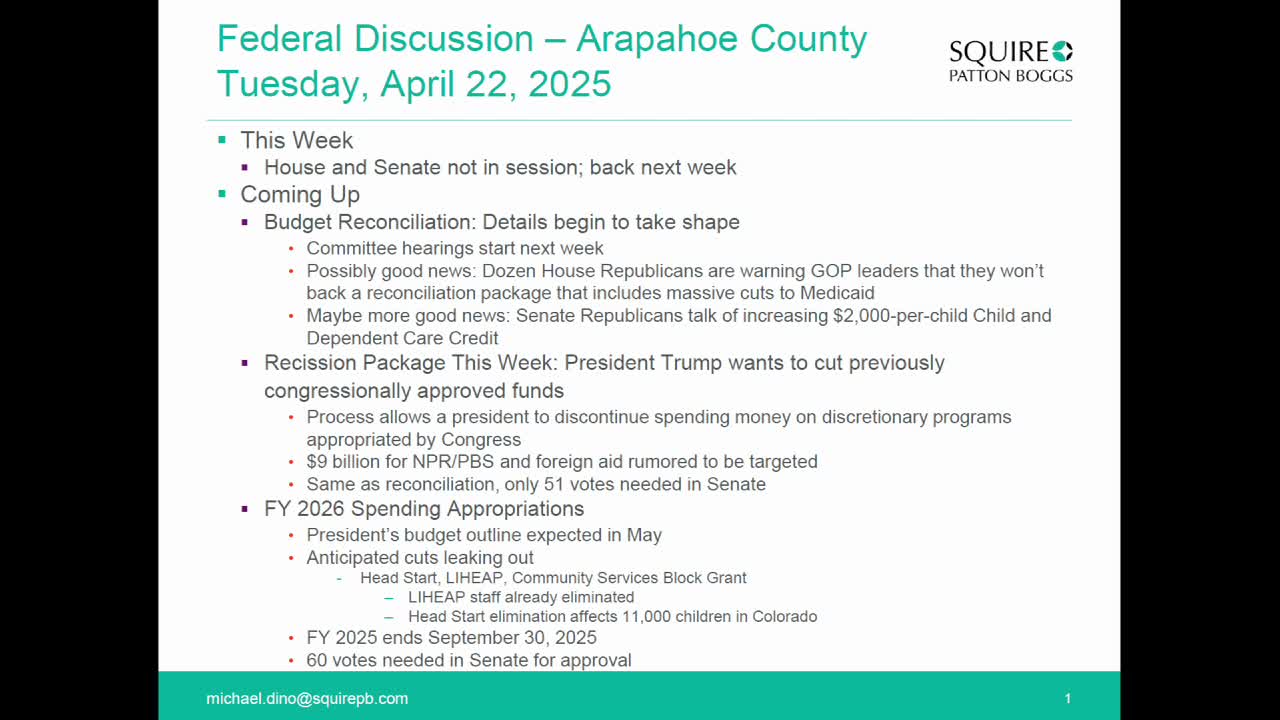
Arapahoe County’s federal lobbyists briefed commissioners on reconciliation and a possible rescission package, warning that proposed cuts to Medicaid, SNAP and other HHS programs could force states and counties to absorb service changes or funding shortfalls.
Arapahoe County’s federal lobbyists updated commissioners on multiple federal‑level threats that could materially affect county services, including budget reconciliation, a possible rescission package and FY2026 appropriations signals that include proposed reductions to several Department of Health and Human Services programs.
Lobbyists from Squire Patton Boggs told the board reconciliation — a budget vehicle that can bypass the Senate filibuster — is being actively negotiated and could move quickly. Committees set to consider major pieces of a reconciliation package include Energy and Commerce (Medicaid), Ways and Means (tax components) and Agriculture (SNAP). The county’s lobbyists identified two major risks: (1) reconciliation language that reduces federal Medicaid matching (for example by constraining how states use hospital provider fees to draw federal match); and (2) SNAP and other nutrition programs being targeted for cuts that would materially increase local food‑security needs.
Lobbyists also briefed the board on a rescission request from the White House that would seek to pull previously appropriated funds from federal accounts. While the rescission total discussed at the time was modest relative to the federal budget, lobbyists said rescission and reconciliation together signal a higher probability of HHS reductions and programmatic changes that would affect local service delivery.
Arapahoe County commissioners and staff asked how quickly cuts could take effect. Lobbyists said some reconciliation actions could be enacted immediately after a president signs them; appropriations for FY2026 would be a separate, later fight and could be constrained by filibuster rules in the Senate. County lobbyists recommended county leaders press U.S. House and Senate members for protections to ensure local programs are not forced to perform with sharply reduced federal funding and to monitor committee calendars (Energy & Commerce, Agriculture and Ways & Means) closely.