Get Full Government Meeting Transcripts, Videos, & Alerts Forever!
Get email alerts on the Housing Needs Assessment topic
No spam. Unsubscribe anytime.
Arapahoe County to use regional housing needs assessment; deadline set for Dec. 30, 2026
Summary
County staff recommended using the regional housing needs assessment prepared by DRCOG (referred to in the meeting as Doctor Cog) rather than commissioning a separate local study; the regional report is conditionally approved by the state and county staff will open a July–September public comment period before final submission.
Arapahoe County staff told commissioners they plan to rely on the regional housing needs assessment prepared by the Denver Regional Council of Governments (DRCOG) to satisfy a state requirement in Senate Bill 24‑174 that jurisdictions complete a local housing needs assessment by Dec. 30, 2026.
Staff said the state guidance on the required assessment arrived recently and that the county’s existing HUD consolidated‑plan work and an earlier market value analysis cover much of the requested data but do not fully match the state template. County staff estimated a standalone local assessment would cost roughly $30,000 and take additional consultant time. Instead, staff recommended “tagging on” to DRCOG’s regional assessment; DRCOG has submitted the regional report to the state and it is conditionally approved pending a public‑comment period.
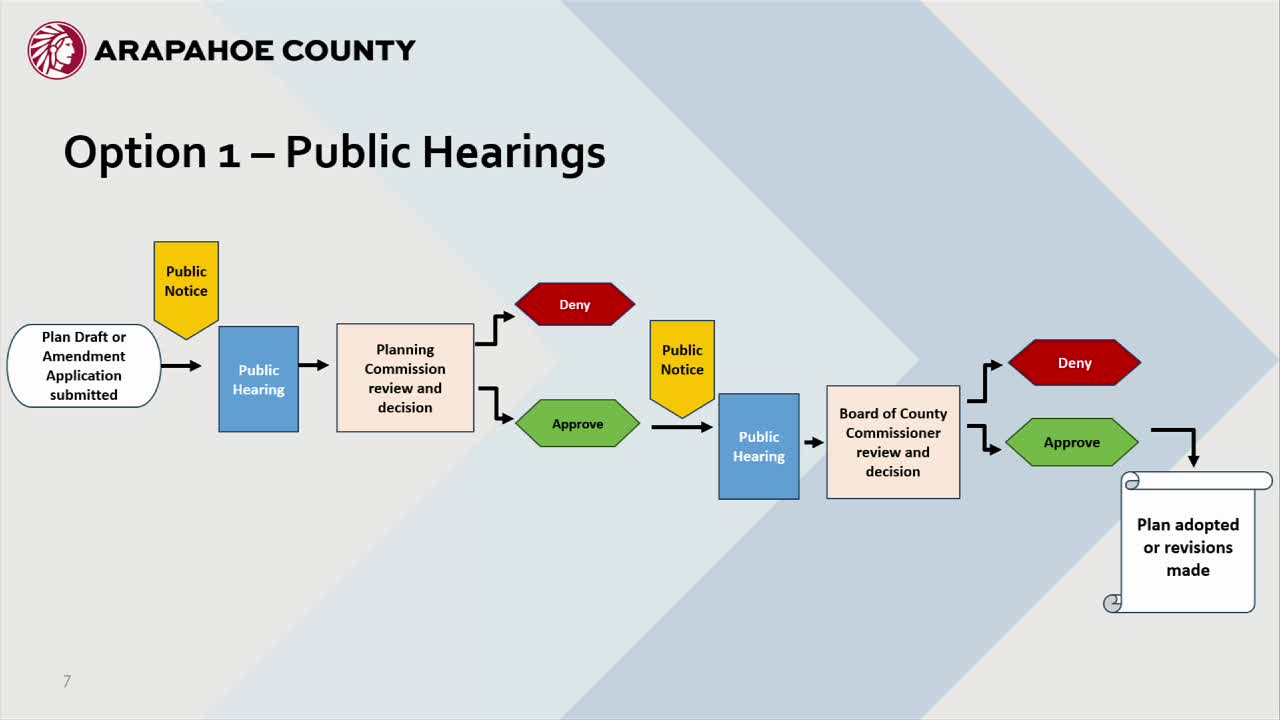
Under staff’s recommendation the county would open a local public‑comment period between July and September, present the regional assessment to the Board in July and then submit the county’s housing needs assessment to the state before the December 30, 2026 deadline. Staff also noted a separate housing action plan will be required by Dec. 30, 2027; the action plan will prescribe land‑use and code changes and will require input from Public Works and Community Resources.
Commissioners at the session expressed support for using the DRCOG regional assessment as the most efficient approach for the county, and several commissioners asked county staff to engage local housing authorities and developers in subsequent work on incentives and gap funding for specific housing types such as senior housing and affordable rental units. Staff said community resources and public works will coordinate outreach to developers and housing authorities, and that HUD funding, private activity bonds and other gap‑funding tools could be deployed to incentivize development that addresses identified needs.
Staff said the consolidated plan and HUD submission timelines also constrain the schedule: the county will submit HUD materials in August and will incorporate updated inventory and demand data as available. Staff will present the regional assessment to the Board in July, open the county’s public comment window, and return with a plan for next steps on the 2027 housing action plan.