Get Full Government Meeting Transcripts, Videos, & Alerts Forever!
Get email alerts on the Road Maintenance And Cip topic
No spam. Unsubscribe anytime.
Public Works warns pavement backlog and staffing gap will worsen without new funding
Summary
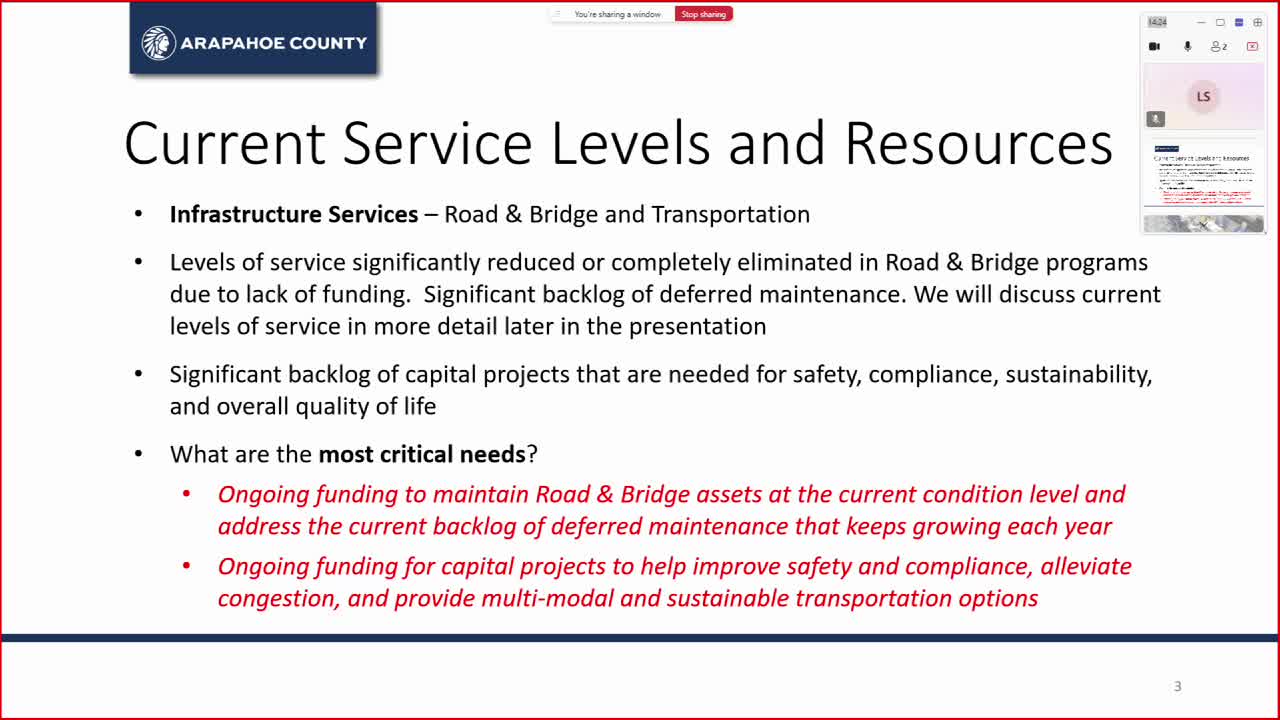
Public Works presented pavement condition data showing that 40% of county lanes are in poor or very poor condition and said existing funding and staffing levels are insufficient to maintain the network, proposing multi‑year capital and ongoing maintenance funding.
Arapahoe County Public Works presented commissioners with a stark view of maintenance needs Thursday, saying that pavement conditions, staffing vacancies and rising construction costs have created an unsustainable maintenance gap.
Director Brian Lamer said the county’s pavement condition index (PCI) sits around 65 out of 100, with about 40% of the county’s road network rated poor or very poor — well above the county’s target of 15 percent. “With our current funding, we are not able to maintain what we have,” Lamer said, noting surface‑treatment cycles and concrete replacement schedules are lengthening as available funds fall short of need.
Staff described lane‑mile years as the accounting metric for pavement life: the county needs to add the equivalent of about 1,200 lane‑mile years annually to hold the system steady but last year completed work equal to roughly 509 lane‑mile years. Staff showed examples of rapid price increases in contracting: a milling contract that cost roughly $272,000 in early 2024 returned low bids near $800,000 in early 2025.
Public Works said the department is short roughly 13–14 field FTEs (about 30% of field positions), forcing reductions in routine services including community street sweeping, eastern patching crews and gravel‑to‑pavement programs. Director Lamer said earlier vacancies numbered six in 2024, rising to 14 the following spring — a turnover driven in part by market wage pressures in construction trades.
On capital funding, staff laid out a proposed five‑year capital allocation (fund 42) of about $77 million to support projects and leverage nearly $157 million in total project value; staff pointed to major projects such as the Quincy‑Gun Club intersection and ILIFF corridor work as examples requiring multi‑year banked funding. The department noted statutory limits on road funding: HUTF and specific ownership taxes are volatile, and the county must share some property‑tax funded road levies with municipalities.
Public Works recommended a multi‑pronged approach: identify sustainable revenue or fee options to steady maintenance funding, consider partnership and development‑driven maintenance mechanisms, and invest in staff recruitment and pay options to close field vacancies. Commissioners asked for a map‑based briefing showing service footprints, assets and population access, and asked staff to model what different funding levels ($3M, $10M, $20M per year) would accomplish.
Ending: Public Works said it will provide detailed asset‑level condition information, funding scenarios and workforce plans for the board to consider as part of the 2026 CIP and budgeting cycle.