Get Full Government Meeting Transcripts, Videos, & Alerts Forever!
Get email alerts on the Land Use Site Plan Review topic
No spam. Unsubscribe anytime.
Boulder County commissioners approve site-plan review limits, set moratorium to end May 13
Summary
Boulder County commissioners voted April 22 to approve text amendments to the county Land Use Code that replace a 125% presumptive compatible size standard with a median‑based structure size limit, with a sliding allotment and several narrow exemptions, and set the temporary moratorium to expire May 13, 2025.
Boulder County commissioners voted April 22 to approve text amendments to the county Land Use Code (docket DC‑24‑0003) that replace the current 125% presumptive compatible size standard used in site plan review with a limit based on the median residential floor area of a defined neighborhood. The board amended staff’s draft on the dais to reduce one middle-tier allotment and directed the temporary moratorium tied to the rulemaking to end on May 13, 2025.
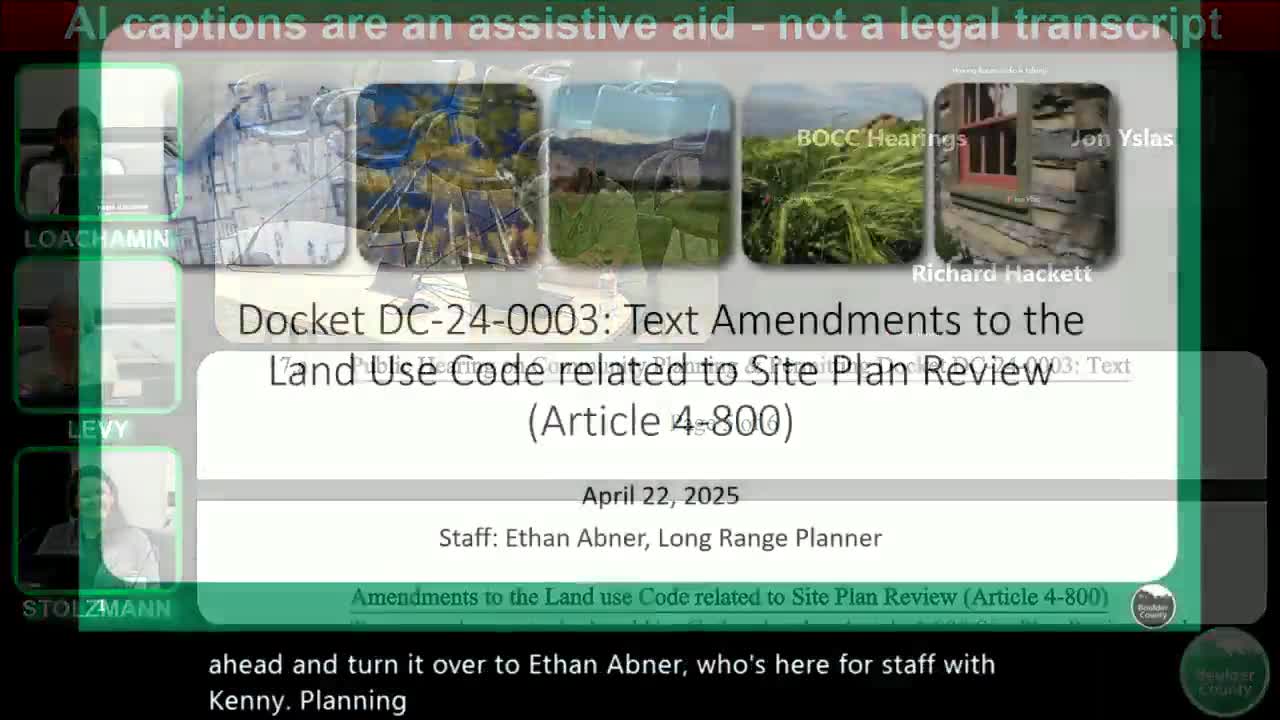
The docket drew a long staff presentation and three hours of public comment. Ethan Abner, long-range planner with Community Planning and Permitting, summarized staff’s findings: “Staff recommend that the Board of County commissioners approve[d] docket DC‑24‑0003 text amendments to the land use code related to site plan review Article 4‑800.” He told the board the county’s building‑permit data show new homes in the unincorporated county have grown well above national averages and that about 91% of applications seeking to exceed the existing size presumption were approved.
County staff framed the changes as a tool to preserve neighborhood character, reduce embodied and operational carbon from very large new homes, and create clearer, more predictable rules for applicants and neighbors. The proposal replaces a presumption that allowed houses up to 125% of a neighborhood median with a structure size limit equal to the neighborhood median, plus a sliding allotment for parcels that currently have smaller houses. Staff also proposed several narrow exemptions (historic structures, certain conservation easements, energy‑efficiency retrofits and limited allowances for low‑carbon building systems).
The hearing drew a long and divided public record. Architects, builders and some residents argued the change would be a de facto taking or a market distortion that raises prices on larger homes and harms trades and small companies that depend on remodel and construction work. Scott Rodwin, representing several professional groups including the American Institute of Architects of Colorado and local trade organizations, urged the board to stop the moratorium and reject the staff proposal, saying, “I ask and encourage commissioners to stop the moratorium immediately.” Other speakers, including residents, climate advocates and local housing advocates, backed staff and the change as a way to protect rural neighborhood character and reduce construction emissions.
Commissioners debated several refinements. Members asked staff to clarify how the new median is calculated, whether subdivision parcels should be included in neighborhood medians, and how the rules treat deconstruction and rebuilds. The board translated one public suggestion into a single change on the dais: the approved motion replaced staff’s draft cap of 4,500 square feet in one tier of the sliding allotment with 3,500 square feet (the board’s amendment reduced the top end of that middle tier). The board’s adoption also specified that the temporary moratorium tied to the drafting process will expire when the new code becomes effective on May 13, 2025.
In voting, the board approved the amended text amendment and separately approved rescinding the temporary moratorium concurrent with the code’s effective date. The land-use changes move the primary measurement for site plan review to a neighborhood median, keep limited allotments for smaller existing homes, narrow the factors that allow an applicant to exceed a size limit, and leave appeals and variance authority with the Board of Adjustment and the commissioners per existing code provisions.
What’s next: staff must update application materials, the county’s neighborhood‑median calculator and internal processes so the new standard can be implemented when the code takes effect May 13. The county also signaled continued work on accessory dwelling unit (ADU) policies, wildfire mitigation and other housing measures in separate workstreams.
Provenance: topicintro — "Good afternoon commissioners, members of the public. My name is Ethan Abner. I am a long range planner in Boulder County community planning and permitting." topicfinish — "All in favor. Aye. Aye. Opposition? No."