Get Full Government Meeting Transcripts, Videos, & Alerts Forever!
Get email alerts on the Police Juvenile Practices topic
No spam. Unsubscribe anytime.
Baltimore Police says homicides, nonfatal shootings are down; details youth‑specific policing changes
Summary
BPD presented year‑to‑date reductions in homicides and nonfatal shootings and outlined reforms for juvenile referrals, centralized booking, and new youth engagement programs during the Public Safety Committee hearing.
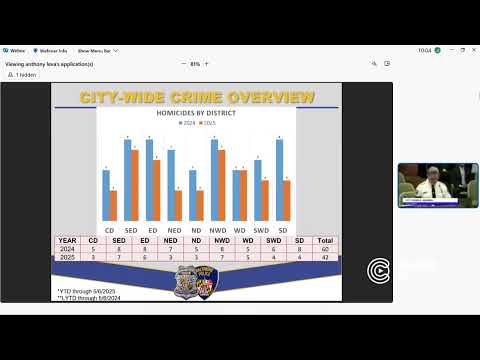
The Baltimore Police Department told the Public Safety Committee on May 12 that citywide homicides and nonfatal shootings were down year‑to‑date and that the department has restructured juvenile processes to improve data sharing and case handling.
Commissioner Rich Whirley, speaking for the Baltimore Police Department, said, “As of today our homicides are down 27% compared to last year” and that nonfatal shootings are down about 25% year‑to‑date; he also highlighted improved clearance rates for violent crimes. Whirley credited interagency cooperation — naming the Department of Juvenile Services, the State’s Attorney’s Office and federal partners — for those outcomes.
BPD leaders described youth‑specific operational changes: a centralized juvenile booking workflow to send all paper referrals and detention requests through booking officers; an appeals pathway to the regional DJS director or the State’s Attorney’s Office when police disagree with a DJS disposition; and weekly case meetings with DJS to review a small group of “youth of concern.”
“We now meet with DJS weekly surrounding those cases,” Chief of Youth and Community Partnerships Lisa Reynolds said, describing how the department and DJS exchange intake decisions so district officers know whether a youth was detained, diverted, or referred for pre‑court supervision. Reynolds added the department has better real‑time warrant notifications from the State’s Attorney’s Office.
BPD also discussed community engagement efforts designed to reduce juvenile victimization and offending: a youth advisory board framed in the police consent decree, a junior cadet program that has grown to 62 participants across the nine police districts, and partnerships with organizations such as the Cal Ripken Sr. Foundation and Project Numa to provide sports, mentoring and contact with trainees.
District action teams and detective units, Reynolds and other BPD officers said, are focusing on early pattern recognition of recurring juvenile offenders; detectives reported that only a small cohort of roughly 10–50 youths account for much of the repeat offending, and citywide robbery patterns had been identified and closed in recent weeks.
What officials said they will do next: BPD said it will continue centralized juvenile booking and maintain weekly intelligence meetings with DJS; the department also plans to present a built youth advisory board proposal to the monitoring team and the Department of Justice by the start of the school year.