Get Full Government Meeting Transcripts, Videos, & Alerts Forever!
Get email alerts on the Stormwater Drainage topic
No spam. Unsubscribe anytime.
Palm Coast residential drainage committee reports 74 complaints, recommends targeted code enforcement and donation program
Summary
City staff and the Residential Drainage Citizens Advisory Committee told the City Council they visited 74 homes with reported infill‑lot drainage problems, recommended working with code enforcement, and proposed repeating a soil donation program that provided about 270 cubic yards of material to 79 residents.
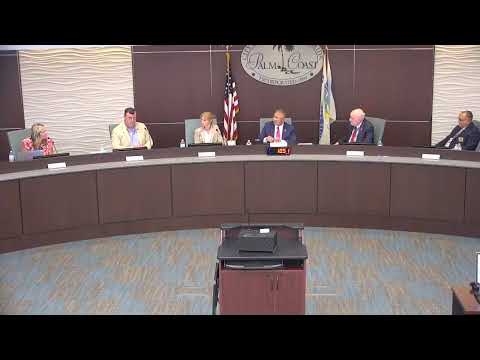
Residential drainage issues tied to infill construction were the focus of a presentation to the Palm Coast City Council at a workshop meeting. Lynn Stevens, deputy director of Stormwater and Engineering, and members of the Residential Drainage Citizens Advisory Committee reported staff visited every case logged and described inspection findings, causes and next steps.
The committee and staff said the problem surfaced after an influx of resident complaints beginning in October 2023. Stevens told council that “from October 2023 to February 2024, 74 cases were logged as infill lot issues” and that every site had been visited by two‑person inspection teams. The city reviewed drainage plans, permit histories and on‑site conditions and placed each case into categories including standing water, finished‑floor elevation questions and water entering structures.
Why it matters: committee members and staff told council the drainage concerns reflect a legacy of pre‑city development practices and more recent infill building next to older homes where lot grading and removed vegetation changed how water disperses. The committee emphasized options to reduce standing water for affected homeowners and recommended stronger collaboration with code enforcement to identify and resolve water flowing onto adjacent lots.
Key details: Stevens reviewed technical changes adopted in February 2024 intended to limit finished‑floor elevations and align new lot grading with existing homes. She said the finished floor can be no more than 10 inches higher than the lowest adjacent home on the left or right side and not more than 22 inches above the road crown unless authorized by the city engineer. Tony Amaral Jr., committee member, and others outlined causes documented in inspections: removal of trees and vegetated lots that previously absorbed runoff, compaction of soils, berms or obstructions in swales and replaced conveyance paths.
The committee described a DIRTT donation program that supplied about 270 cubic yards of soil or fill to 79 residents and suggested the city consider running the donation again to help alleviate standing‑water areas. Amaral said the committee had arranged for Stevenson Wilcox & Associates to provide 30 free property drainage surveys for the 30 most affected houses and reported that 28 of those surveys were complete.
Discussion versus decision: council asked whether the proposed culvert policy would address these backyard issues; staff and the committee replied that culvert inspection policy “will do nothing for the water issues in people’s yards from adjacent properties” and is separate from residential infill drainage work. Council and staff agreed the next steps are continued committee work, cooperation with code enforcement on fencing and easement questions, and to continue inspections and homeowner education. Stevens said the committee sunsets in February 2026 unless the council provides otherwise.
What’s next: committee members said they will move to monthly meetings and work with code enforcement to develop guidance on when enforcement should occur and how to address fences or obstructions in drainage easements. Councilmembers thanked the volunteers and asked staff to continue updates to the dais.