Get Full Government Meeting Transcripts, Videos, & Alerts Forever!
Get email alerts on the Law Enforcement Personnel Files topic
No spam. Unsubscribe anytime.
Committee approves substitute for bill standardizing law-enforcement personnel-file practices
Summary
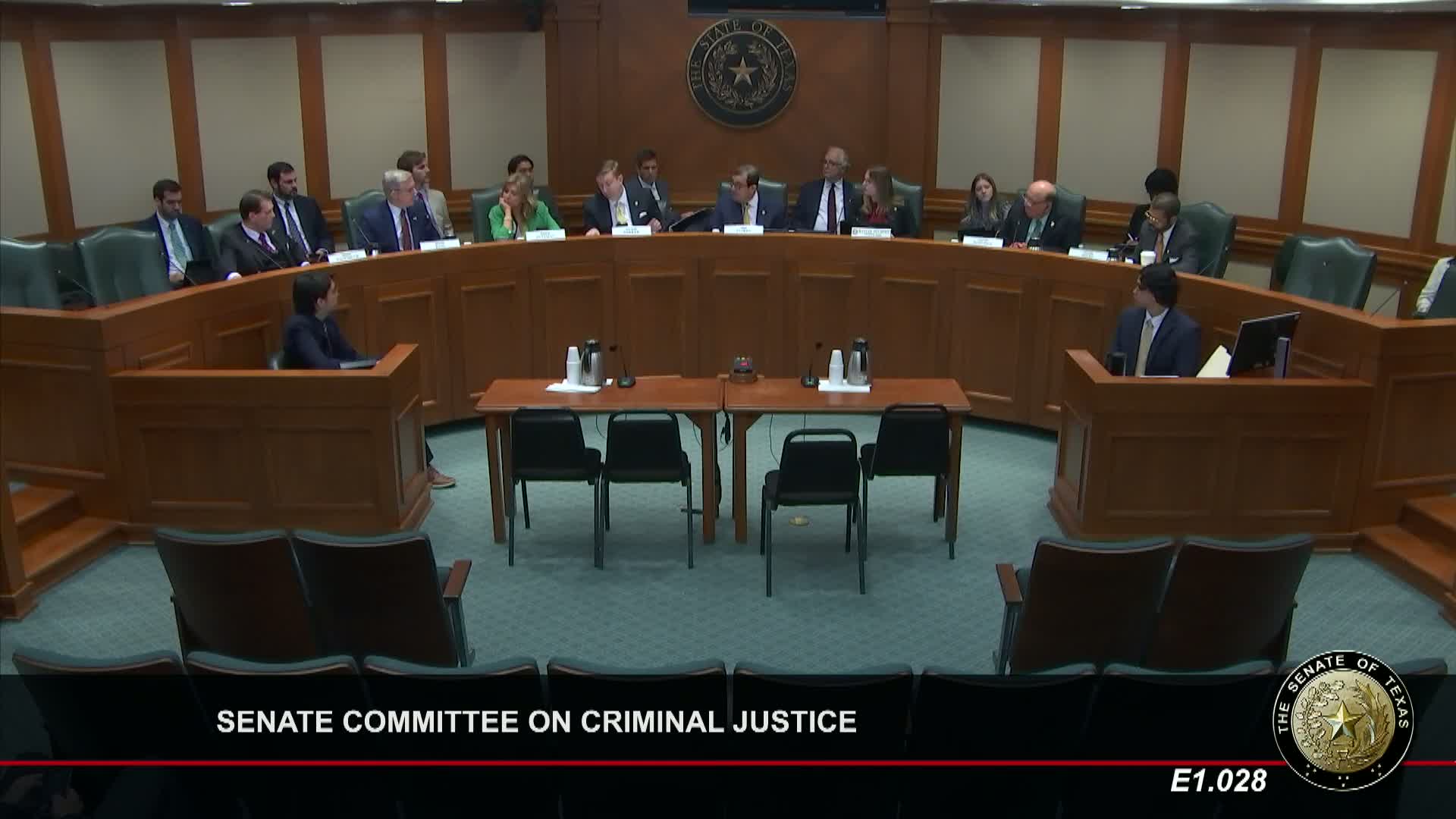
The Senate Committee on Criminal Justice adopted a committee substitute and voted 6–1 to report Senate Bill 781, a measure to standardize handling of law-enforcement personnel records based on a TCOLE model policy and to align practices across jurisdictions, with clarifications about sealed files and criminal discovery.
The Senate Committee on Criminal Justice voted 6–1 to adopt a committee substitute to Senate Bill 781 and report it to the full Senate with a favorable recommendation. Senator King described the measure as an effort to make personnel-file policies consistent across Texas and to codify a model policy developed by a Texas Commission on Law Enforcement (TCOLE) work group.
Why it matters: The substitute aims to create consistent procedures for what information is public and what is held in a sealed personnel file for law-enforcement officers, affecting public records requests, hiring background checks, and discoverability in criminal proceedings.
Senator King told the committee the TCOLE work group produced a model policy that is already voluntarily in effect for governing files for more than 20,000 officers in Texas and that cities subject to state civil-service law already follow similar rules. Under the approach King described, agencies maintain two personnel files in practice: a public file containing information available to the public and a sealed file containing background or exonerated-allegation materials that are not released in routine public-records responses. King said that sealed or investigative materials remain discoverable when relevant to criminal discovery: “if it is in a criminal court, those files would be available through the defense,” he said.
Senator Miles said he would not support the bill because sealed files can keep information about prior allegations from the public and jurors; he said he was concerned about the effect on assessing an officer's propensity and past conduct. King and other supporters said agencies already have mechanisms for interagency review: applying agencies can request full personnel records when screening candidates, and prior legislation requires agencies to consider a candidate’s file when transferring officers across departments. King described the substitute as an attempt to standardize what is public and what is private while preserving discoverability in criminal cases.
The committee first discussed that a related House bill failed on a point of order; supporters said they were advancing the Senate bill to preserve the policy work. The roll call on the committee substitute produced six ayes and one nay; the substitute for SB 781 will be transmitted to the Senate floor for further consideration.