Get Full Government Meeting Transcripts, Videos, & Alerts Forever!
Get email alerts on the Bullion Depository Digital Currency topic
No spam. Unsubscribe anytime.
Committee grills depository plan for gold-and-silver debit card as stakeholders raise security, fiscal, and regulatory concerns
Summary
House Bill 10,56 would let Texans use gold and silver held in the Texas Bullion Depository as legal tender and create a state-run digital payment mechanism; witnesses split across industry, banks, and legal experts, and the comptroller described significant operational questions and a rising fiscal estimate.
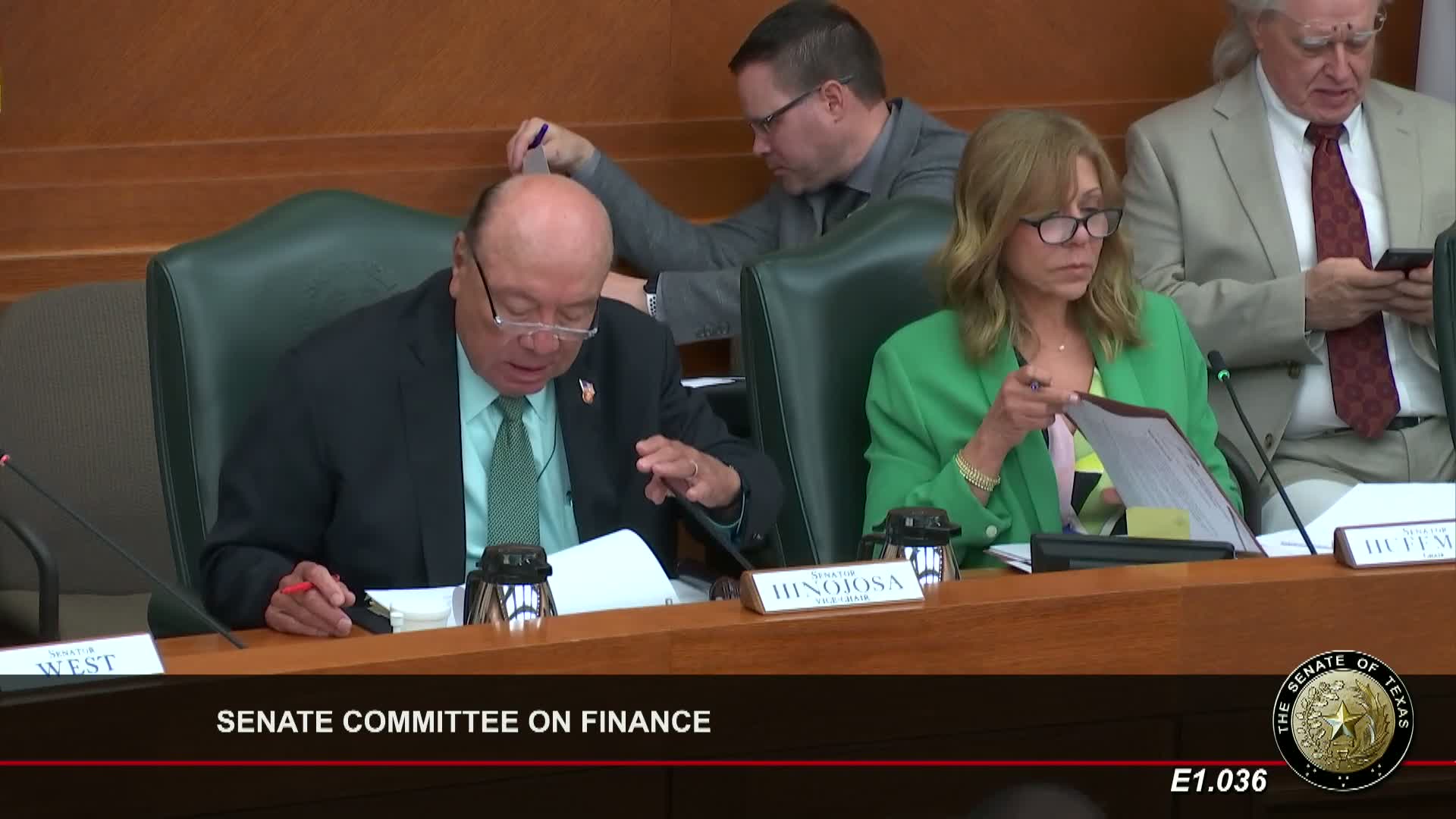
The Senate Finance Committee held an extended hearing Wednesday on House Bill 10,56, a measure to enable gold and silver held in the Texas Bullion Depository to function as legal tender and to permit transactions via a state-run or contractor-run digital payment mechanism.
Senator Bryan Hughes, the bill’s sponsor in the Senate, said the measure would allow Texans to deposit physical gold and silver in the state depository or buy bullion-backed digital currency and use a debit card for ordinary purchases. “Based on the existence of the Texas bullion depository…this would be run by the state of Texas,” Hughes said.
Comptroller staff and the depository administrator described operational and fiscal issues. Macy Douglas, administrator of the Texas Bullion Depository, said the state facility currently holds more than $380 million in metals on deposit and that most customer deliveries are shipped to the Leander facility; she cautioned that the program as written requires further market research and vendor work. Victoria North of the Comptroller’s Office told senators the draft limits administrative fees to the “industry standard merchant fee,” which her office said could constrain revenue recovery and prompted the comptroller’s office to raise its fiscal estimate. The comptroller’s office provided a revised fiscal estimate during questioning that included millions in vendor and IT costs for initial implementation; witnesses described a revised first-year estimate in the low‑ to mid‑tens of millions (committee staff cited a revised estimate of roughly $27 million in the hearing).
Several bankers and credit-union witnesses opposed the bill or urged major changes, citing consumer-protection gaps and uncertainty about how existing federal banking and electronic-funds protections (Regulation E, Electronic Funds Transfer Act) and deposit-insurance frameworks would apply to bullion-backed digital currency. “House Bill 10 56 is silent on all of those provisions,” Celeste Embree, general counsel for the Texas Bankers Association, told the committee.
Proponents, including private-sector vendors and constitutional legal experts, argued the state has authority under the U.S. Constitution for states to make gold and silver legal tender and said technology exists to manage transactions. Ari Kunan, a former Texas solicitor-general attorney now in private practice, told the committee he believes the legislation tracks Constitutional text and existing Supreme Court precedent on state use of specie.
Members asked detailed operational questions about definitions in the bill, including the term “specie” and whether the measure contemplates coinage or only bullion-backed digital units. Macy Douglas said the bill’s language could be interpreted to permit coins (specie) and that the depository currently supports segregated storage for depositors but that the bill contemplates pooled storage to back transactional units. Senators also asked how merchants would be paid, whether a federal capital-gains issue would arise when people use bullion for purchases, and whether the program should be vendor-operated or run through an array of regulated Texas banks and credit unions.
Credit-union and banking representatives asked that state-chartered financial institutions be considered as partners and that the bill clarify consumer protection, anti-money-laundering, and settlement requirements. Resource witnesses and several stakeholders urged more market research and clearer statutory definitions before moving forward. The committee closed public testimony and left the bill pending.