Get Full Government Meeting Transcripts, Videos, & Alerts Forever!
Get email alerts on the Transportation High Speed Rail topic
No spam. Unsubscribe anytime.
Senate committee reports bill requiring annual disclosures from private high‑speed rail proposers
Summary
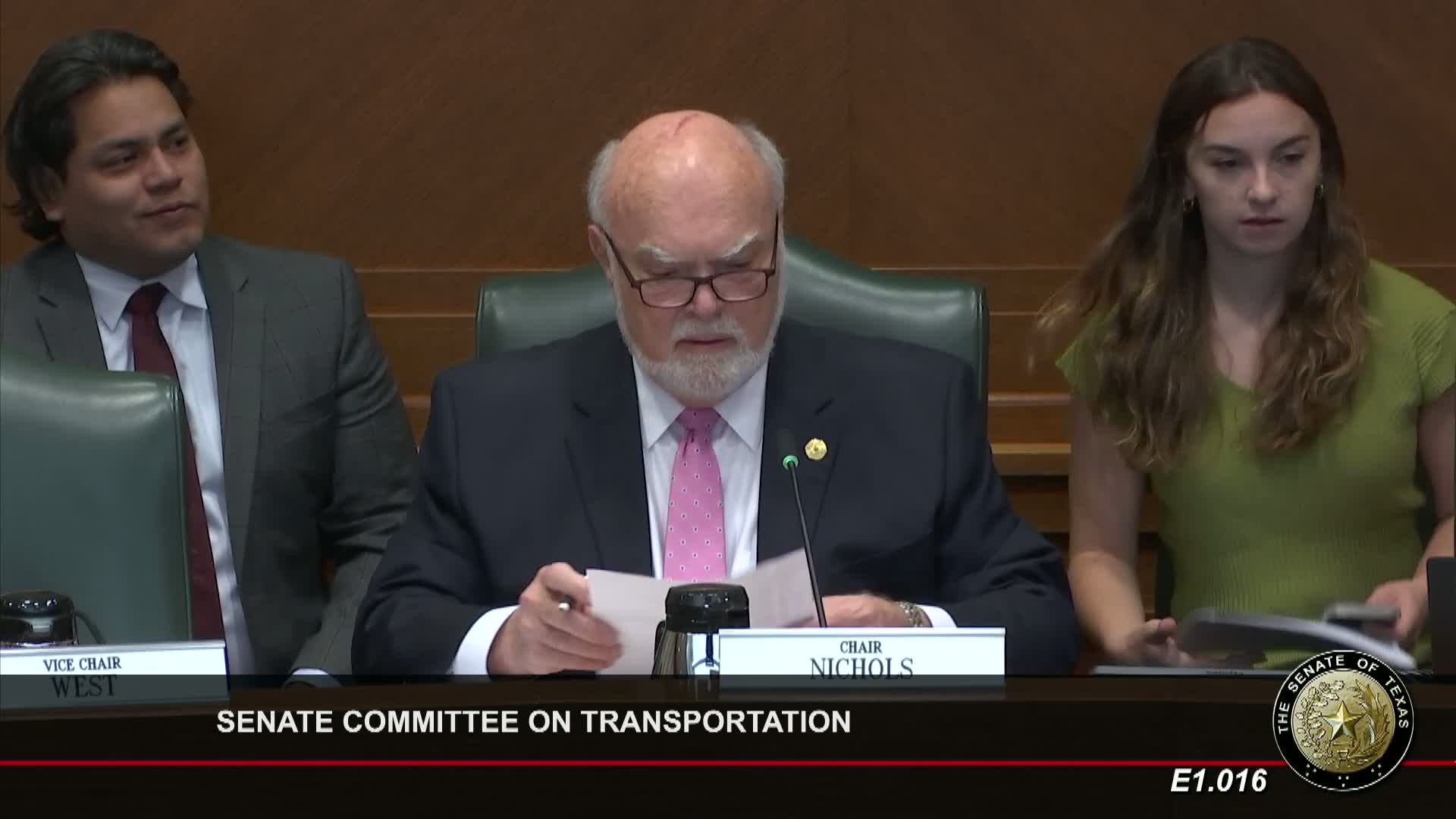
The Senate Committee on Transportation voted to report House Bill 2003, which would require the responsible party for projects listed in the Texas Rail Plan to submit annual disclosures to TxDOT on financing, schedule, route, ridership and organizational information.
The Senate Committee on Transportation voted to report House Bill 2003, which would require the responsible party for any project included in the Texas Rail Plan to submit an annual package of information to the Texas Department of Transportation explaining financial status, financing methods, full project cost, timelines for permitting/funding/land acquisition, the proposed route and ridership projections.
Supporters said the requirement is intended to give landowners and public officials basic, up‑to‑date information about projects that can affect private property and local planning. “An annual update to TxDOT with basic information is not too much to ask of a private HSR company that has the power of the state to take our private property,” Desi Burns Porter, executive director of Texans Against HSR, told the committee during public testimony.
Opponents raised privacy and competitive concerns, saying small or proprietary negotiations could be harmed if detailed financial documents are posted publicly. “This information from a private company with no ties to state funding would then be published on the TxDOT website for everybody to see,” Peter Lacotte, president of Texas Rail Advocates, said in opposition, adding that forcing disclosure could set a precedent for other private projects.
Committee discussion also addressed the distinct legal posture of private high‑speed rail proponents who have, in some instances, obtained eminent domain authority through litigation or permitting. Witnesses and senators noted prior Texas Supreme Court rulings and an old statute referenced during the hearing that factors into when a private rail company may exercise eminent domain. Committee members also debated whether the presence of eminent domain authority justified the requested disclosures.
The bill text, as presented, would require TxDOT to post the submitted items on its website and would include an organizational disclosure requirement for proposed management and any planned foreign investment. Proponents said the change responds to years of inconsistent communications from developers and to landowners who said they were left with uncertainty about whether and when projects would proceed.
After public testimony and committee discussion, the committee reported the bill favorably to the full Senate. The clerk recorded a committee tally of 5 ayes and 3 nays; the bill was reported with the recommendation that it be passed and printed.
The measure will go next to the Senate calendar for possible floor action.