Get Full Government Meeting Transcripts, Videos, & Alerts Forever!
Get email alerts on the State Budget topic
No spam. Unsubscribe anytime.
Subcommittee briefed on phase 3 work sessions, timelines and procedural rules for agency budgets
Summary
Legislative Fiscal Office staff told the Public Safety subcommittee on May 14 that phase 3 work sessions will focus on 14 primary agency budget measures and one fee measure, with strict posting and amendment deadlines and a tentative sine die target of June 5, 2025.
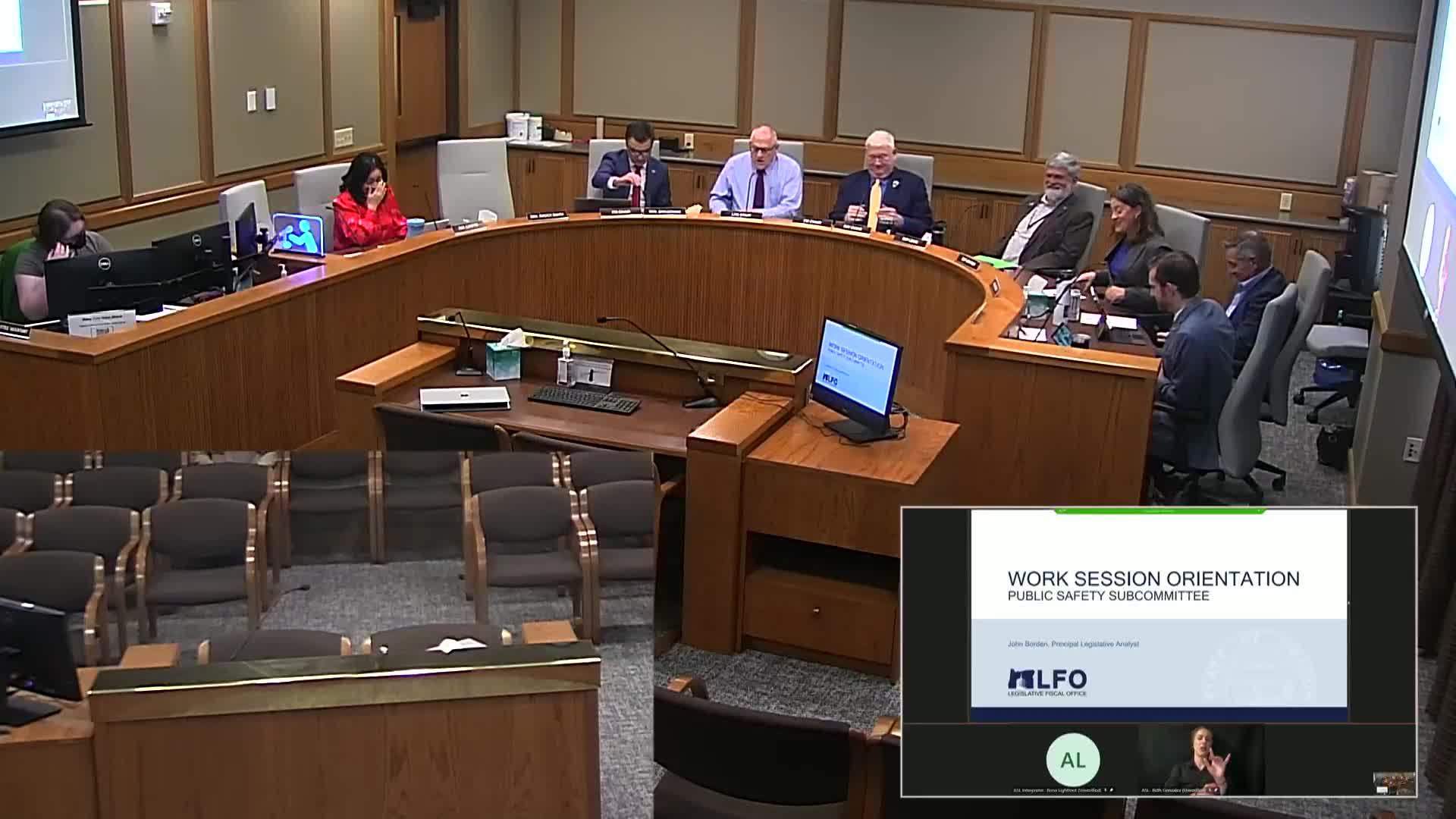
The Public Safety subcommittee received an orientation Wednesday on phase 3 work-session procedures, timelines and documentation requirements as it prepares to consider 14 primary agency budget measures and one fee measure.
The briefing, delivered by a Legislative Fiscal Office presenter, explained that work-session agendas will be posted 48 hours in advance, that LFO recommendations will be posted to OLISS about 24 hours before sessions, and that amendments must be posted at least four hours before a work session. The presenter said the subcommittee’s current target sine die for all subcommittees is tentatively Thursday, June 5, 2025, though that date may shift.
The orientation matters because these primary budget measures set appropriation limits and guide agencies’ spending authority for the coming biennium. The Legislative Fiscal Office presenter told the subcommittee the legislature has a constitutional obligation to produce a balanced state budget and described how the primary budget measures are structured, how they relate to the governor’s budget and which changes can be made administratively.
LFO staff explained that the measures the subcommittee will consider are the 5,000-series budget bills; they carry an emergency clause, are effective on passage but not operative until July 1, 2025, and are enacted under Oregon law so their authority expires at the end of the biennium. Capital construction, bonding and other capital activities are handled separately by the capital construction subcommittee and are not included in these primary budget measures.
Work sessions will include LFO recommendations, proposed budget amendments, budget notes and key performance measures (KPMs). The presenter said LFO work-session memoranda and reports will show columns for actuals, the legislatively approved budget, current service level and the LFO recommendation to make comparisons transparent. He also noted that proposed amendments will reflect the LFO recommendation and that each of the subcommittee’s measures is expected to have at least one amendment.
Committee members pressed for clarification about administrative modifications and what the presenter called “non-limited funds.” The presenter said certain adjustments — for example unemployment payments, PERS benefit payments and position reclassifications — may be handled administratively but are coordinated through the Department of Administrative Services and require documentation and review by DAS.
On performance measures, LFO staff said the subcommittee will act on agency KPMs and targets for 2026–27 and warned that KPMs should be durable and well considered, ideally crafted during the interim rather than on the fly during the session. Budget notes, the presenter said, are instructions placed in budget reports under the authority of joint Ways and Means rule number 9 and are limited in scope and duration; they expire at the end of the biennium and are not a substitute for policy legislation.
The presenter provided a brief summary of phase 1 and phase 2 activity to date: 55 subcommittee meetings totaling about 83 hours, 42 informational hearings, 15 public hearings, 87 individual presenters and over 200 people testifying. He said the work to date had examined proposed expenditures of approximately $9,000,000,000, investments totaling about $877,000,000 and reductions totaling about $819,000,000.
Staff also described the incremental coding system used in Oregon budgeting: policy and package changes are tracked with three-digit codes so every change is transparent and traceable. The presenter said some series (for example the 800 series) are used for certain LFO adjustments and that omnibus or policy measures that add appropriations likewise receive assigned codes to track their fiscal impact.
The subcommittee was reminded of procedural limits: the subcommittee must follow joint Ways and Means rules, an affirmative vote of the majority of appointed members of each chamber on the subcommittee is required for a measure to advance, and the subcommittee “does not have the power to hold or table” measures. LFO work-session papers will be posted to OLISS and staff asked members to prioritize attendance so quorum can be maintained during the expected fast-moving end-of-session period.
The meeting closed with the cochair reviewing the next agenda: the subcommittee will hear an item on unrepresented persons at the next meeting with presentations from the Public Defense Commission, the Judicial Department and district attorneys. The orientation adjourned after questions and a short preview of upcoming scheduling requirements.