Get Full Government Meeting Transcripts, Videos, & Alerts Forever!
Get email alerts on the Reproductive Health topic
No spam. Unsubscribe anytime.
Committee advances IVF bill after hours-long debate over definitions, donation and protections
Summary
SB156, a bill to update Louisiana law on in vitro fertilization, was reported to the House floor as amended after extensive testimony from medical providers, fertility advocates and religious and pro-life groups over definitions, donation/adoption language and viability standards.
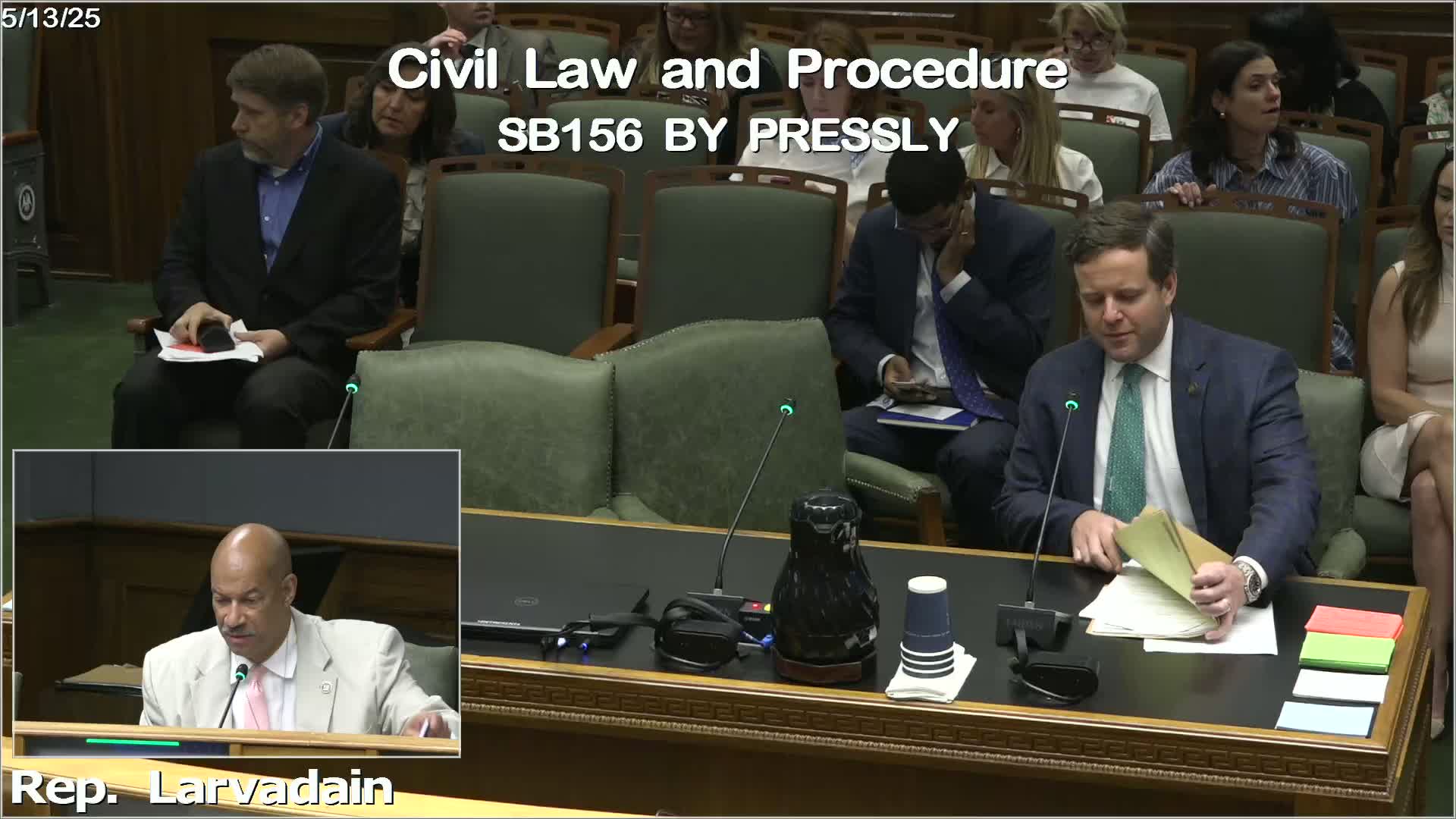
The House Civil Law and Procedure Committee reported Senate Bill 156 as amended after a lengthy May 13 hearing that drew medical specialists, fertility advocates, faith-based organizations and pro-life groups to debate changes to Louisiana's decades-old IVF law.
Senator Thomas Presley, sponsor, said the bill "was written in response to an incident that occurred in Alabama" and described the measure as "a proactive approach to modifying the Louisiana law regarding IVF treatment." He told the committee the goal is to update practice-oriented language in statutes that date to the 1980s and to protect both patients and providers.
Proponents, including Katie Bliss, executive director of the Louisiana Fertility Alliance, and Dr. Jay Huber, a reproductive endocrinology specialist, described the bill as aligning statute with current clinical practice. Bliss said, "We can do all of these things while increasing protections for patients and increasing protections for physicians." Tanner McGee, a private citizen who testified in support, urged lawmakers not to allow restrictions that would push young families out of the state.
Opponents, including Dorinda Plaisance, a bioethics attorney who consults with Louisiana Right to Life, and Erica Encina, policy director for Louisiana Right to Life, said several provisions "go too far." Plaisance warned the bill "takes away protections that these parents would want to have," arguing language that replaces adoption references with "donation" could reduce parental safeguards. Encina said her organization does not oppose IVF but objected to provisions that give precedence to private agreements over the "best interest of the embryo."
Medical witnesses and legal commentators debated technical definitions and the phrase "nonviable." A committee amendment adopted in the hearing—amendment set 2,578—defines "nonviable" to mean an in vitro fertilized human embryo that "fails to develop over a 72 hour period from fertilization or does not continue to progress through necessary developmental milestones during the in vitro development." Another amendment, set 2,732, added the word "goods" to a phrase so the statute reads "provider of goods and services." Both amendment sets were adopted without objection.
Committee counsel and witnesses discussed points of internal consistency: whether the bill creates different legal statuses for embryos conceived in vitro versus those conceived in vivo, and whether the law's use of terms such as "donation" and removal of "adoption by notarial act" could have unintended consequences. Several speakers asked the sponsor to continue negotiations between the committee hearing and the floor vote; Senator Presley said he would continue discussions.
After debate and the adoption of amendments discussed above, a motion to report SB156 as amended carried on a roll call. The clerk announced an 8-4 vote in favor of reporting the bill to the next stage. The committee hearing record shows extensive public comment both in support and opposition, and multiple stakeholders asked for further work to refine statutory language before potential final enactment.
The committee's action advances statutory changes that members said are intended to clarify modern IVF practice while the comments on definitions and procedural provisions signal further negotiation may follow before final passage.