Get Full Government Meeting Transcripts, Videos, & Alerts Forever!
Get email alerts on the Lsu Agcenter Research Extension Workforce topic
No spam. Unsubscribe anytime.
LSU AgCenter tells Senate committee its research and extension programs drive statewide economic and workforce benefits
Summary
Matt Lee, vice president for agriculture and dean of LSU’s College of Agriculture, told the Senate Committee on Agriculture and Forestry that the LSU AgCenter’s research, extension and youth programs generate large economic returns, support farmers with variety development and pest mitigation, and supply workforce training across Louisiana.
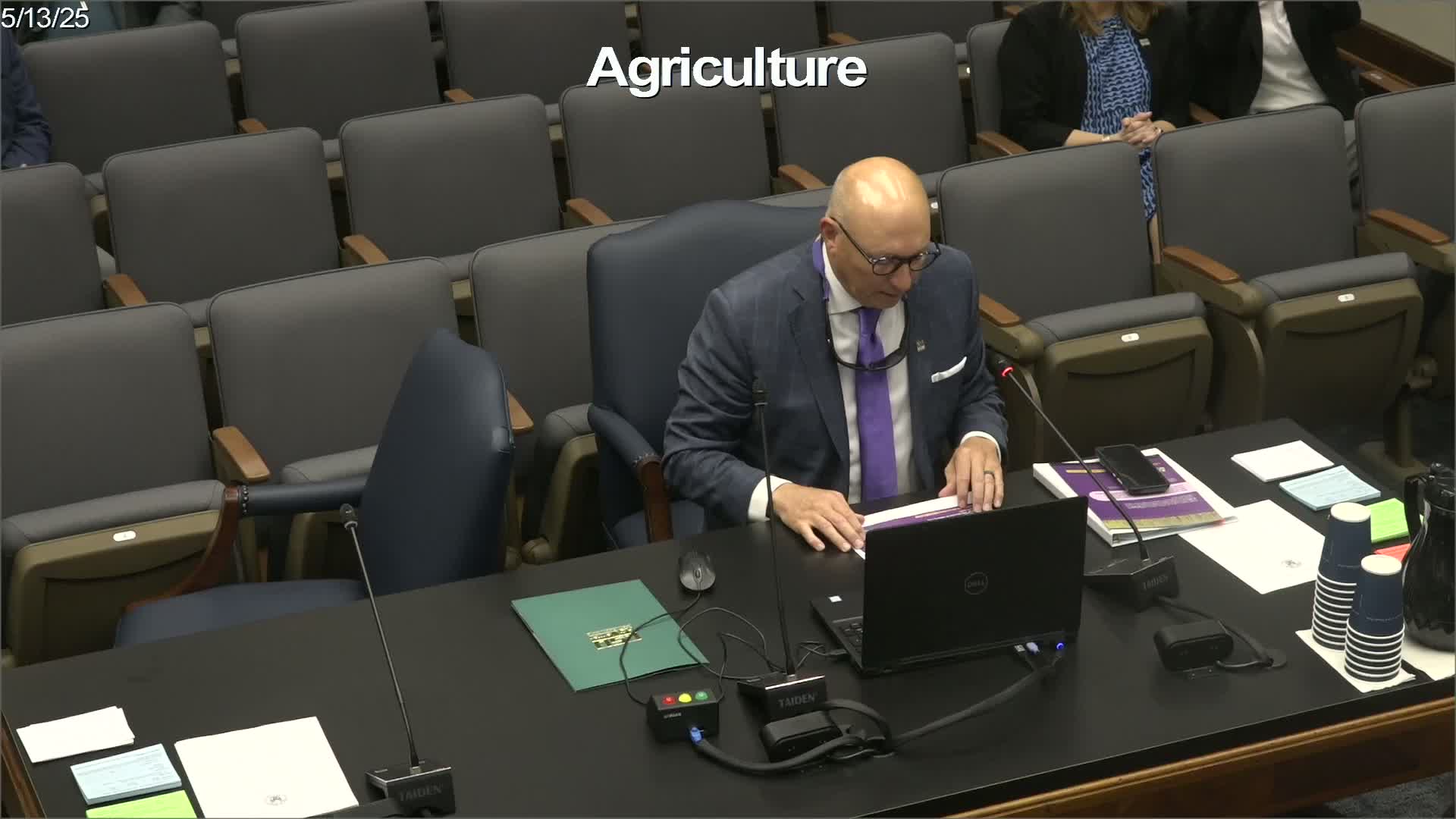
Matt Lee, vice president for agriculture and dean of the College of Agriculture at LSU, briefed the Senate Committee on Agriculture and Forestry on May 13 about the LSU AgCenter’s statewide research, extension and workforce-development activities and funding needs.
Lee said the AgCenter has an office in each of Louisiana’s 64 parishes and 14 experiment stations. "Over the last 5 years, our total research activity has amounted to $454,000,000," Lee told the committee, and he cited a USDA estimate that "for every dollar that is spent on ag sciences research, it ultimately returns about $20 to the economy." He said LSU-submitted research expenditures rose from about $94 million in earlier figures to $106.9 million in the most recent report.
The presentation focused on concrete examples of value to producers and communities: LSU variety-development programs account for a majority of rice and sugarcane acreage in the state, Lee said. "Currently, our varieties are grown by over 60 of the producers. They count for about 60% of the acreage around the state," he said regarding sugarcane varieties developed by LSU scientists. Lee also described the AgCenter’s diagnostic labs, invasive-species work and rapid response to threats such as a strawberry fungus, and he highlighted a patented feral-hog toxicant that is "patented and we are now waiting for EPA approval." He said the earlier estimate of annual crop damage from feral hogs was about $90 million.
Lee described the AgCenter’s extension and youth programs as large-scale workforce pipelines. He said 4-H enrolls about 117,000 young people annually and that extension education reached approximately 1.5 million people across programs including nutrition, Ag and natural-resources outreach and field days. "We have about 1,200 employees," Lee said, citing labs, incubators and training programs such as Foodie (a food incubator) and a seafood-safety training lab at Iberia Station.
On workforce credentials, Lee said the AgCenter and affiliated agricultural-education programs certified roughly 3,500 people last year with industry-recognized credentials and trained 1,800 people in food-safety certifications. He also described efforts to lower barriers for participation in youth livestock shows and to increase scholarships for Camp Grant Walker.
Lee told the committee the AgCenter has active licenses for intellectual property in 15 countries and memoranda of understanding with institutions in 11 countries. He noted recent one-time legislative support—$11 million two years ago and $4 million last year—that helped buy new equipment and instrumentation; Lee identified ongoing needs including laboratory renovations and faculty recruitment and retention to sustain the research enterprise.
Committee members asked follow-up questions about international collaborations, who implements invasive-species biocontrols, the timeline for EPA review of the feral-hog toxicant and whether grant applications had been affected by federal funding delays. Lee said some grants had slowed but that the AgCenter’s funding portfolio (about 17–18% federal research funding) had so far limited negative impacts on operations.
No committee action was taken on the presentation; Lee concluded by offering to provide follow-up information on implementation chains for biocontrol releases and other operational details requested by senators.