Get Full Government Meeting Transcripts, Videos, & Alerts Forever!
Get email alerts on the Procurement Compliance Utilities topic
No spam. Unsubscribe anytime.
DOT says federal Buy America rules are delaying some utility relocations; Kenai Spur project highlights options
Summary
At a Senate Transportation Committee hearing, DOT officials explained that Build America Buy America (BABA) compliance can stop utility relocation work until materials meet federal requirements; staff described shifting some relocations into construction contracts as an alternative and discussed outstanding agreements on the Kenai Spur Road work.
Department of Transportation staff told the Senate Transportation Committee on May 13 that federal Build America Buy America (BABA) compliance has created delays on projects that require utility relocations, and that DOT is using contract strategies to keep projects moving when utilities cannot meet procurement requirements in time.
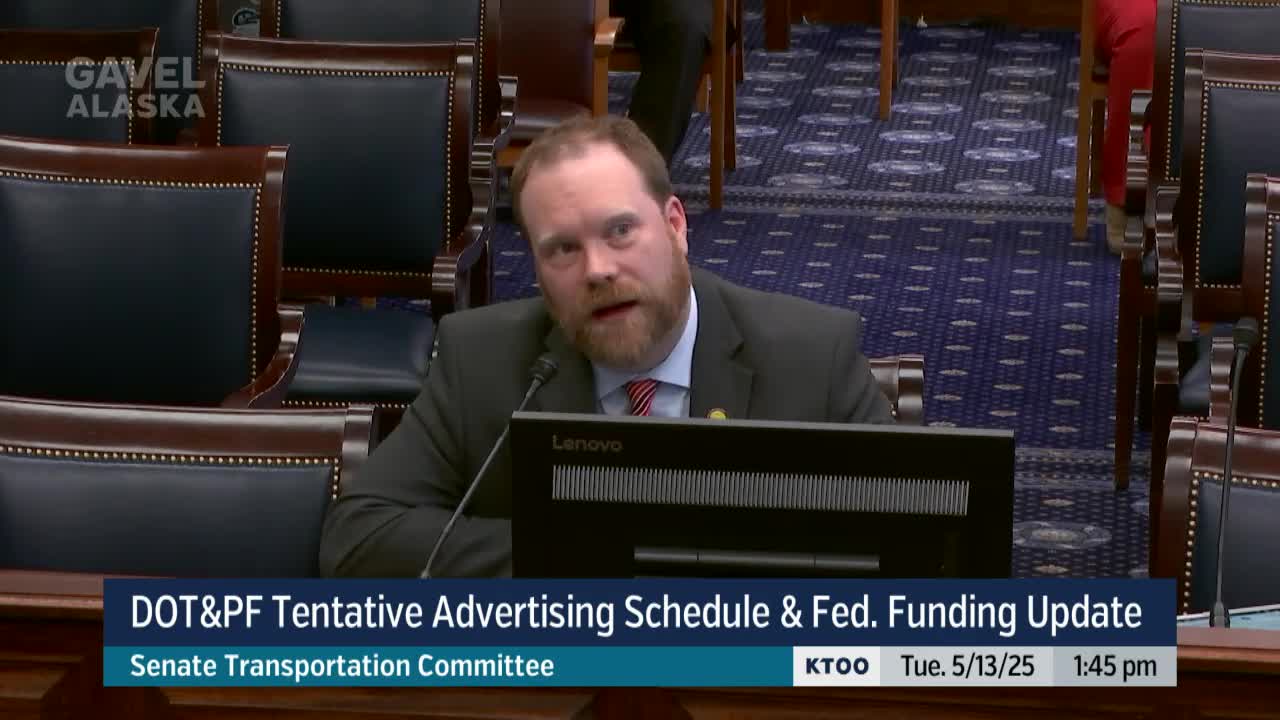
Andy Mills, special assistant and legislative liaison for DOT, told the committee that when utility relocation materials do not comply with federal Build America Buy America requirements, "that project stops until such time as we're able to resolve that." He said, in some cases, DOT is placing utility relocation elements into the construction contract rather than relying on the utility company to perform relocations.
Committee members pressed for specifics about unresolved utility agreements on the Kenai Spur Road rehabilitation project (Sports Lake Road to Swires Road). Luke Boland, Central Region preconstruction engineer, said the project has cleared right‑of‑way and environmental issues but that two utility agreements remain outstanding: one with GCI and one with Homer Electric Association (HEA). Boland summarized the department's approach and status: "what we're working with GCI on is low risk. There was some coordination with GCI on BABA or buy America, build America, compliance efforts here, and some legal language that has gone through a number of different lawyers on our side and their side." He said GCI had signed a related agreement for another project that included the BABA language, which reduces risk.
Boland said DOT and HEA are pursuing a dual path: HEA could execute a relocation agreement and procure compliant materials, or DOT could incorporate HEA's relocation work into the DOT construction contract so the prime contractor would procure materials under the DOT contract and assume Build America Buy America compliance responsibility. Boland said both options remain in play and that staff expect to resolve the approach "in the very near future." Andy Mills told the committee DOT had been willing to use the construction‑contract path as a workable alternative to avoid delays.
The committee asked why language that was acceptable in one utility's agreement appeared to take longer with another provider; DOT said iterations of legal language and differing procurement circumstances had led to multiple drafts. Mills offered to provide further detail to the chair on comparative contract language if requested.
DOT staff emphasized that BABA compliance is one of several critical‑path issues that can be tracked in the TAS confidence format; committee members pressed departments and utilities for timely resolution because outstanding utility agreements can push a project out of the current federal fiscal year obligation window.