Get Full Government Meeting Transcripts, Videos, & Alerts Forever!
Get email alerts on the Insurance Regulation topic
No spam. Unsubscribe anytime.
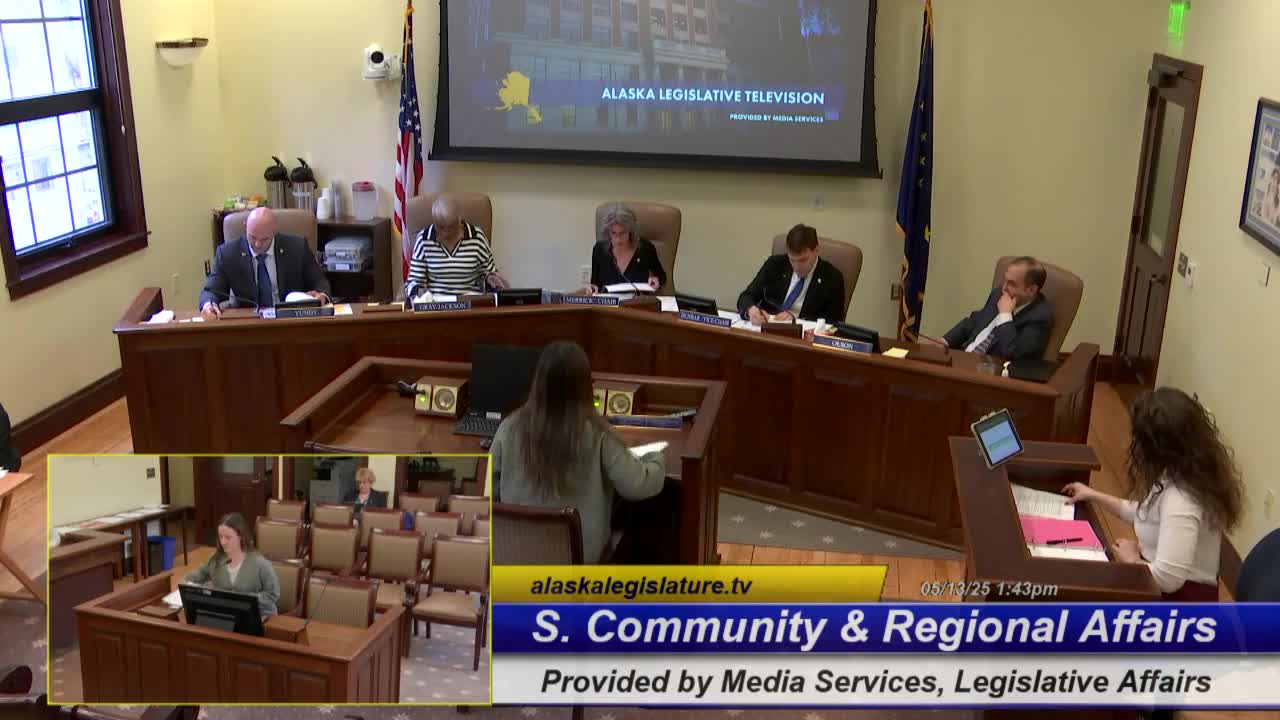
Committee hears bill to modernize anti-rebating law for insurers; regulators outline guardrails
Summary
Senate Bill 185 would update Alaska’s anti-rebating statutes to allow insurers to provide limited noncash gifts, wellness tools and pilot programs; the Division of Insurance described regulatory oversight and raised possible limits to prevent abuses.
Senate Bill 185, sponsored by Senator Bjorkman and carried in committee by staff, would update Alaska’s insurance statutes to clarify exceptions to anti-rebating rules and to add a new prohibition on certain advertising practices.
Sevea Bieber, staff to Senator Bjorkman, told the committee SB 185 “modernizes Alaska’s anti rebating laws by clearly defining exceptions for value added services, wellness incentives, educational tools, and low value promotional gifts.” Bieber summarized sectional changes: the bill would amend AS 21.36.010 to add the Gramm-Leach-Bliley Act to a list of federal laws; amend AS 21.36.110 to clarify exemptions for reduced-cost products or services related to the policyholder’s coverage; add provisions defining allowable noncash gifts and pilot programs; create a new section on prohibited advertising practices; and give the director of the Division of Insurance authority to adopt regulations, with most of the bill effective Jan. 1, 2026.
Laurie Winghire, director of the Division of Insurance, supported the policy thrust and described the bill’s origin in conversations about public-private partnerships under Healthy Alaskans. Winghire said the change would permit insurers and brokers to provide small devices and items that “make the property a better risk to insure or hopefully improve the life or the health of the consumer.” She told the committee this model is based on guidance from the National Association of Insurance Commissioners and industry requests from the American Property and Casualty Insurance Association.
Senator Dunbar asked how the statute’s phrase that gifts “does not exceed an amount determined by the director to be reasonable for each term of the policy year” would be implemented. Winghire said the division intends to specify parameters in regulation and discussed potential caps tied to premiums, suggesting a limit framed in relation to premium levels so gifts are proportional to the insurance product.
Dunbar also raised concerns about potential unequal influence—analogous to pharmaceutical gift practices—where a negotiator for a large purchaser or association could receive gifts that sway decisions. Winghire said she would look “very unkindly” on any insurer or broker who gave gifts only to a negotiator rather than to the policyholder as a whole, and that the division would clarify in regulation that gifts should go to the policyholder rather than an individual negotiator. The director said she “would not object” to a statutory amendment that directs gifts to the policyholder rather than to a contracting individual.
The committee set the bill aside for further consideration; no committee motion to move the bill was recorded during this hearing.