Get Full Government Meeting Transcripts, Videos, & Alerts Forever!
Get email alerts on the Childcare Assistance topic
No spam. Unsubscribe anytime.
Committee advances SB 95 to expand childcare assistance and grants; advocates say it would serve about 18,000 children
Summary
Sen. Forrest Dunbar and invited witness Stephanie Berglund described SB 95 as expanding childcare assistance to roughly 18,000 children; the committee moved SB 95 out with individual recommendations and attached fiscal notes after a single invited testimony and review of a fiscal note from the Department of Health.
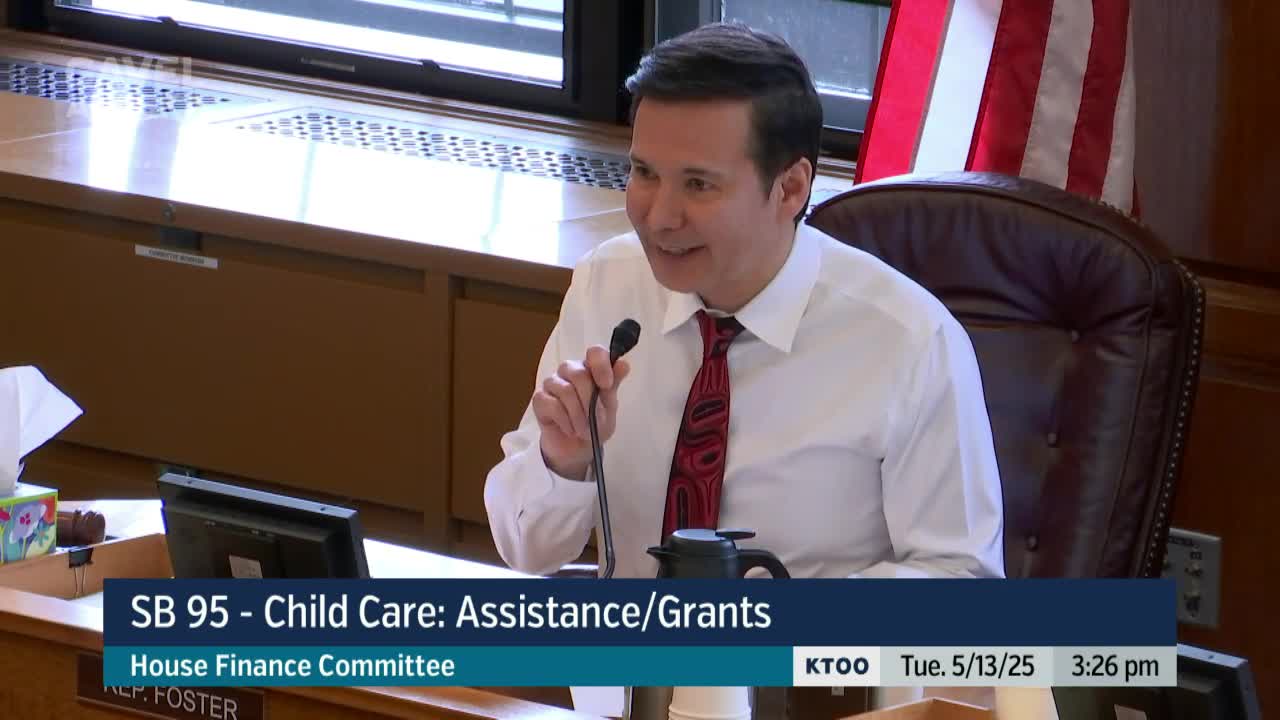
Senator Forrest Dunbar, chair of the Senate Health and Social Services Committee, introduced Senate Bill 95 to the House Finance Committee on May 13 and described it as a reenactment of provisions already enacted in SB 189. "The underlying substance of this bill is that it expands childcare to about 18,000 kids," Dunbar said.
Stephanie Berglund, chief executive officer of THRED (a statewide child care resource and referral nonprofit), gave the invited testimony and urged passage. "When Alaskans can't work, they don't have the financial security to support their families," Berglund said, and she described workforce and program metrics to justify the proposal.
Berglund told the committee that since 2020 more than 25% of licensed child care programs in Alaska have closed and that staff shortages and low wages limit capacity in remaining programs. She cited a 2023 family survey in which 51% of responding families reported household members' ability to be employed or work more hours was affected by child care availability, up from 22% in 2019.
SB 95 would change eligibility thresholds for child care assistance (raising income eligibility toward the 105th percentile of median household income, per testimony) and would cap co‑payments to make assistance more accessible, Berglund said. The bill would also create a program to partner with employers to incentivize on‑site or near‑site child care and would allow use of a cost‑of‑care methodology alongside market rates when setting reimbursement levels to better reflect the true cost of providing quality care.
Brody (Bridal) Anderson, staff to Representative Neil Foster, presented the Department of Health fiscal note for SB 95. The fiscal note shown to the committee lists line items including $203,800 for personal services, $28,000 for services, $2,000 for commodities, and a grants-and-benefits figure reported in the briefing as "5,000,858,400.0" (committee staff read this amount during the hearing). The total appropriation presented was stated as $6,092,000.2, with $225,100 identified as federal receipts and $225,100 as UGF match; the remainder was described as unrestricted general funds. The Department of Health said the bill would create two new positions and would require regulation changes.
Committee members asked departmental staff about salary ranges for the new positions. Leah Van Kirk, health care policy adviser for the Department of Health, said the hourly rates presented for the two ranges were $24.15 (range 12) and $36.30 (range 18). Van Kirk confirmed the $83,700 figure referenced by a member incorporated wages and benefits for a range‑12 position.
Representative Tom Shefsky, Representative Bynum and others asked questions about program funding history and federal support; Berglund confirmed that prior federal pandemic relief investments that had supported child care have been exhausted. Representative Schrage moved SB 95, work order 34‑LS0446\A, out of committee with individual recommendations and attached fiscal notes. The motion carried with no objections.
The committee closed public testimony for SB 95 after Berglund's invited testimony; staff invited written comments by email. The bill will appear on further legislative calendars and carries the fiscal note and positions described by department staff.