Get Full Government Meeting Transcripts, Videos, & Alerts Forever!
Get email alerts on the Student Attendance topic
No spam. Unsubscribe anytime.
Texas Tech'ECISD partnership finds early attendance patterns, highlights teacher effect
Summary
A phase—one research-practice partnership presented by Texas Tech researchers found chronic absenteeism rose after the pandemic and remains elevated in ECISD; early attendance in the first six weeks strongly predicts yearlong chronic absenteeism, and effective teachers were associated with large reductions in chronic absence risk.
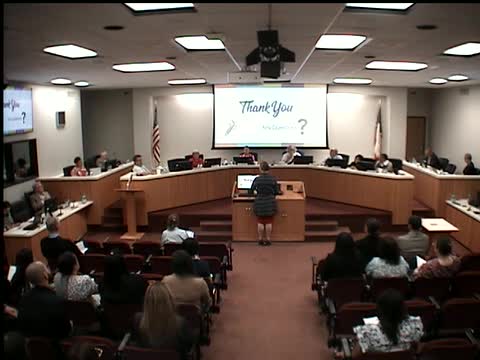
Researchers from Texas Tech presented phase one of a research-practice partnership with Ector County Independent School District analyzing attendance trends, campus practices and early-warning indicators; they recommended continuing to phase the work, adding family and student voices in phase two, and studying teacher and principal practices that appear to reduce chronic absenteeism.
The work matters because ECISD reported a rise in chronic absenteeism after the COVID'19 pandemic and school leaders seek evidence-based steps to restore attendance levels linked to academic outcomes.
Dr. Boyer introduced the Texas Tech team and said the district asked for research to "do something different to move the metric for kids." Jessica Gottlieb, a Texas Tech researcher, described the partnership's three-phase structure and noted the definition of chronic absenteeism the team used: students who miss 10 percent or more of enrolled school days, including excused and unexcused absences. The research team combined literature review, more than 30 interviews with principals, teachers and attendance clerks across 13 campuses, and quantitative analysis of district and state data.
Key quantitative findings presented included a district chronic-absence peak of about 30 percent in 2022 with a modest decline to roughly 28 percent in 2023. The researchers said first-six-weeks attendance is a strong early predictor: students missing 1'2 days in the first six weeks had an elevated likelihood of yearlong chronic absence, and students missing 6'9 days in that window had markedly higher risks (the team reported an example where elementary students missing 6'9 days were about 65 percent likely to be chronically absent for the year). The researchers emphasized that these early-warning patterns held across demographic subgroups.
The study also identified strong positive associations between teacher effectiveness and subsequent attendance. Researchers reported that students who had been severely chronically absent the previous year were up to 20 percentage points less likely to be chronically absent if assigned a highly effective (TIA master) teacher, after adjusting for background characteristics and prior outcomes. The team highlighted the district's investments in teacher quality, the Teacher Incentive Allotment (TIA) designations and the Opportunity Culture roles as plausible levers to improve attendance.
Qualitative interviews surfaced recurring themes: consistent campus-level attendance processes and strong appreciation for the district community outreach center; perception of parental disengagement at some elementary campuses; challenges tied to economic conditions, mobility and industry-specific local labor opportunities; safety and transportation concerns for students who live within walking distance but face hazardous crossings; and logistical constraints at large comprehensive high schools (multiple exterior doors, students leaving for dual-credit or CTE coursework). Texas Tech flagged mobility, local labor-market incentives and school climate as important contextual drivers.
Trustees discussed additional considerations including post'COVID anxiety among students, student rebellion and out-of-school congregation (trustees mentioned parks as places students gather), and the need to interview students directly. Researchers confirmed phase two will incorporate family and student voices, develop teacher and principal surveys to isolate effective practices, and produce cross-campus comparisons to identify bright spots.
No board action was taken; the presentation was informational. The research team recommended next steps: continue to phases two and three, incorporate family and student surveys, investigate specific teacher and principal practices that reduce chronic absence, and explore operational solutions for transportation and safe-passage for short-distance walkers.