Get Full Government Meeting Transcripts, Videos, & Alerts Forever!
Get email alerts on the Human Relations Commission topic
No spam. Unsubscribe anytime.
Orange County supervisors add law-enforcement seats to Human Relations Commission after split vote
Summary
The Board of Supervisors voted 3-2 to amend bylaws for the Orange County Human Relations Commission to add two law-enforcement seats and direct staff to refine incident-reporting methods; the change touched off debate over commission size, independence and how to collect hate-incident data.
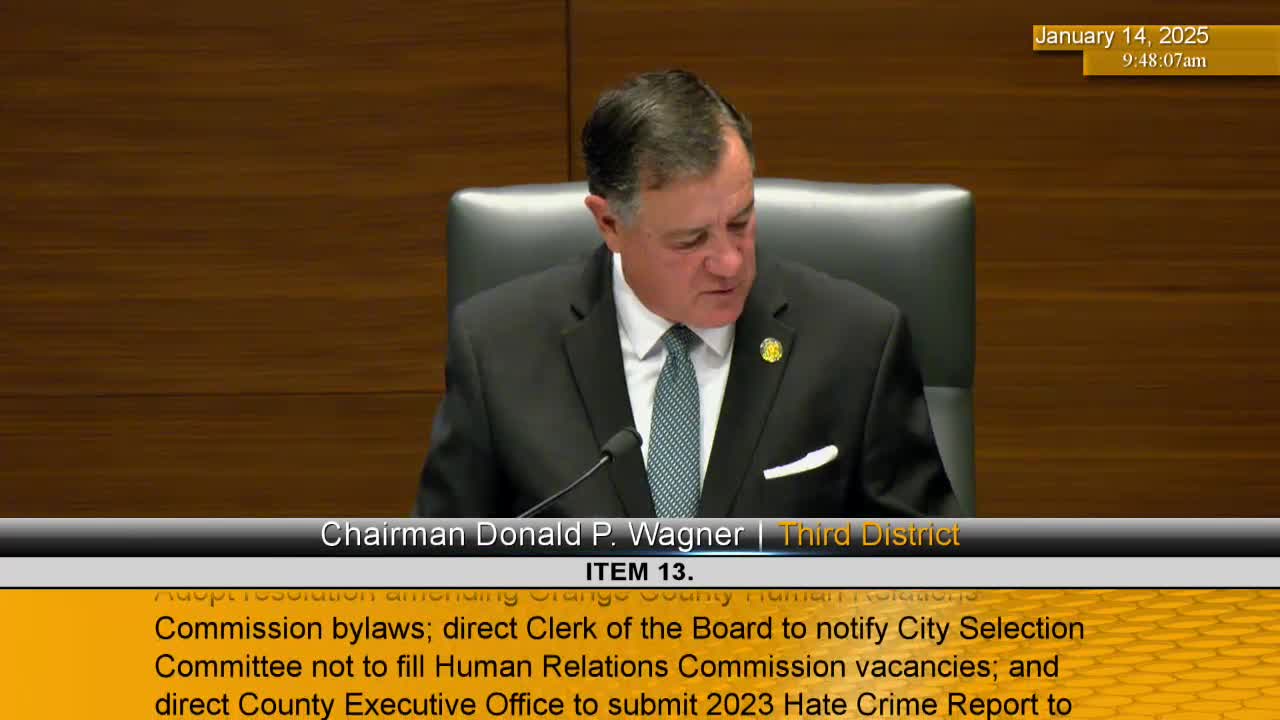
The Orange County Board of Supervisors voted 3-2 on Jan. 14 to amend the bylaws of the county Human Relations Commission to add two law-enforcement representatives, a change county staff said would accompany a reset of the panel's role and reporting processes.
The change — proposed by Chair Donald Wagner and seconded on the dais — prompted more than an hour of debate over whether the commission should be larger and more independent or smaller and refocused on producing reliable countywide hate-crime and hate-incident reporting.
Supporters said law enforcement presence would improve data-driven responses and community safety. Sheriff Don Barnes told the board the commission provides “an opportunity for us to both provide and, more importantly, receive input on issues impacting the community we serve,” and said tracking hate crimes and trends is essential. Irvine Police Chief Michael Kent, speaking for the Orange County Chiefs and Sheriffs Association, said the “symbolism of having law enforcement representation on the commission makes the message very clear: we will not tolerate hate in Orange County.”
District Attorney Todd Spitzer told supervisors his office supports restoring a law-enforcement seat and said the DA’s office prosecutes hate crimes using existing legal thresholds: “We report when we are referred by the police departments hate crimes. We decide whether or not there’s enough evidence to prove that case beyond a reasonable doubt,” he said, adding that his office is leading a federal outreach grant on hate-crime education.
Opponents warned the change could chill community participation. Supervisor Vicente Sarmiento said the commission must remain a broad, independent forum where residents can speak candidly about bias and incidents: “Having two law enforcement [seats] in a group of seven is going to certainly chill the speech of many of those that are present in the room,” he said.
County staff told the board the revision was intended as a “reset” after the commission moved in-house and after staff concluded the commission’s prior contractor used methods the county could not validate. Jessica Witt, director of government and community relations in the County Executive Office, described gaps in how organizations reported incidents and why the county recommended first defining a consistent methodology for collecting hate-incident information across cities, school districts and community partners before incorporating incident-level data into the annual report.
Deputy District Attorney William Haw, who works in the DA’s hate-crimes unit, told the board the office can train law enforcement on definitions and capture referrals and filings in the attorney general’s statistics, but that the state does not currently collect a standardized tally of noncriminal “hate incidents.” He said determining how to count incidents — for example whether multiple reports about the same episode should be de-duplicated — is one of the issues the commission should address.
After discussion, the board amended the staff recommendation to include two law-enforcement representatives — one from the sheriff’s office and one “at-large” seat representing a municipal police agency selected by the Orange County Chiefs and Sheriffs Association. Chair Wagner said the Chiefs Association would determine the local-police representative.
The board’s action also directed the commission and county staff to develop a credible, countywide methodology for capturing and reporting hate incidents alongside hate-crime data so the annual report would reflect consistent, verifiable information from cities, schools and community-based organizations.
The item arose after months of review of commission structure, staffing and the county’s process for producing an annual hate-crimes report. Several supervisors said they expect follow-up work — including possible revisions to commission size and budget — to be considered as staff and commissioners develop the methodology and during the county’s upcoming budget process.
The board’s recorded vote on the amendment was 3-2. The board then approved the amended bylaws and related staff recommendations by the same margin.