Get Full Government Meeting Transcripts, Videos, & Alerts Forever!
Get email alerts on the Education Gifted And Talented topic
No spam. Unsubscribe anytime.
ECISD presents 2025–26 gifted-and-talented plan, proposes screening shift to second grade
Summary
Ector County ISD staff presented the district'wide gifted-and-talented (GT) plan for 2025'26, reported improved identification equity over five years, and proposed three non-programmatic enhancements including moving universal GT screening from third to second grade.
Ector County Independent School District officials presented the district'level gifted-and-talented plan for the 2025'26 school year and recommended several "enhancements" to identification and teacher support, while saying no programmatic changes are being requested at this time.
The plan matters because the district tracks GT access and outcomes against the Texas Education Agency'defined GT state plan and state accountability expectations; staff told trustees the district is currently in compliance and is working to return to an "exemplary" designation.
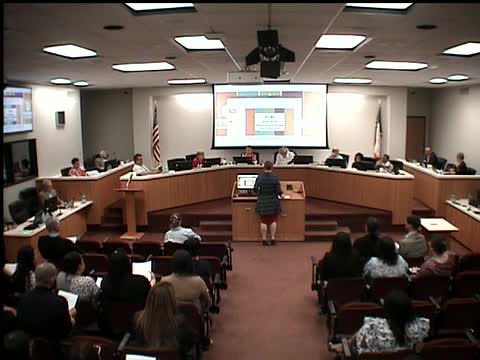
Kristen Beasley, director of advanced academics for Ector County ISD, led the presentation and described program structure, student demographics and three proposed enhancements: move the universal screener from third to second grade; expand the GT showcase program into secondary schools so older students can present products and performances; and require depth-and-complexity training for every teacher who has a GT student in their class. "We are not asking to make any programmatic changes in the approval. There are no program changes," Beasley said, framing the items as improvements rather than a change in core service delivery.
District data presented by Beasley showed ECISD identifies about 10 percent of its students as GT, which staff said is within the statewide range and within the TEA guidance that GT subgroup percentages should be within 10 percentage points of the district population for most demographic categories. Beasley said identification gaps have narrowed over the past five years and that referrals have increased, especially at the elementary level.
On services, Beasley described a two-pronged delivery model: cluster classrooms led by GT-trained, certified teachers, supplemented by pullout instruction. At elementary grades three through six the district offers a weekly two-hour pullout; certified GT specialists provide support and also co-teach to help students transfer skills back to the general classroom. At the secondary level GT services are provided through honors, AP and IB courses, with three content-specific specialists supporting those teachers.
Trustees asked operational questions. Beasley said the district currently has four elementary GT specialists and three secondary specialists, noted staffing is constrained and said the district plans to ask for additional personnel in the future but must weigh requests against state legislative and budget conditions. On screening, Beasley explained the universal screener is administered to every child in the tested grade and recommended screening second graders (in addition to kindergarten and fifth grade) beginning next year so the district will screen kindergarten, second, third and fifth grades during the transition year and then move to kindergarten, second and fifth thereafter.
Board members also raised equity and newcomer concerns: trustees asked how the district will avoid missing newly enrolled students or students who arrive midstream, including emergent bilingual learners. Beasley said the secondary showcase and other outreach efforts will help identify students who were not screened earlier and that staff will present additional clarifying procedures as the plan is implemented.
Beasley summarized the district'level focus for next year as sustained teacher training and support, stronger secondary supports through the expanded showcase, and improved coordination with special education and bilingual services so GT needs are represented on IEPs and LPAC discussions. She said those enhancements are intended to strengthen Tier 1 instruction and teacher capacity rather than change service models.
The presentation was informational; Beasley explicitly stated the board was not being asked to adopt program changes at this meeting. Trustees requested additional operational details and follow-up on screening logistics and on how the district will identify newcomers and emergent bilingual students outside the universal-screening windows.
Looking ahead, staff said any formal policy or staffing requests that derive from the enhancements would come to the board for future consideration, with implementation details and timelines provided at that time.