Get Full Government Meeting Transcripts, Videos, & Alerts Forever!
Get email alerts on the Infrastructure Construction topic
No spam. Unsubscribe anytime.
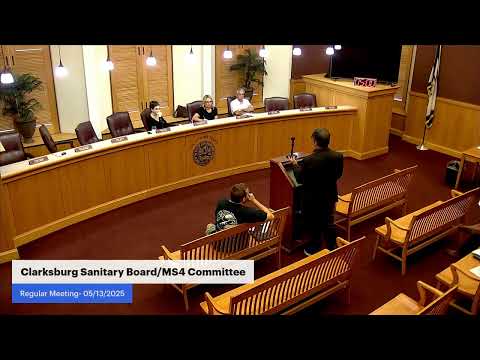
Clarksburg sanitary board approves construction payments, hears Phase 5A contamination and lateral-connection update
Summary
The Clarksburg Sanitary Board approved several contractor payments and invoices and received an update on Phase 5A construction noting a larger-than-expected contamination plume and additional lateral tie-in work that may require change orders.
Members of the Clarksburg Sanitary Board approved contractor payments and engineering invoices and were told construction on Phase 5A remains generally on schedule despite finding a larger contamination plume near a former gas station.
The update came during a board meeting when Anthony Jefferson, a sanitary-staff member, said, “The plume was bigger than we anticipated, bigger than it was on DEP's map they sent us.” Jefferson also said, “We got the sewer tied in. All the sanitary work in the Triangle Intersection is complete.”
Why it matters: board votes released funds needed to keep work moving while staff said unexpected site conditions and larger-than-anticipated lateral pipe sizes could increase costs and require contract changes.
Jefferson told the board crews excavated through contaminated soils at the Triangle Intersection and tied the sewer there. He said contractors encountered lateral connections larger than the 4-inch size the contract assumed and were directed to “tie in with whatever size line they find.” Jefferson warned that those larger laterals will “incur a little bit more cost” and said he may bring a change-order proposal at the next meeting to add bid items for 6-inch and 8-inch lateral tie-ins.
On formal actions, the board approved pay request number 3 to Independent Enterprises Inc. for $231,088.50, which Jefferson said covers work through the Triangle Intersection. The motion to award payment number 3 was moved and seconded and carried on an affirmative voice vote.
The board also approved several engineering and design invoices from Thrasher Engineering: $19,260.46 for Phase 5B engineering review, $64,250 for Clarksburg Phase 5B services, and $40,000 for the Arlington sewer-extension engineering invoice; each was moved, seconded and approved by voice vote.
Separately, the board approved a contract motion for repair of the sewer line under the central bus garage with Independent Enterprises, not to exceed $40,000, including a $10,000 contingency. Earlier in the meeting staff said Independent had quoted $30,000 but did not specify whether that quote was for nighttime work; the board set the higher not-to-exceed amount to allow a contingency.
The board considered an engineering agreement for a developer-funded sewer extension (identified in materials as the Wilson Energy/Wolfson Energy sewer extension). Staff described the agreement as a pay-forward arrangement in which the developer deposits estimated design and construction funds into the board’s account and the board pays invoices as work is completed. Thrasher presented a proposed agreement with a total fee of $280,000 broken down as $160,000 for basic services (design, bidding, construction and post-construction), $70,000 for additional services (surveys, geotech, permitting, construction stakeout) and $50,000 for resident project representation/inspection services. A motion to award the contract to Thrasher Engineering, subject to attorney review, passed on a voice vote.
Jefferson said work on the Arlington extension will require easement acquisition and that staff expects to hire a right-of-way agent this summer; he said there are 67 easements in total (not 67 separate property owners). He said staff expects an Army Corps review to take 45 to 60 days and that the project is progressing toward 60% design.
Board members asked that staff print current plans to confirm schedule and alignment; Jefferson said he planned to do that and continue monitoring the job. He told the board he would bring any change-order requests for larger lateral tie-ins to the next meeting.
The board’s votes on the payment requests and invoices were recorded as carried by voice vote; no formal roll-call tallies were recorded in the transcript.