Get Full Government Meeting Transcripts, Videos, & Alerts Forever!
Get email alerts on the School Budget topic
No spam. Unsubscribe anytime.
Crowley ISD hears three budget scenarios for 2024–25 and preliminary priorities for 2025–26
Summary
District finance staff presented best-, worst- and most‑likely fiscal scenarios for the 2024–25 year end and outlined priorities for the 2025–26 preliminary budget, including possible compensation and health‑insurance increases amid legislative uncertainty.
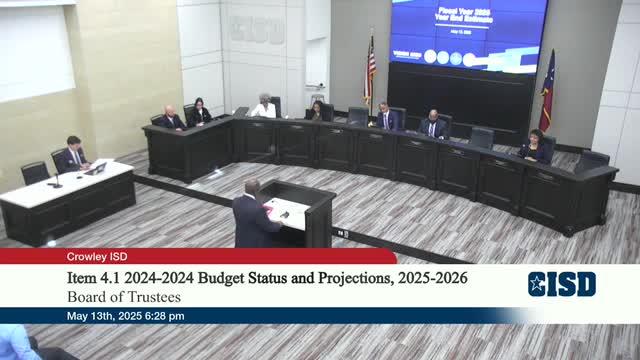
Crowley ISD finance staff told the board on Tuesday that the district is tracking three fiscal scenarios for the 2024–25 year end and is planning budget priorities for 2025–26 that could require millions in additional revenue to cover pay raises and higher health‑insurance costs.
In a presentation, district staff laid out a best‑case scenario with roughly $191 million in revenue and about $186 million in expenditures, which “would put back into the fund balance approximately $5,000,000,” according to the presenter. The worst‑case scenario projected about $187 million in revenue and $195 million in expenditures, producing a roughly $8 million deficit. The district’s “most likely” projection showed about $189 million in revenue and $187 million in expenditures, leaving just under $2 million to add to fund balance.
The presentation put the board’s previously adopted plan in context: the adopted budget assumed a $2,300,000 transfer from the workers’ compensation fund and a $1,900,000 planned use of the general operating fund balance. Staff said those planned uses total roughly $4.2 million and that the final year‑end position will depend on state revenues and local cost pressures.
Why it matters: the board is preparing a 2025–26 budget that leaders said will prioritize smaller class sizes, employee compensation and increases in the district’s contribution to health insurance. Trustees asked how much additional revenue would be needed to fund potential raises and benefits; one trustee said the district is “looking at almost $7,000,000 just so that we can do right by our faculty, staff, and employees.”
Details: presenter Leon Fisher (finance staff) said the district used a “conservative” approach to revenue projections and stressed protecting the fund balance while aligning expenditures to student needs. He flagged rising costs in property insurance, utilities for the new Baylor Elementary School, and inflation escalators in contracts for transportation, custodial and food services. Fisher also noted ongoing uncertainty about state school‑finance changes under the current legislative session and how different basic‑allotment figures would change district revenue.
Board members pressed staff on how much a modest basic‑allotment increase would deliver to Crowley ISD: the presenter and trustees calculated that an increase of $220 per student would generate about $3,700,000 for the district. One trustee said that even with proposed statewide investments, “public schools are still grossly underfunded,” and that no basic‑allotment increase has been received since 2019.
Legislative context: staff said several bills remain under consideration at the state level, including proposals that would change the basic allotment and increase the school‑safety allotment; the board was told that some proposals (referred to as HB 2 in discussion) face uncertain passage and may require a special session. The board also confirmed that Education Savings Accounts (ESAs) referenced in the session have been funded, which trustees noted could affect the state’s budget tradeoffs.
Next steps: staff said they will return with budget packages that reflect multiple scenarios and recommended priorities for 2025–26, including a compensation package and a proposal to increase the district’s health‑insurance contribution. No formal budget action was taken at the meeting; the item was a presentation and Q&A.
Ending: Trustees and staff agreed to continue monitoring legislative outcomes and revenue updates while preparing the district’s proposed 2025–26 budget for future board consideration.