Get Full Government Meeting Transcripts, Videos, & Alerts Forever!
Get email alerts on the Ogap Csi Math topic
No spam. Unsubscribe anytime.
PGCPS pilots OGAP math coaching in CSI schools; teachers report confidence gains
Summary
Prince George's County Public Schools said it implemented the OGAP (ongoing assessment project) this year in support of 24 state-identified Comprehensive Support and Improvement (CSI) schools; participating teachers reported improved content knowledge and classroom practice in early results from surveys and coaching.
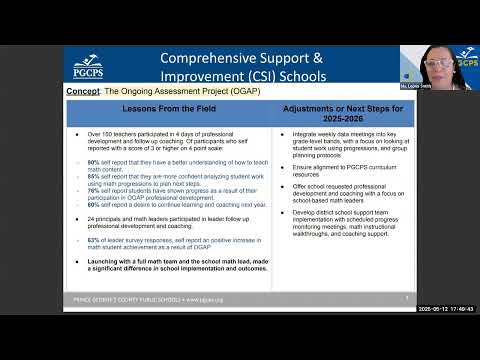
Prince George's County Public Schools reported Monday that an OGAP (ongoing assessment project) professional-development pilot reached more than 150 teachers in CSI schools this year and that participants who completed a follow-up survey reported stronger understanding of math instruction and greater confidence applying student work progressions.
The district presented OGAP as a multi-day, hands-on professional learning sequence focused on four math domains — addition, multiplication, fractions and proportional reasoning — and said the work was paired with follow-up coaching in schools. "We implemented the ongoing assessment project or OGAP, and it is a professional development around how we look at student work in 4 domains," said Leona Smith, innovation officer for transformation, leadership, and continuous improvement.
Why it matters: OGAP is listed among research-based practices recommended by the Maryland State Department of Education for improving student outcomes; the district said OGAP is one of multiple strategies to help CSI schools make measurable gains required to move out of state identification.
District officials said roughly 150 teachers attended four days of OGAP training and received differing levels of follow-up coaching (small group and one-on-one). Of the participants who completed a follow-up survey — "about 70, about almost half," Smith said — 90 percent said they had a much better understanding of how to teach math content, 85 percent reported increased ability to analyze student work against a learning progression, and 76 percent said they were seeing day-to-day improvement in students' work. The district noted that end-of-year assessment data were not yet available to show summative gains.
Leaders emphasized the importance of school leadership participation: schools that launched OGAP with a full math team and a math lead who also received training showed stronger implementation, the presentation said. The district plans to continue OGAP next year with stronger alignment to the curriculum, broader coaching access, weekly data meetings using a common protocol, and newly planned district school support teams for implementation monitoring.
Committee members asked about evidence of impact and scaling; officials said OGAP appeared most effective with multi-year implementation and that schools will use benchmark and state assessment (MCAP) data together with internal monitoring to determine whether CSI schools can exit identification. No formal policy or ordinance change was proposed during the discussion.