Get Full Government Meeting Transcripts, Videos, & Alerts Forever!
Get email alerts on the Economic Development topic
No spam. Unsubscribe anytime.
Board re-authorizes SCOG to accept California Jobs First funds, extends Community Economic Resilience pilot
Summary
The Board of Supervisors approved a resolution allowing the Eastern Sierra Council of Governments (SCOG) to continue participating in the California Jobs First program and to accept related grant funding through September 2026.
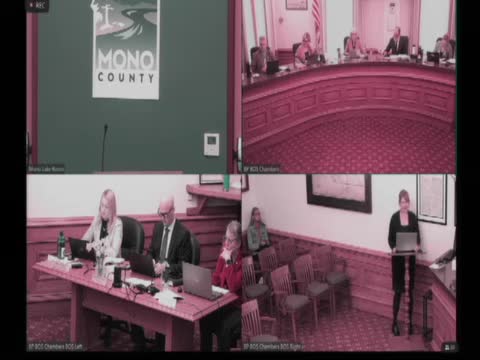
The Mono County Board of Supervisors voted 5-0 to reauthorize the Eastern Sierra Council of Governments (SCOG) to take part in the California Jobs First initiative and to accept related funding for the Community Economic Resilience Fund pilot program.
SCOG Executive Director Elaine Kabala told the board SCOG has won several grants in recent years and that the California Department of Fish and Wildlife awarded a $3.8 million grant to build regional wildfire-resiliency capacity. "I want to thank your board for the invitation to provide a presentation on SCOG activities," Kabala said during her presentation.
Nut graf: The board’s action restores SCOG’s authority to accept and administer California Jobs First and related catalyst grants and continues SCOG’s role as a regional coordinator for economic development, sustainable recreation and ecosystem management. SCOG officials said the authorization is needed for the organization to receive funds and carry out program work through the state funding window that runs through September 2026.
SCOG told the board it has used recent grants to complete environmental review for the 58,000-acre Donut Around Mammoth fuels-reduction project and to fund recreation-planning work such as the Buttermilk Infrastructure and Recreation Planning Initiative and a Towns-to-Trails feasibility analysis. Kabala described three recent awards SCOG sought: capacity building for recreation and wildfire mitigation, funding for an Eastern Sierra Business Resource Center, and trails planning in areas that have developed without coordinated management.
Board members asked how SCOG would ensure geographically equitable distribution of projects across the member jurisdictions; Kabala said SCOG intentionally keeps member contributions low and leverages grant funding and partner contracts while it builds staff capacity. She told the board SCOG’s operating budget is about $150,000 annually and member agency contributions total about $100,000.
Outcome: The resolution authorizing SCOG to accept California Jobs First and related funds passed on a unanimous 5-0 vote. SCOG representatives said they will continue monthly staff-level coordination among Inyo, Mono and Alpine counties and return to member agencies with project updates and requests for project-level approvals as required.
Ending: SCOG also told the board it intends to develop a legislative platform reflecting priorities common to its member agencies and to pursue opportunities for an Economic Development District designation in the future. The board recorded the resolution adoption and thanked Kabala for the update.