Get Full Government Meeting Transcripts, Videos, & Alerts Forever!
Get email alerts on the Nuclear Testing On Indigenous Land topic
No spam. Unsubscribe anytime.
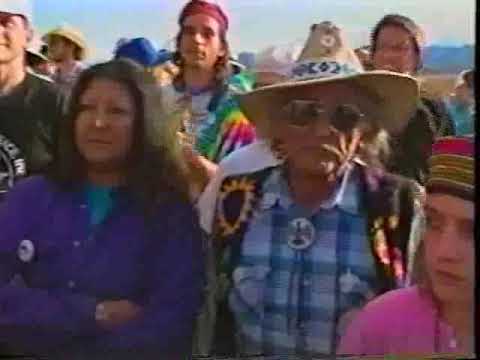
Western Shoshone elders, activists at Global Healing rally demand end to nuclear testing and waste on treaty land
Summary
Speakers at a Global Healing gathering near the Nevada Test Site said nuclear testing and waste have harmed land and people, invoked the 1863 Treaty of Ruby Valley, and urged the public to pressure federal officials; international visitors joined for healing and cultural exchange.
At a Global Healing gathering near the Nevada Test Site, Western Shoshone elders and activists urged an immediate end to nuclear testing and the storage of nuclear waste on lands they said remain theirs under treaty, described health and environmental harms, and called on the public to contact federal officials about the issue.
Speakers said the site and surrounding lands are spiritual ground for the Western Shoshone and others. Corbin, described in the gathering as a spiritual leader and healer for the Western Shoshone, said, “All our food, all the living things here had to be prayed to because they're life like we are.”
The gathering’s speakers tied cultural and spiritual concerns to specific policy grievances and health claims. Maha Spotted Eagle, who identified herself as Western Shoshone, said the 1863 Treaty of Ruby Valley established continuing Shoshone claims to the land and said the federal government did not disclose above‑ground atomic testing when seeking to use the land. “They never told us that they were gonna be testing these things called atomic bombs,” she said.
An unnamed commenter at the event framed the issue as both legal and humanitarian and urged public pressure on elected officials. That speaker said, “What people need to do is write to the president of The United States. They need to write to their members of congress. They need to write to their senators, and they need to write to the, representatives of foreign governments.”
Speakers described specific environmental and health concerns they connected to decades of nuclear activity in the region: references included the Nevada Test Site’s history of nuclear detonations, low‑level waste at Beatty, the proposed Yucca Mountain repository, and military test ranges such as Tonopah Test Range and China Lake Naval Weapons Station. One commenter said, “We have the Nevada test site with a thousand, nuclear weapons detonations,” and also linked the pattern of siting hazardous activities to “environmental racism.”
Catherine Blossom, introduced as an elder of the Shoshone Nation, addressed the health impacts she said are visible in communities. “I do not understand, as an elder, why that why the nuclear waste is being brought to Shoshone land,” she said, adding that illnesses and birth problems have followed decades of testing and waste storage.
Speakers also argued for Indigenous approaches to environmental assessment and remediation. An unnamed commenter described a community‑based “nuclear risk management” approach that seeks to integrate cultural values with scientific work and said that approach “makes our science better” by treating people as part of the environment being studied.
International attendees and activists participated in the gathering’s healing and cultural exchange activities. Rieko Kokuban, who said she lives in New York City but came from Japan, described taking the event’s practices—morning and evening prayers and nonviolent training—back to her community in Japan. Performers played songs and participants mentioned healing practices such as crystal singing bowls; a visitor identified as Awa Hoshi was named as having introduced those instruments to the group.
No formal government action or vote was recorded at the gathering. Instead, speakers framed the meeting as protest, spiritual ceremony, and public education, and several urged letter‑writing, outreach to members of Congress, and broader public involvement as the next steps.
Ending: The gathering combined spiritual ceremony, personal testimony about health and environmental harms, and political appeals. Organizers and speakers asked viewers and attendees to contact elected officials and to support Indigenous‑led approaches to assessment and healing; the transcript shows no formal government response or official decision arising from the event.