Get Full Government Meeting Transcripts, Videos, & Alerts Forever!
Get email alerts on the Land Management Fees topic
No spam. Unsubscribe anytime.
Lane County approves 7% phased fee increase for Land Management Division permits
Summary
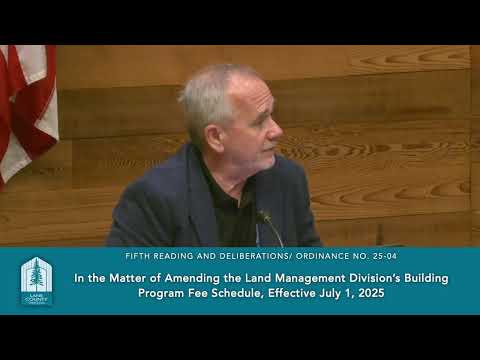
The Lane County Board of Commissioners voted 5-0 May 13 to adopt Ordinance No. 2504, phasing a 7% increase to the Land Management Division building program fee schedule over three years, effective July 1, 2025, to address a $1.2 million operating deficit.
Lane County commissioners voted 5-0 on Tuesday, May 13, 2025, to adopt Ordinance No. 2504, approving a 7% increase to the Land Management Division (LMD) building program fee schedule phased over three years, effective July 1, 2025. The motion was made by Commissioner Trigger and seconded by Commissioner Farr; the roll call vote was unanimous in favor.
The fee change is intended to close a $1,200,000 operating deficit in the division’s budget, County staff said. Kier Miller, Land Management Division manager, told the board the increases were reduced from an earlier, larger proposal and that the board elected to phase the necessary increases after public input. Miller said certain permit types needed to site more affordable housing — ‘‘such as 80 use emergency RVs and homes within manufactured home parks’’ — were exempted from the increases.
The ordinance was the fifth reading of the proposal. Miller outlined operational improvements LMD has made while rebuilding staffing levels, including an electronic permit application submittal system (ePass) and process mapping with partner agencies. He cited measurable reductions in permit timelines: Type 1 land use permits averaged about 75 days historically and dropped to 33 days last year, with an expectation of three-week issuance this year; Type 2 reviews dropped from about 126 days to roughly 52 days (2025 data not yet complete); and commercial plan review times fell from nearly 60 days to 27 days.
Miller warned of service impacts if the structural deficit is not addressed. ‘‘If we are unable to address our structural deficit, we will need to reduce expenses,’’ Miller said, adding that labor is the bulk of the division’s costs and staffing reductions would likely stall or reverse recent improvements.
Commissioners pressed on implementation details and oversight. Commissioner Farr confirmed the board will hold a work session before the next year’s fee step is implemented to review LMD’s operational progress and financial status. Commissioners discussed the mechanism for pausing or changing the second-year increase; county staff said the current direction is to return to the board for a work session and the board could give new direction at that time.
Board members also raised a packet discrepancy showing inconsistent fee figures; Miller acknowledged a recent posting error that included an older attachment and said staff would correct it. Commissioner Buck emphasized the need to make the division financially sound and described the 7% phased approach as a compromise from an earlier, larger increase that would have been harder on customers.
On service improvements for rural constituents, Miller said LMD recently hired and trained a senior office assistant to act as a dedicated receptionist, aiming to improve phone responsiveness for callers in areas with limited cell service. Commissioners also noted a planned work session — tentatively June 10 or June 24 — to review outstanding operational items, including the Howe Mann review and legal lot verification issues.
The ordinance takes effect July 1, 2025. The board scheduled its next regular meeting for May 20 at 9 a.m. in Harris Hall.