Get Full Government Meeting Transcripts, Videos, & Alerts Forever!
Get email alerts on the Local Budget topic
No spam. Unsubscribe anytime.
Lane County budget committee hears proposed 2025–26 budget that trims staff, earmarks $2M for housing and opioid funds for stabilization center
Summary
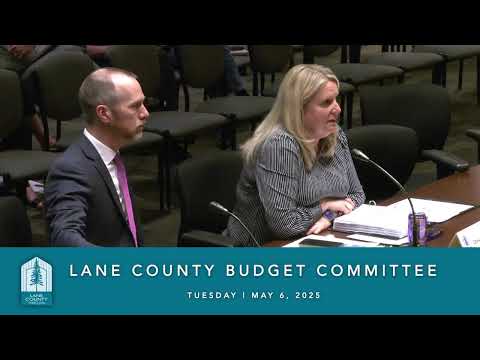
Lane County Budget Committee members on May 6 heard a proposed 2025–26 budget from County Administrator Mokrohisky that reduces about 80 positions, identifies roughly $3 million in permanent general‑fund reductions and proposes one‑time investments including $2 million in video‑lottery funds for a housing land‑bank and opioid settlement funds for a 24‑7 stabilization center.
Lane County Budget Committee members on Tuesday, May 6 heard a budget message from Administrator Mokrohisky outlining a proposed 2025–26 budget that reduces staffing and central‑service spending while using one‑time revenues for two targeted initiatives.
Mokrohisky said the proposed budget reduces about 80 full‑time equivalent (FTE) positions between the current year and the next, identifies approximately $3 million in permanent general‑fund expense reductions and relies on a mix of fee adjustments, vacancy assumptions and one‑time reserves to reach structural balance for the general fund.
Why this matters: Lane County faces a structural revenue shortfall, Mokrohisky said, driven in part by a permanently low county property‑tax rate and the long decline in timber‑related revenue. The algorithm of modest property‑tax growth versus faster growth in wages and benefit costs means the county must reduce or reallocate services to balance future budgets.
Most important facts first: The proposal aims to limit layoffs by targeting vacant positions and shifting extra‑help and material‑and‑service budgets, but officials said those choices will still have service impacts. The budget relies on the following notable items:
- Staffing and cuts: The proposed budget shows a net decrease of 80 positions year‑over‑year; the general fund portion shows a planned reduction of 14.5 FTE and broader countywide FTE of about 2,009 in the proposed budget document. Mokrohisky said most position reductions are vacant or can be mitigated by internal hiring moves.
- Permanent savings: About $3 million in ongoing general‑fund expense reductions were identified, including cuts to extra help (a roughly 40% reduction in extra‑help funding in the general fund), consulting, travel and materials and services. Central service departments took average reductions near 6%; direct service areas’ reductions range roughly 1.2%–5.1%.
- One‑time and restricted funding: The proposal would use $2 million in state video‑lottery reserve funds to create a housing land‑bank and revolving loan program intended to acquire and clear sites for workforce housing and then partner with private developers. Mokrohisky and budget staff said state law restricts video‑lottery dollars to certain uses, and the proposed use is being positioned as consistent with those restrictions.
- Opioid settlement and stabilization center: The county proposes allocating $5 million in one‑time opioid settlement reserves and $1 million in annual opioid settlement funding to create a 24‑7 Lane stabilization center as part of the behavioral‑health system of care.
- Public safety and patrols: The county will continue expanded patrols in West Lane and McKenzie Valley in the short term using one‑time reserves; Mokrohisky warned that federal and other one‑time dollars that funded patrol expansion will end after fiscal 2025 and the services will need a funding solution.
- Structural imbalances: Budget staff identified nine operating funds that remain structurally unbalanced at the proposed level. Those include the coroner’s fund, law library, community justice subfunds and some Health & Human Services subfunds; some rely on state fee levels that the county cannot change, staff said.
Context and background: Mokrohisky placed the current proposal in a longer history of county budgeting, including volatility in timber receipts dating to the 1970s and the loss of timber dollars that helped keep Lane County’s permanent property‑tax rate low. He also referenced the Secure Rural Schools (SRS) adjustments that followed timber declines and noted that other counties collect materially more property‑tax revenue (the presentation cited an estimated $53 million in county property‑tax revenue for Lane County versus roughly $208 million for Washington County and $137 million to the City of Eugene, as presented).
“The world we’re operating in is chaotic, but we’re not gonna meet chaos with chaos,” Administrator Mokrohisky told the committee, quoting a peer and urging a values‑based, measured approach. He later said the county should “be the eye of the storm,” a phrase he used to describe leading with steadiness amid broader uncertainty.
Budget process and schedule: Christine Moody of the central budget office reviewed the local budget cycle and the committee’s role. Committee members were told the proposed document was posted online, work sessions with departments begin Thursday in the Board of Commissioners conference room and final deliberation and approval by the budget committee are scheduled for May 20, after which the board of commissioners will consider adoption in mid‑June.
Staff cautioned the committee that some items are unresolved and could change the numbers before adoption: ongoing labor negotiations with county employee groups (including the Lane County Peace Officers Association and AFSCME) and final revenue updates will be incorporated in supplemental adjustments before final adoption. Moody said a vacancy‑variance assumption was increased from 3.5% to 4.5% during the process to reflect expected unfilled time and that the current‑year budget will be adjusted in Supplemental 4 to incorporate recently negotiated pay changes.
Process notes and risks: Moody and Mokrohisky emphasized the county relied on a “surgical” approach that prioritized protecting direct services where possible and spreading reductions across central and direct service areas rather than deep, across‑the‑board cuts. They cautioned that several freedoms in the proposal depend on external factors — state or federal grants, one‑time reserves, or restricted revenue streams — so the plan carries medium to high implementation risk if those revenues do not materialize.
Public input and next steps: The committee opened a public hearing later in the meeting; staff said submitted and verbal public comments would be incorporated during work sessions. Committee members will hear departmental presentations over the next three work sessions and then deliberate on May 20.
Ending note: Mokrohisky closed by thanking budget‑office staff and departmental financial teams and by urging committee members to consider the values‑based approach — including prioritizing people — as the county balances immediate fiscal pressures and longer‑term service needs.